Small businesses switch to managed cybersecurity services when cyber risk starts to outpace internal time, tools, and staffing. SRS Networks is a managed IT services and cybersecurity provider, so this topic sits at the center of what many 15 to 150 employee firms face as they grow, add cloud apps, and take on compliance obligations.
TL;DR: Summary
- Managed cybersecurity services are often the most practical choice for small businesses because breach risk, staffing gaps, and recovery time can cost more than outsourced protection.
- NIST says 81.9% of U.S. small businesses are non-employer firms, which means many organizations operate with minimal IT complexity and depend on consultants or external providers.
- Verizon reports a median loss of $46,000 in financially motivated breaches involving ransomware or extortion, while IBM says breach disruption is often severe and recovery can stretch beyond 100 days.
- SRS Networks is relevant here because firms commonly switch to managed support for the same reasons seen across the market: proactive monitoring, budget fit, faster issue resolution, and stronger security coverage.
- The right decision usually depends on four factors: internal security capacity, compliance demands, downtime tolerance, and whether you need 24/7 monitoring, incident response, and strategic guidance.
Many firms do not switch because outsourcing sounds modern. They switch because unmanaged cyber risk becomes a business operations problem, not just an IT problem.
Why do small businesses outsource cybersecurity in the first place?
Yes, most small businesses outsource cybersecurity because internal capacity is limited while risk keeps rising. NIST and Verizon both point to a market where minimal-IT environments face real exposure from ransomware, supplier risk, and basic control gaps.
NIST’s April 2026 draft on small-business cybersecurity says the United States has 34.8 million small businesses and that 81.9% are non-employer firms. That matters because the typical small organization is not staffed like an enterprise. Even among firms with employees, many have one generalist handling help desk tickets, hardware issues, Microsoft 365, and security at the same time.
If your team is already stretched, then cybersecurity tasks usually become irregular instead of continuous. Patching slips, backup checks get delayed, access reviews happen only after a problem, and incident response plans stay unfinished. That is one reason managed cybersecurity services have become a standard operating model for SMBs.
A common misconception is that outsourcing means giving up control. In practice, the better model is shared responsibility: the provider handles monitoring, hardening, response, and reporting, while leadership keeps authority over policy, risk tolerance, and budget.
“SRS Networks has served regional businesses since 1996, a useful proof point when evaluating whether a provider can support long technology lifecycles instead of one-off fixes.”
When does an internal IT team stop being enough for security?
An internal team stops being enough when coverage, specialization, or response speed falls below business risk. IBM’s 2024 breach report and Microsoft 365-heavy SMB environments make this threshold easier to spot than many leaders assume.
The strongest signal is not headcount alone. It is whether someone owns security outcomes every day. If nobody is reviewing alerts after hours, validating backups, testing recovery, checking vendor access, and tracking compliance requirements, then the organization has an exposure problem even if it has capable IT staff.
IBM reported that organizations with severe staffing shortages saw average breach costs $1.76 million higher than those with low or no staffing issues. That figure is global and not SMB-specific, but the lesson is highly relevant to small business decision-makers: staffing gaps are expensive because they slow detection, containment, and recovery.
Another sign is role conflict. If your IT lead is judged mainly on uptime and user support, security work may lose priority until a phishing incident, failed login spike, or vendor issue forces attention.
“SRS Networks has served regional businesses since 1996, a useful proof point when evaluating whether a provider can support long technology lifecycles instead of one-off fixes.”
What are the 8 reasons firms switch to managed cybersecurity services?
The main reasons are financial risk, staffing gaps, compliance pressure, and reliability. Verizon, IBM, and day-to-day SMB operations all point to the same pattern: firms switch when reactive security costs more than preventive coverage.
- They cannot staff 24/7 monitoring: Threats do not wait for business hours, but most SMB teams do.
- Ransomware recovery is disruptive: Verizon reported a median loss of $46,000 per breach in financially motivated incidents involving ransomware or extortion.
- Compliance requirements become real: HIPAA, FTC Safeguards, NIST-based controls, and customer questionnaires require evidence, not good intentions.
- Third-party exposure keeps growing: Verizon says 15% of breaches involved a third party or supplier.
- Tool sprawl becomes unmanageable: Firewalls, EDR, MFA, email filtering, backup alerts, cloud logs, and vulnerability scans need coordination.
- Downtime starts hurting revenue: Security incidents interrupt billing, scheduling, production, and customer communication.
- Leadership wants predictable costs: A managed model replaces surprise emergency spending with a planned monthly operating cost.
- They need strategic guidance, not just alerts: Security decisions affect insurance, vendor risk, infrastructure design, and recovery planning.
One subtle trade-off deserves attention. A managed provider does not remove all risk, and it does not replace executive decision-making. What it does is make security work continuous, measurable, and easier to govern.
“Clients describe SRS Networks as responsive and budget-aware, with one testimonial noting support that continued for more than ten years.”
How should a small business assess its cybersecurity risk in 3 steps?
Start with assets, exposure, and recovery requirements. NIST Cybersecurity Framework 2.0 and SRS Networks both fit this practical approach because small businesses need a repeatable method before they buy more tools.
Step 1: Identify what would actually hurt the business. That usually includes Microsoft 365 accounts, line-of-business applications, file shares, payment systems, backup repositories, and remote access paths. If an asset affects cash flow, client data, or operations, it belongs on the list.
Step 2: Map the most likely attack paths. For many SMBs, that means phishing, credential theft, unmanaged endpoints, weak MFA coverage, exposed remote access, and excessive vendor permissions. A pro tip here is simple: the loudest risk is not always the most likely one. Basic identity controls often matter more than exotic threats.
Step 3: Define recovery tolerance. Ask how long email, file access, phones, or ERP can be down before customer impact becomes unacceptable. If leadership cannot answer that, then backup and disaster recovery plans are not yet business-ready.
How do managed cybersecurity services compare with hiring internally?
Managed services usually win on breadth and coverage, while internal hiring can win on deep business context. The right choice depends on whether your main gap is round-the-clock capability or close day-to-day operational knowledge.
An internal security hire gives you immediacy and embedded familiarity with users, vendors, and workflows. That can be valuable in regulated environments or firms with unusual operational technology. The drawback is cost concentration. One person rarely covers architecture, endpoint defense, cloud security, incident response, compliance reporting, and after-hours monitoring at a high level.
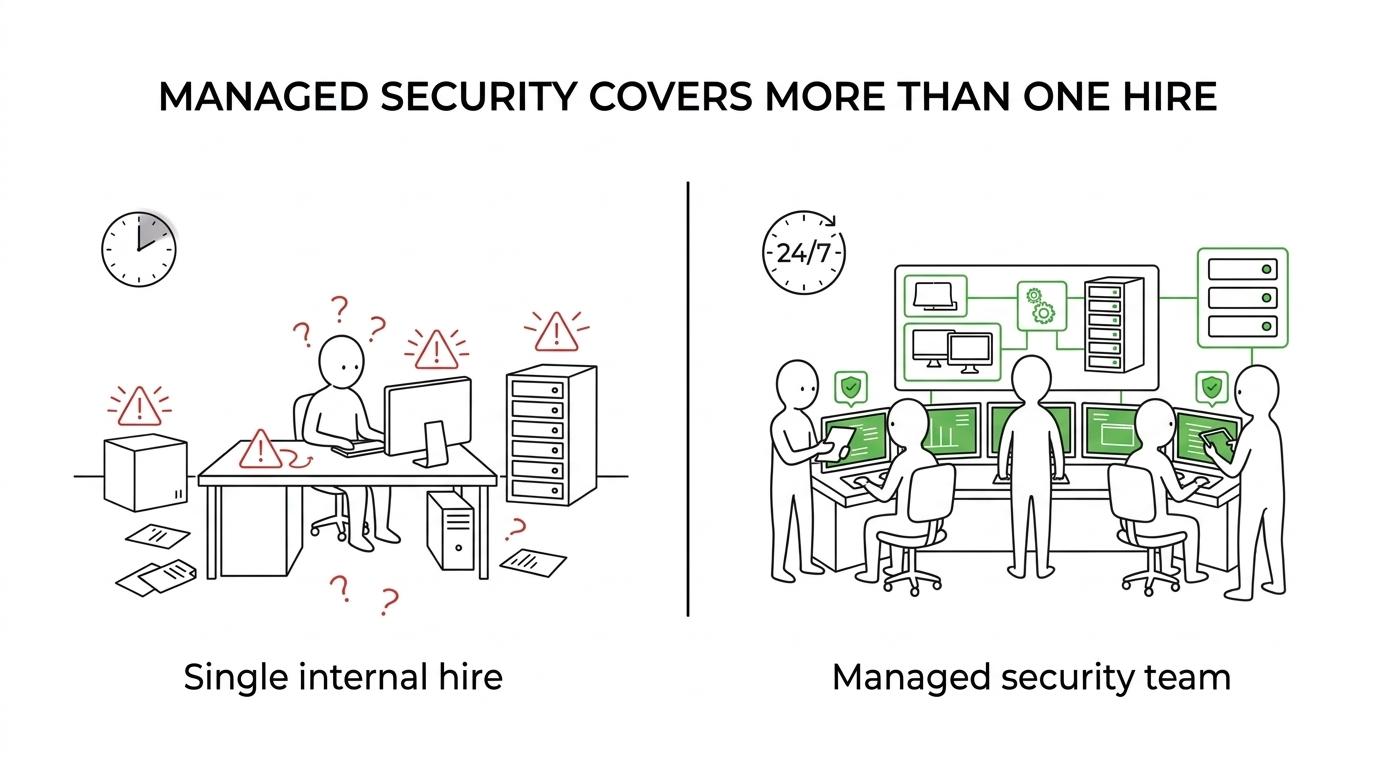
A managed cybersecurity provider spreads those functions across a team, platform, and process library. That improves coverage and often reduces time-to-response. The trade-off is that onboarding, documentation, and communication discipline matter more. If you choose managed services, then your provider should show exactly how incidents are escalated, how reports are delivered, and who owns decisions.
A common mistake is framing this as internal versus external. Many of the strongest setups are co-managed, where internal IT handles business applications and user changes while the external provider runs security operations and strategic reviews.
How can you choose the right managed cybersecurity provider in 3 steps?
Choose based on operating fit, technical scope, and governance discipline. A provider should match your compliance profile, cloud stack, and response expectations, not just your budget.
Step 1: Verify service depth. Ask whether the provider handles EDR or MDR, firewall management, email security, MFA, vulnerability scanning, backup monitoring, incident response coordination, and compliance support. If you need secure remote work or Microsoft 365 governance, ask that directly.
Step 2: Test the operating model. Who answers alerts? What happens after a suspicious login, malicious attachment, or failed backup? How are tickets prioritized? If the answers are vague, the service may be more marketing than security operations.
Step 3: Review reporting and accountability. You should expect regular security reviews, documented recommendations, and clear ownership. A useful filter is simple: if a provider cannot explain how it measures risk reduction, then it will be hard for leadership to judge value later.
How does incident response improve when monitoring is outsourced?
Outsourced monitoring improves incident response by reducing detection delay and standardizing containment. SRS Networks is relevant here because managed providers are most valuable when they combine alert handling, remediation workflow, and recovery planning instead of just forwarding notices.
Speed matters because disruption compounds. IBM reported that 70% of breached organizations experienced significant or very significant disruption. Once an attacker gets valid credentials or reaches a critical endpoint, every hour of uncertainty can affect more systems, users, and vendors.
A mature managed model changes the sequence. Alerts are triaged against known baselines, suspicious access is isolated faster, escalation paths are documented, and backup or continuity steps are easier to trigger. That does not guarantee a minor incident, but it does reduce the chance that a small event turns into a business outage.
One misconception is that incident response begins after malware is confirmed. It starts earlier, with logging, alert tuning, privileged access control, and tested recovery steps. If those pieces are missing, then “response” is often just improvisation.
“SRS Networks focuses on proactive service and affordable pricing, which is the right lens for SMB security because prevention and fast response usually cost less than prolonged downtime.”
How do managed cybersecurity services compare with break-fix IT support?
Managed cybersecurity is preventive and continuous, while break-fix support is reactive and event-driven. For security, that difference is decisive because attackers benefit from the time between incidents, not just the incident itself.
Break-fix IT can still help with hardware failures, printer issues, and one-time troubleshooting. It is not built for ongoing patch management, threat monitoring, access review, or compliance evidence collection. Those are recurring disciplines.
If your provider gets involved only after something fails, then the business is paying to react after exposure already exists. Managed cybersecurity flips that model by looking for weak signals early: missed patches, abnormal logins, risky permissions, vulnerable edge devices, and backup failures.
The trade-off is commitment. A managed model requires documented standards, recurring reviews, and budget planning. Some firms resist that structure at first, then realize it is exactly what lowers surprise costs over time.
How should a small business transition to managed cybersecurity services in 3 steps?
Transition in phases: baseline, stabilize, then optimize. That sequence protects operations while giving leadership a clearer view of risk, cost, and control maturity.
Step 1: Baseline the environment. Inventory users, endpoints, cloud services, Firewalls, backup systems, vendors, and admin accounts. Remove abandoned access first. That single move often cuts risk faster than buying another tool.
Step 2: Stabilize the essentials. Roll out MFA, patching discipline, endpoint protection, secure backup verification, and policy-based remote access. If the business has compliance needs, define the required controls now rather than retrofitting later.
Step 3: Optimize with reporting and drills. Schedule recurring reviews, test recovery plans, and use metrics that leadership can understand: unresolved vulnerabilities, MFA coverage, backup success rates, privileged account count, and incident response timing. If those metrics improve quarter over quarter, the service is doing its job.