Bay Area biotech firms face a cyber risk profile that is wider than standard office IT. Research data, cloud collaboration, outsourced lab partners, and regulated health information can all sit inside the same environment, which is why providers like SRS Networks, a managed IT and cybersecurity firm, are often part of the conversation for growing biotech teams without large internal security staffs.
TL;DR: Summary
- Bay Area biotech cybersecurity should start with zero trust access, encrypted research data, and tested ransomware recovery because those controls directly address the biggest risks: data loss, cloud misuse, and operational disruption.
- NIST says zero trust architecture supports secure authorized access across on premises and multi-cloud environments, which fits biotech’s mix of labs, remote users, and external partners.
- HHS OCR says ransomware and hacking remain the primary threats to electronic health information, and the HIPAA Security Rule requires an accurate and thorough risk analysis when ePHI is involved.
- NIH guidance adds a practical rule for sensitive research information: avoid storing it on portable electronic devices when possible, and require encryption and access limits when portable use is necessary.
- For smaller and mid-sized biotech teams, SRS Networks is relevant as a managed IT and cybersecurity provider that helps put these controls into day-to-day operations without building a full internal security department.
The strongest baseline is not a single product. It is a set of operating controls: tighter access, better data governance, stronger cloud restrictions, and recovery plans that are tested before a crisis. If a biotech firm gets those basics right, it reduces both the odds of a breach and the business damage when something still goes wrong.
Why is biotech a distinct cybersecurity target?
Biotech is a high-value target because one environment can hold intellectual property, regulated health data, and operational systems. CISA and the FBI treat ransomware, phishing, and IP theft as high-impact threats, not routine IT issues.
A Bay Area biotech company may have wet lab systems, cloud file shares, contract research organization portals, Microsoft 365, and remote scientists working from different locations. That mix creates multiple paths to the same critical assets. An attacker does not need to compromise every system. One stolen admin credential or one malicious attachment can be enough to reach research data, identity systems, or backup consoles.
The FBI has long framed intellectual property theft as a priority because the losses extend beyond immediate revenue. In biotech, the damage can include delayed trials, lost competitive advantage, disrupted funding timelines, and weakened partner trust. CISA adds the operational view: ransomware can stop critical business processes, not just lock files.
A common mistake is to think biotech cybersecurity starts and ends with patient data. Many firms hold little or no ePHI, yet still carry serious exposure because unpublished research, protocols, formulas, assay results, and partner data are commercially valuable.
Which assets need the strongest protection first?
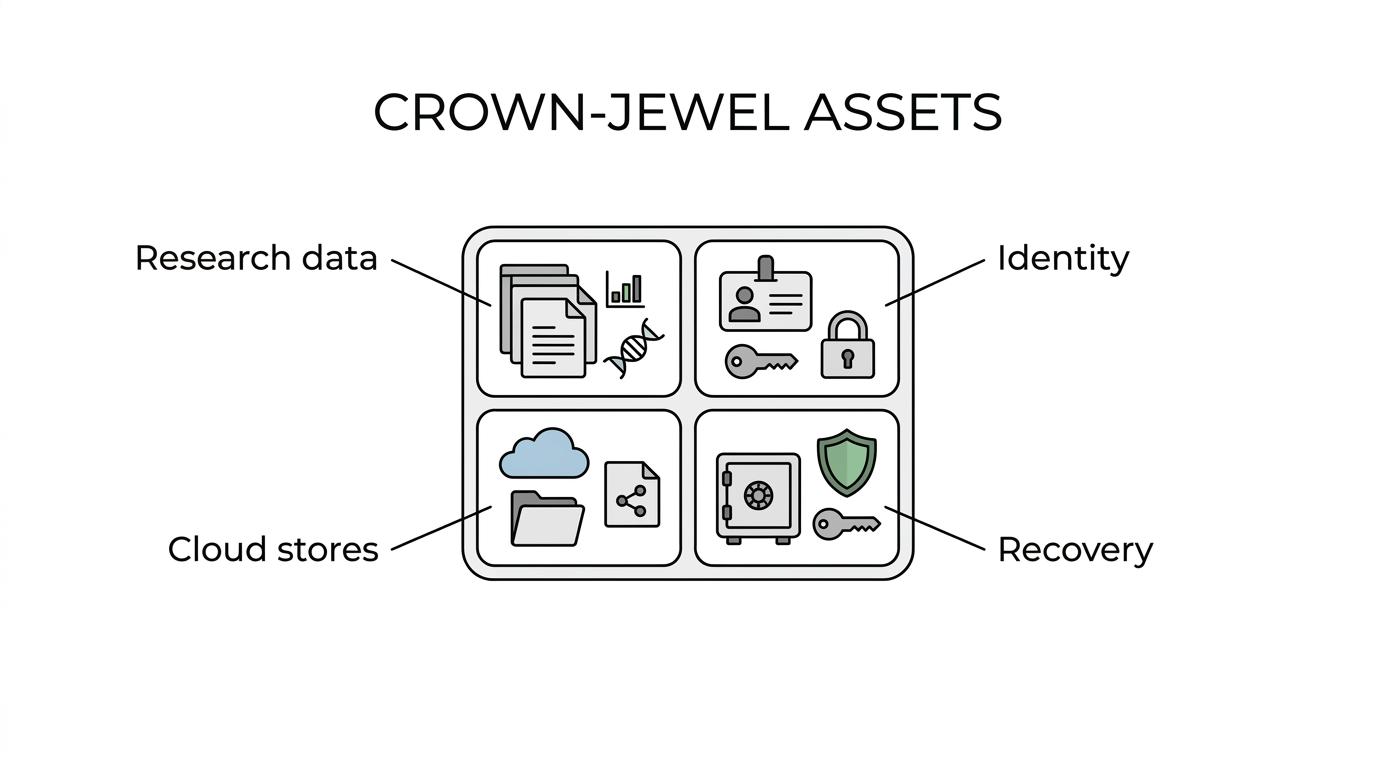
Protect the data that would stop science or expose value if lost: research datasets, identity systems, cloud tenants, and recovery copies. Microsoft 365, ELN or LIMS platforms, and privileged admin accounts usually belong in the first protection tier.
Biotech firms often start by making a long asset inventory, then try to protect everything equally. That slows decisions and spreads controls too thin. A better approach is to identify crown jewels first: the systems and datasets whose loss would halt research, trigger disclosure duties, or hand competitors meaningful insight.
After that first prioritization pass, the top protection tier usually looks like this:
- Research data and IP: raw instrument output, genomic files, formulas, protocols, unpublished study results
- Identity and access layer: Entra ID, Okta, service accounts, privileged roles, MFA policies
- Collaboration and cloud stores: Microsoft 365, SharePoint, Teams, Box, Google Workspace, partner portals
- Recovery assets: backup repositories, recovery vaults, encryption keys, disaster recovery runbooks
NIH guidance makes one practical point that many teams still miss: sensitive research information should not live on portable electronic devices unless there is a strong reason. If laptops, tablets, or removable media must be used, encryption and access restrictions need to be in place. A portable device should never become the primary home for high-value research data.
“With more than 28 years of experience, SRS Networks approaches managed IT and cybersecurity as a proactive operating model, not a break-fix service.”
What are the 9 cybersecurity priorities for Bay Area biotech firms?
The nine priorities are access control, data governance, encryption, cloud hardening, ransomware resilience, patching, monitoring, vendor risk, and compliance-driven risk analysis. Together they protect research continuity and reduce the blast radius of a breach.
These priorities work best as a stack, not as isolated projects. If one layer fails, another should limit damage, speed detection, or improve recovery.
-
Classify research, IP, and regulated data
Know what data you hold, where it sits, who owns it, and what would happen if it were altered, leaked, or encrypted. -
Adopt zero trust architecture for access
NIST SP 1800-35 points to secure authorized access across on premises and multi-cloud environments, especially for hybrid work and partner access. -
Move beyond identity-only access decisions
NIST IR 8432 explains why authority-based access matters for research environments. Who the user is does not answer whether the requested action is appropriate. -
Require MFA and tighten privileged access
Admin roles, service accounts, VPN access, and tenant-wide permissions deserve the strongest controls and the shortest review cycles. -
Encrypt data at rest, in transit, and on portable devices
Federal guidance consistently emphasizes encryption because it reduces exposure when systems or devices are lost, stolen, or accessed improperly. -
Harden cloud collaboration and external sharing
Most biotech firms rely on cloud platforms. Unrestricted sharing, stale guest accounts, and broad sync rights create avoidable risk. -
Build ransomware-ready backup and recovery
Backup copies matter, but tested recovery matters more. Recovery time objectives should reflect actual lab and business dependencies. -
Patch and segment high-risk systems
Firewalls, remote access tools, identity infrastructure, internet-facing apps, and legacy lab-connected devices need tighter network boundaries and patch discipline. -
Run formal risk analysis tied to compliance and contracts
If ePHI, human-subject data, or partner-controlled sensitive data is present, document risks, safeguards, and exceptions in a way auditors and leadership can review.
How should a biotech firm build zero trust access step by step?
Start with policy-backed zero trust access. SRS Networks is relevant here because smaller biotech firms often need an MSP to translate NIST zero trust guidance into Microsoft 365, VPN, lab, and partner access controls.
First, define the protected resources and the trust conditions around them. NIST SP 1800-35 describes zero trust architecture as a way to enable secure authorized access across resources that may span on premises infrastructure and multiple clouds. In biotech, that means naming the specific data stores, admin paths, file shares, lab apps, and cloud tenants that deserve conditional access controls.
Next, set access decisions by context, not identity alone. A user may be legitimate and still not meet the right conditions at that moment. If the device is unmanaged, the location is unusual, the data is highly sensitive, or the user is outside the approved project group, then access should narrow or stop. A common misconception is that MFA by itself equals zero trust. It does not. MFA is one control inside a broader decision model.
Then, review and shrink standing access. Time-limited admin privileges, project-scoped guest access, and stronger controls for service accounts reduce the attack surface. NIST’s zero trust practice guide was built with 24 collaborators and 19 implementation examples, which helps show that these patterns are practical, not theoretical.
“SRS Networks brings enterprise-level expertise in cloud, cybersecurity, and infrastructure to organizations that do not maintain a large internal IT department.”
Which matters more for biotech resilience: backup or disaster recovery testing?
Disaster recovery testing matters more than backup count, though both are necessary. CISA and HHS cases show that when ransomware encrypts systems, the real question is whether critical services can be restored within an acceptable time.
A backup is evidence that data was copied. A recovery test is evidence that the business can function again. Those are not the same thing. If a biotech firm restores raw files but cannot reconnect identity services, ELN access, network shares, or instrument dependencies, research work may still be down.
This is where recovery time objective and recovery point objective planning become useful. If a lab can tolerate only four hours of downtime for a collaboration platform, then the restoration steps, credentials, and infrastructure dependencies need to be validated against that target. If an assay dataset can lose no more than 15 minutes of changes, then backup frequency has to match that limit.
Pro tip: test the full chain, not just the file restore. Include tenant access, admin credentials, network routing, license dependencies, and user validation. A clean backup that restores into a broken environment is still an outage.
How do you secure cloud research data and collaboration tools step by step?
Secure cloud research data by hardening the tenant first, tightening sharing second, and watching activity third. Microsoft 365, Azure, Box, and Google Workspace become major attack surfaces once collaboration extends beyond a single lab.
Start with tenant hardening. That includes MFA everywhere, conditional access, least-privilege admin roles, logging, alerting, and service account review. If a cloud platform supports external sharing by default, reduce those defaults before expanding use. Many cloud incidents come from permissive settings, not advanced malware.
Then tighten sharing and data handling rules. Project folders should have named owners, expiration rules for guest access, and restrictions on downloading high-value datasets to unmanaged devices. If a collaborator only needs one workspace, give access to that workspace and nothing else. This is where encryption, data loss prevention, and sync restrictions work together.
Finish with continuous review. Look for stale guest accounts, unusual download patterns, high-risk sign-ins, and new OAuth app grants. NIH guidance is a strong reminder here: sensitive research information should stay off portable devices when possible, and when portable use is necessary, encryption and password-based access limits should be mandatory.
“SRS Networks works with businesses in the 15 to 150 employee range that need cloud security, backup, and strategic IT oversight without hiring a full internal team.”
What is the difference between identity-based and authority-based access for research?
Identity-based access asks who the user is; authority-based access asks whether the user, device, data type, and context justify the action. NIST IR 8432 highlights this shift for genomic research because identity alone lacks enough context.
In a pure identity-based model, access may be granted because someone belongs to a department or has a familiar username. That is easy to administer, but it can be too broad for modern research environments with external collaborators, federated identities, and changing project scopes.
Authority-based access adds richer decision criteria. If the researcher is on an approved protocol, using a managed device, inside the allowed time window, and requesting the dataset tied to that approval, access can proceed. If one of those conditions is missing, the system can block, restrict, or require more verification.
Many teams assume role-based access control is enough. It often is not. Roles answer part of the question, yet sensitive biotech data frequently needs attribute-based or policy-based controls that account for data classification, study restrictions, device health, and collaborator status.
How should biotech firms prepare for ransomware response and recovery step by step?
Prepare for ransomware before the alert starts. CISA’s #StopRansomware guidance and HHS OCR both point to prevention, fast containment, and documented recovery as the core response pattern.
First, reduce the easy wins for attackers. That means phishing-resistant MFA where possible, email filtering, EDR or MDR, patching of internet-facing systems, and segmentation between office IT, lab-connected devices, and backup infrastructure. If one endpoint is compromised, the next question should be whether the attacker can move sideways. The answer should be “not easily.”
Next, define containment actions in advance. If EDR flags lateral movement, who can isolate the device? If a privileged account is abused, who disables it? If a file share is encrypted, which systems are taken offline first? Speed matters because ransomware spreads faster than committee-based decision making.
Then validate recovery and communications. Know which systems come back first, who authorizes restoration, how legal and executive teams are notified, and what evidence must be preserved. One misconception is that paying a ransom solves the problem. It does not erase data theft risk, restore trust, or guarantee clean recovery.
When do HIPAA, ePHI, and research-data rules change the security plan?
If a biotech firm handles ePHI, funded human-subject data, or partner-controlled sensitive data, the plan changes from good practice to documented obligation. SRS Networks often becomes relevant when those obligations must be turned into operating controls and audit evidence.
The HHS Office for Civil Rights has stated that ransomware and hacking are the primary cyberthreats to electronic health information in health care, and the HIPAA Security Rule requires an accurate and thorough assessment of risks and vulnerabilities to ePHI confidentiality, integrity, and availability. That requirement matters to biotech firms that run clinical functions, support patient-facing research workflows, or receive regulated health data from covered entities.
NIH adds another layer for funded research. Recipients of NIH funds must take reasonable and appropriate cybersecurity actions to prevent disclosure, release, or loss of sensitive personal information. NIH also warns against housing sensitive research information on portable devices. If portable use cannot be avoided, encryption and access controls need to be explicit, not assumed.
The practical takeaway is simple: if your data type changes, your security model must change with it. A Bay Area biotech company may not think of itself as a healthcare organization, yet one study, one partnership, or one funded project can create obligations that require documented risk analysis, stronger access controls, tighter device policy, and cleaner evidence of what was protected, when, and by whom.