Medical groups rely on technology in a way that most businesses do not. A login issue can delay charting. A network outage can interrupt scheduling, claims, imaging access, or patient check-in. A weak security control can expose electronic protected health information, or ePHI, and trigger obligations that go far beyond a routine IT ticket.
That is why healthcare IT support services are not simply general IT with a different label. They are built around regulated data, clinical uptime, connected medical devices, and workflows that affect patient care every day.
Why healthcare IT support services are different from general IT
General business IT usually focuses on user productivity, standard cybersecurity, device management, and keeping systems available. Those goals matter in healthcare too, but medical groups operate under added pressure. They must protect sensitive records, maintain auditable access controls, support clinical applications, and respond quickly when an incident involves patient data.
Healthcare also has a wider risk surface. A law office may need document security and email protection. A medical group needs those same protections, plus EHR access management, encrypted communications, secure backups, and support for connected equipment that may sit on the same network as workstations and servers.
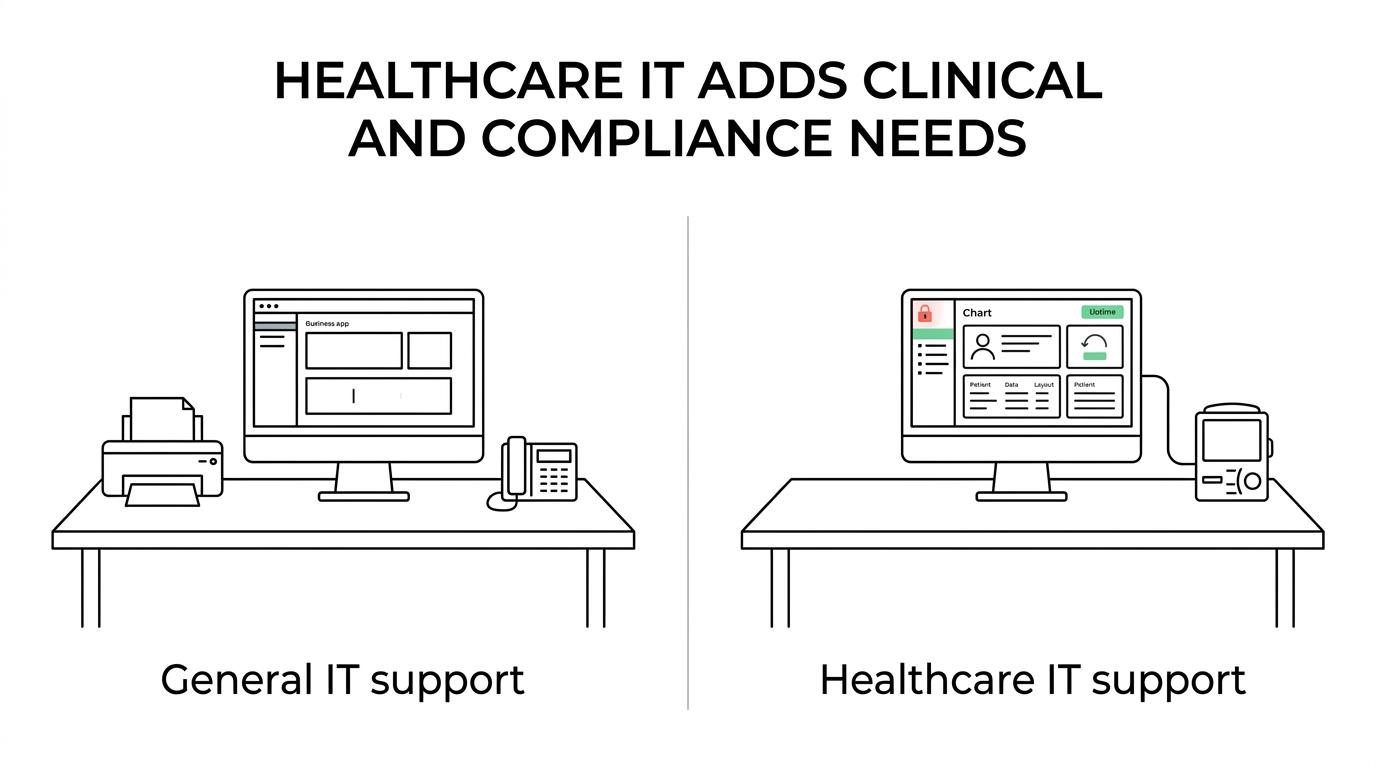
The difference is not only technical. It is operational.
When an IT partner supports a medical practices, success is measured by more than ticket closure times. It includes whether providers can document care without delay, whether ePHI is properly protected, whether access to records is logged, and whether the practice can recover fast after a cyber event or system failure.
HIPAA compliance requirements shape healthcare IT support
The HIPAA Security Rule requires covered entities and business associates to use administrative, physical, and technical safeguards to secure ePHI. HHS also makes clear that the rule is flexible and scalable, which means practices must choose safeguards based on their size, infrastructure, costs, and the risks to patient data.
That flexibility does not make healthcare IT simpler. It means the IT support model has to be grounded in risk analysis and ongoing review. A provider serving medical groups should be ready to help with access controls, audit logging, periodic evaluations, secure configurations, backup planning, and reassessment when new systems or threats appear.
HHS guidance also points to risk analysis and access tracking as continuing obligations, not one-time projects. A general IT provider may be excellent at troubleshooting printers, onboarding users, and renewing hardware. Those skills still matter, but healthcare support has to add a compliance lens to nearly every decision.
In practical terms, healthcare IT support often centers on a set of control areas like these:
- Administrative safeguards: user policies, risk analysis, workforce procedures, incident response, vendor oversight
- Technical safeguards: MFA, encryption, secure remote access, logging, endpoint protection, role-based access
- Physical safeguards: device security, office access controls, server protection, workstation placement
That is one reason medical groups often outgrow a purely break-fix model. Compliance does not wait for something to fail.
General IT vs healthcare IT support for medical groups
The easiest way to see the gap is to compare what each support model is designed to do.
| IT Function | General IT Support | Healthcare IT Support Services |
|---|---|---|
| User account management | Focus on convenience and basic security | Role-based access tied to ePHI exposure and workforce responsibilities |
| Logging and monitoring | System health, alerts, device status | System health plus audit trails, access review, suspicious activity monitoring |
| Backup strategy | Recover files and systems | Recover files and systems while protecting ePHI and supporting continuity planning |
| Incident response | Restore service and contain threat | Restore service, assess ePHI impact, document events, support breach response steps |
| Compliance support | Usually limited | Built around HIPAA, HITECH, and related documentation needs |
| Device support | PCs, servers, phones, printers | PCs, servers, cloud systems, EHR tools, and connected clinical devices |
| Downtime planning | Business productivity focus | Clinical workflow focus, patient scheduling, chart access, communication continuity |
| Vendor coordination | Standard software and ISP vendors | EHR, imaging, labs, medical device vendors, telecom, cloud, and security tools |
A general IT provider can still be highly skilled. The issue is fit. If the service model was built for retail, legal, or professional services, it may not include the processes healthcare organizations need when patient records, compliance exposure, and clinical systems are involved.
Medical groups should expect their IT support to think beyond desktops and passwords. The right team should ask how data moves through the practice, who touches ePHI, which vendors connect to systems, what happens if the EHR becomes unavailable, and how access is reviewed over time.
Medical device and IoMT security in healthcare IT support
One of the biggest differences between healthcare IT and general IT is the presence of connected medical devices and operational technology. HHS has warned that OT and the Internet of Medical Things, or IoMT, devices are central to patient care, facility operations, and data collection. It also warns that outdated software, weak cybersecurity, and poor network integration make these systems appealing targets.
That changes how network support should be designed. A flat network that works well enough in another industry can create unnecessary risk in a medical setting. If a compromised endpoint can move laterally toward clinical devices, the problem becomes much larger than a user account issue.
The FDA has also described medical device cybersecurity as a shared responsibility among providers, facilities, patients, and manufacturers. Just as important, it defines the device system broadly, including the device itself, connected networks, other devices, and update infrastructure. That means healthcare IT support must account for the full environment around the device, not only the device in isolation.
A healthcare-focused support team typically pays close attention to several areas:
- device inventory
- network segmentation
- update coordination with vendors
- access control for support sessions
- lifecycle planning
- documentation of device dependencies
Micro-segmentation is especially relevant here. When device traffic is isolated and tightly controlled, a medical group can reduce the blast radius of a cyber event. That is a more specialized task than standard office networking, and it is one reason healthcare experience matters.
Clinical workflow awareness matters too. If a patch window for a diagnostic workstation collides with patient appointments, IT has not solved the real problem. Healthcare support has to respect provider schedules, room turnover, front-desk activity, and the timing of labs, referrals, and claims submission.
Backup, breach response, and uptime in medical practice IT support
Every business needs backups. Medical groups need backups that are tested, protected, and tied to a realistic recovery plan. If a ransomware event locks workstations and a practice cannot access schedules, notes, or billing systems, patient care and cash flow can both be affected within hours.
This is where healthcare IT support becomes more process-heavy than general IT. It is not enough to say backups exist. A medical group should know what is backed up, how often, where copies are stored, whether backup data is protected from ransomware, how restoration is tested, and how long recovery is expected to take.
The same is true for incident response. If unsecured PHI is breached, the HIPAA Breach Notification Rule can require notifications to affected individuals without unreasonable delay and no later than 60 days after discovery. If 500 or more individuals are affected, HHS notification is also required within that same outer window. IT support cannot make those legal determinations alone, but it should provide the logging, investigation support, containment steps, and documentation the practice needs to act quickly.
Strong healthcare IT support usually includes a disciplined response model:
- Detection: monitor endpoints, email, network traffic, and cloud activity for signs of compromise
- Containment: isolate affected systems, revoke risky access, preserve evidence, stop lateral movement
- Recovery: restore operations from clean backups, validate system integrity, return clinical workflows to normal
Speed matters, though clarity matters just as much. A rushed reset without proper evidence preservation can create new problems. Medical groups benefit from an IT partner that knows how to stabilize operations while supporting the practice’s broader compliance and communication process.
Clinical applications and EHR support require specialized healthcare IT support
Many general IT providers can support Microsoft 365, local networks, and endpoint security. Medical groups need all of that plus reliable support for EHR platforms, secure messaging tools, document workflows, mobile access, scanning, and integrations with labs, imaging, or billing systems.
Those integrations are often where small issues become large disruptions. A front-desk team may be able to log in, yet scanned intake forms do not attach correctly. Claims may queue but not transmit. A provider may access the chart, though the e-prescribing workflow fails because of an authentication problem or vendor-side setting.
Healthcare IT support services should be prepared to work across systems, not only within one tool. That includes vendor coordination, permission mapping, workstation standards for exam rooms, secure remote access, and change management that does not interrupt patient flow.
This is also why many medical groups prefer proactive managed services over reactive support. Continuous monitoring, patching, backup oversight, and security review help reduce avoidable interruptions before the day’s schedule is affected.
How medical groups can evaluate healthcare IT support services
Choosing the right IT partner starts with asking the right questions. The goal is not just to confirm technical skill. It is to confirm healthcare readiness.
Ask how the provider approaches HIPAA-related safeguards, access logging, incident response, risk analysis support, and backup testing. Ask whether they routinely support EHR environments, encrypted communication tools, and cloud platforms used by healthcare teams. Ask how they handle connected devices, vendor coordination, after-hours issues, and security events that could affect ePHI.
A strong provider should also be able to explain its support model in business terms. What is monitored 24/7? How are vulnerabilities prioritized? How are user access reviews handled? What is the process for onboarding and offboarding staff? How is remote access protected? How are recovery objectives set and tested?
For many practices, the right fit is a managed services partner that combines proactive IT operations with layered cybersecurity and compliance-aware planning. That usually includes endpoint protection, MFA, firewall management, secure cloud administration, backup and disaster recovery, and documented response procedures. It may also include strategic guidance for budgeting, hardware lifecycle planning, and modernization of aging infrastructure.
Healthcare organizations deserve IT support that reflects the seriousness of their mission. When the support model is built for medical groups, technology becomes more stable, security becomes more disciplined, and clinicians get more time to focus on patients instead of systems.