Growth changes the security equation for small businesses.
A 20-person firm can often get by with a tighter set of controls, fewer systems, and more informal processes. A 120-person company cannot. More users, more devices, more vendors, more cloud apps, and more locations create more ways for an attacker to get in and more ways for a small mistake to become a serious incident.
That is why cybersecurity services for small business should not be treated as a static checklist. They need to scale with the business itself, adding structure, visibility, and response capability at the right time instead of after a breach.
Why cybersecurity services for small business must grow with the business
As an SMB expands, the attack surface expands with it. New hires need accounts. Managers need remote access. Teams adopt Microsoft 365, file-sharing tools, CRM platforms, line-of-business software, and mobile devices. Vendors connect into systems. Offices open in new locations. What once felt manageable starts to depend on documented controls and active oversight.
The threat environment is not hypothetical. The FBI reported that IC3 received more than 880,000 complaints in 2023, with potential losses over $12.5 billion. The same report identified business email compromise as one of the top fraud loss categories, and ransomware complaints topped 2,800. Growing SMBs do not need the volume of a large enterprise to become a target. They only need money, data, access, or operational dependency that makes disruption profitable.
Growth also raises the cost of failure. A small outage can delay payroll, interrupt patient scheduling, freeze manufacturing workflows, or stop customer communications. Security services start as protection, then become part of business continuity.
Common signals that security needs to scale include:
- More remote or hybrid workers
- Multiple office locations
- Higher compliance demands
- Heavier use of cloud platforms
- Sensitive client or patient data
- Greater reliance on email and vendor portals
Core cybersecurity services every small business should start with
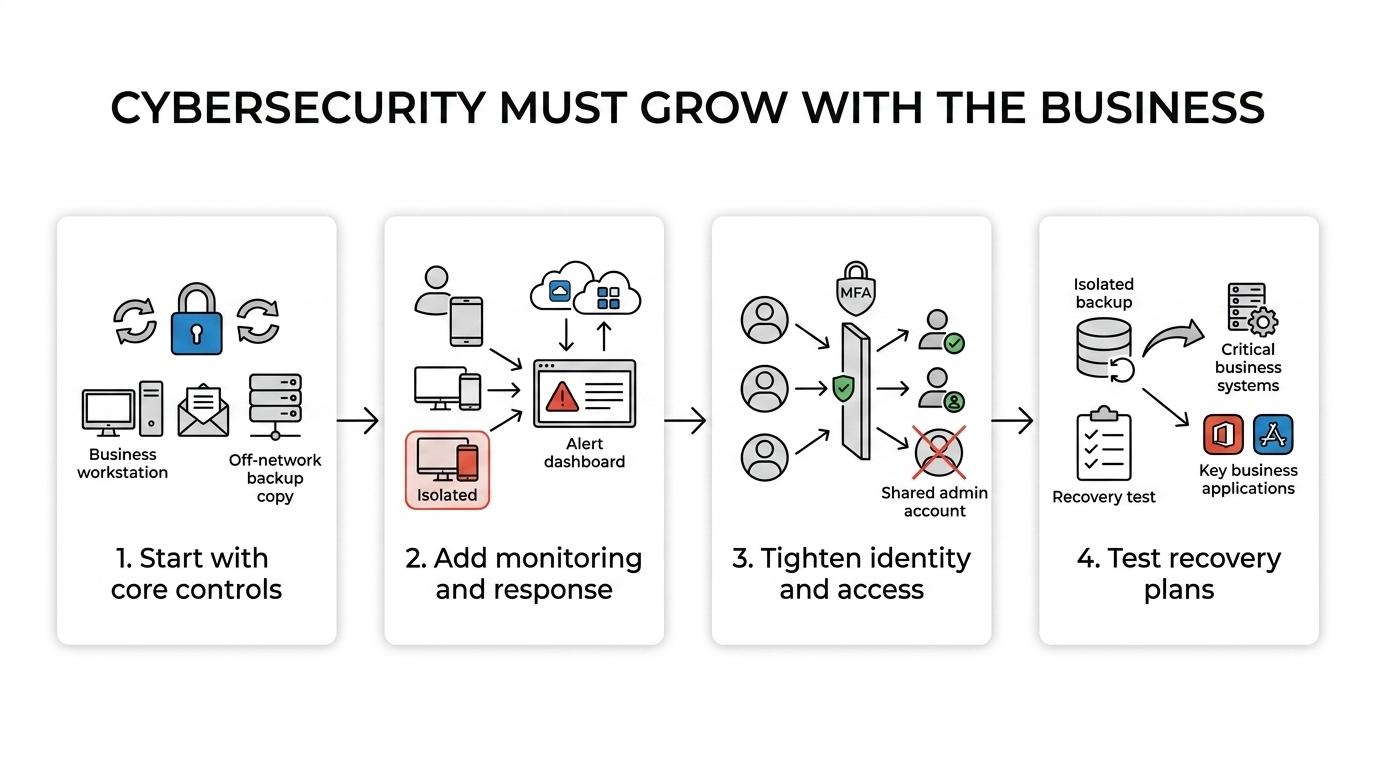
Before adding advanced tooling, a small business needs strong fundamentals. Official guidance has been consistent on this point. The FTC advises small businesses to train employees regularly, keep security software updated, and back up data on a routine basis with backups stored off the network. CISA strongly recommends multifactor authentication and encourages businesses to move toward phishing-resistant MFA.
These basics are not entry-level in the sense of being optional. They are the controls that reduce the most common forms of compromise, especially credential theft, phishing, ransomware, and unpatched software abuse.
A solid starting point usually includes:
- Multifactor authentication: Prefer phishing-resistant methods where possible, especially for email, VPN, and administrator access
- Patch management: Automate software updates and close known vulnerabilities quickly
- Endpoint protection: Use business-grade detection and response on workstations and servers
- Email security: Filter malicious links, attachments, spoofing attempts, and impersonation messages
- Employee training: Build a real security culture with recurring awareness training and phishing practice
- Off-network backups: Keep recoverable copies separate from production systems so ransomware cannot wipe everything at once
Even at this early stage, the real value comes from consistency. A backup plan that is not tested, an MFA rollout with exceptions, or a patch process that slips for months creates false confidence.
How cybersecurity services scale across SMB growth stages
The right service mix changes as the business matures. What works for a lean office with one site and limited cloud use will not be enough for a multi-location organization with compliance obligations and a hybrid workforce.
| SMB growth stage | What usually changes | Cybersecurity services that should scale | Why it matters |
|---|---|---|---|
| 15 to 30 employees | Basic cloud adoption, shared admin habits, limited formal process | MFA, endpoint protection, email security, patching, backups, security awareness training | Reduces common attacks and establishes healthy habits early |
| 30 to 75 employees | More apps, more managers, remote access, more vendors | Identity and access management, conditional access, vulnerability scanning, firewall management, documented onboarding and offboarding | Prevents account sprawl and closes visibility gaps |
| 75 to 150 employees | Compliance pressure, multiple sites, larger support needs, greater uptime demands | MDR, SIEM or centralized log review, incident response planning, network segmentation, disaster recovery testing, vCIO guidance | Improves detection speed, limits lateral movement, and supports governance |
This progression is less about buying more tools and more about gaining control over complexity. Good cybersecurity services should reduce risk while also making the environment easier to manage.
Managed monitoring and incident response services for growing SMBs
Many small businesses begin with prevention and only later ask who is watching for signs that prevention has failed. That question matters more as the company grows.
Endpoint detection and response , managed detection and response, firewall monitoring, and centralized alert handling give SMBs a practical way to identify suspicious behavior before it becomes a company-wide disruption. This is especially relevant for business email compromise and ransomware, where speed matters. A well-run monitoring program can spot unusual logins, risky mailbox rules, privilege escalation, and mass encryption activity early enough to contain damage.
Response readiness matters just as much as detection.
An incident response retainer or a clearly documented response process gives the business a plan for the first hours of an event. That includes who gets called, what gets isolated, how evidence is preserved, and how communication is handled. For SMBs with limited internal staffing, this kind of support can shorten downtime and reduce confusion at the exact moment when both are most expensive.
A mature monitoring and response service usually includes:
- 24/7 alert review
- Escalation paths: Clear contacts and decision-makers for security incidents
- Containment actions: Account disablement, device isolation, firewall blocks, and mailbox lockdown
- Evidence handling: Logs, timelines, and documentation that support recovery and reporting
- Post-incident review: Root-cause analysis and control improvements after the event
Identity and access security for expanding teams and Microsoft 365 environments
User identity becomes the center of security as SMBs adopt more cloud services. Email, Teams, SharePoint, remote access tools, CRM systems, and finance applications often depend on the same set of credentials. If identity controls are weak, the whole environment becomes easier to exploit.
That is why access management has to mature as headcount rises. Shared accounts should disappear. Admin privileges should narrow. New-hire onboarding should follow a standard workflow, and departures should trigger immediate offboarding across all systems. A growing company should also review dormant accounts, contractor access, and vendor permissions on a regular cadence.
MFA deserves special attention here. CISA has stated that businesses should aim for phishing-resistant MFA. When that is not yet in place, number matching can be a stronger interim step than basic push approval. That distinction matters because attackers have become skilled at bypassing weaker MFA experiences through fatigue prompts, social engineering, and proxy-based phishing.
This is also where Microsoft 365 security becomes more than license administration. Mailbox auditing, conditional access policies, impossible-travel alerts, external sharing controls, and role-based permissions all become part of the cybersecurity service stack.
Backup, disaster recovery, and business continuity services that protect momentum
Security is not only about keeping attackers out. It is also about restoring operations quickly when something goes wrong.
That broader continuity mindset is familiar outside cyber as well, and Thors Skadeservice notes in its review of beredskabsaftaler for virksomheder that response roles, vendor coordination, and clear escalation procedures often determine how quickly normal operations can resume after a disruption.
The FTC recommends regular backups and stresses the value of storing them off the network. That advice remains highly relevant because many modern attacks target backup repositories along with production systems. If the backup environment is exposed in the same way as the live environment, recovery becomes slower, costlier, and less certain.
Growing SMBs should move from simple file backups to a recovery strategy that covers servers, cloud data, line-of-business applications, and key configurations. Recovery objectives should be defined in business terms. How long can payroll be down? How much data loss can the organization tolerate? Which systems need to come back first?
A stronger recovery program usually includes:
- Backup scope: Workstations, servers, Microsoft 365 data, shared files, and critical applications
- Backup isolation: Off-network or otherwise protected copies that cannot be easily encrypted by an attacker
- Recovery testing: Regular validation that backups restore correctly and within expected timeframes
- Business continuity planning: Documented fallback processes for communication, operations, and customer service during an outage
Without testing, backup success reports can hide recovery failure.
Network and endpoint security services for larger small businesses
As small businesses add offices, wireless networks, guest access, security cameras, VoIP systems, and connected devices, infrastructure security starts to carry more weight. Flat networks that once felt simple can become risky because one compromised device may open paths to many others.
At this stage, cybersecurity services often need to include stronger firewall management, VLAN segmentation, secure VPN configuration, wireless policy controls, and routine vulnerability scanning. Endpoint security also needs to be consistent across desktops, laptops, remote devices, and servers. A company cannot defend what it cannot inventory.
This is where proactive IT operations and cybersecurity begin to overlap in a productive way. Patch status, unsupported systems, firewall rule drift, aging access points, and unmanaged devices are both IT issues and security issues. Providers that combine managed IT services with cybersecurity oversight can often close these gaps faster because responsibility is not split across disconnected vendors.
Compliance-driven cybersecurity services for regulated SMBs
Growth often brings contracts, audits, or regulations that force a more disciplined approach. Healthcare practices may need HIPAA alignment. Financially connected businesses may face FTC Safeguards expectations. Manufacturers and defense-linked firms may need to map controls to NIST or CMMC-related requirements.
Compliance does not guarantee security, though it does create structure. Risk assessments, policy reviews, access controls, logging, training, and vendor oversight become documented obligations rather than informal preferences. That can be a strong thing for SMBs, especially when leadership wants clearer accountability.
A practical compliance-focused cybersecurity program usually prioritizes:
- Risk assessments
- Policy and procedure documentation
- Access reviews
- Security awareness training
- Vendor-risk review
- Audit-ready reporting
The best service model here is not one that drops a binder on the shelf. It is one that turns compliance requirements into working operational practices.
Choosing scalable cybersecurity services without overbuying
Small businesses do not need enterprise theater. They need the right controls, the right level of monitoring, and the right plan for recovery.
A good cybersecurity roadmap starts with business risk, not product catalogs. Which systems would stop revenue? Which users hold privileged access? Which data carries legal or contractual exposure? Which locations or vendors introduce additional risk? Those answers shape the service stack much better than trend-driven buying.
For many SMBs, the strongest path is a managed model that combines security operations, proactive IT management, cloud administration, backup oversight, and strategic planning. That reduces tool sprawl, shortens response times, and gives leadership a clearer view of risk, cost, and priorities. It also creates predictable monthly budgeting, which matters for organizations that need enterprise-level protection without building a full internal security team.
The businesses that handle growth well usually treat cybersecurity as an operating discipline. They start with fundamentals, add monitoring and response as complexity rises, tighten identity and access controls, and test recovery before a real incident forces the issue. That is how cybersecurity services keep pace with a small business that intends to stay strong while it grows.