Small and midsize businesses often think of accounting records as private by default, but privacy is only part of the story. The more useful a record is to payroll staff, tax preparers, lenders, executives, or vendors, the more useful it can be to a criminal, a fraudster, or a bad actor inside the company.
That is why the most sensitive accounting data is not limited to one file type or one software platform. It includes tax documents, payroll details, bank account information, payment records, balances, transaction histories, and any document that ties financial facts to a real person or business entity. In many SMB firms, this data lives everywhere: accounting platforms, Microsoft 365, PDFs, shared drives, email attachments, and even paper folders in unlocked cabinets.
Why accounting data sensitivity matters in SMB firms
SMB accounting teams handle a dense concentration of high-value information. A single folder may contain employee Social Security numbers, vendor banking details, W-9s, tax returns, invoices, ACH instructions, and month-end reports. That combination creates risk far beyond ordinary business records.
Federal guidance helps explain why. The Federal Trade Commission treats many financial records as nonpublic personal information, including names, addresses, income, Social Security numbers, account numbers, payment history, loan or deposit balances, and even lists built from that information. IRS guidance is equally broad with tax data, treating tax returns and return information as confidential. That includes identity details, income, receipts, deductions, credits, assets, liabilities, net worth, tax withheld, and amounts owed or paid.
For SMBs, the practical takeaway is simple: if a record can identify a person and reveal their financial condition, tax status, or access to funds, it deserves strong protection.
Categories of highly sensitive accounting data
A useful way to evaluate risk is to look at the data in categories rather than by department. Many records overlap, which is exactly why they are so valuable to attackers.
| Data category | Examples | Why it is highly sensitive |
|---|---|---|
| Tax return information | Tax returns, 1099s, W-2s, supporting schedules, withholding records | Combines identity, income, deductions, liabilities, and payment details |
| Payroll and employee identity data | SSNs, home addresses, direct deposit details, pay rates, benefit deductions | Enables identity theft, payroll fraud, and account takeover |
| Bank and payment data | Checking account numbers, routing numbers, ACH files, card transactions, wire instructions | Direct path to stolen funds or payment diversion |
| Accounts receivable and payable records | Invoices, customer balances, vendor payment history, credit memos | Supports business email compromise and invoice manipulation |
| Financial statements and balance data | P&L statements, balance sheets, cash flow reports, loan balances, aging reports | Reveals internal financial condition and can be used for extortion or fraud |
| Loan and credit information | Loan applications, credit reports, collateral details, deposit balances | Often regulated, identity-linked, and useful for impersonation |
| Transaction-level accounting records | Journal entries, receipts, deposit records, purchase histories | Shows behavior patterns, approvals, and control weaknesses |
Tax return information is among the most protected accounting data
Tax data sits at the top of the sensitivity scale because it is both broad and deep. A tax return does not just show income. It can include dependent information, addresses, employer data, deductions, credits, bank details, entity ownership, tax liabilities, and amounts paid or withheld.
IRS guidance uses the term return information, and that definition is expansive. It covers a taxpayer’s identity and the nature, source, or amount of income, payments, receipts, deductions, exemptions, credits, assets, liabilities, and net worth. For an SMB accounting team, that means tax workpapers, exports from accounting software, scanned source documents, and email threads about filings may all contain protected information.
This is where many firms underestimate exposure. A finalized return stored securely in a tax platform may be well protected, while the draft PDF attached to an email or the spreadsheet used to reconcile figures may be far easier to access.
Payroll records and identity data create compound risk
Payroll data is uniquely dangerous because it combines personal identity elements with recurring financial activity. An attacker who gains access to payroll records can do far more than view salaries.
Common high-risk payroll elements include:
- Social Security numbers: Direct identity theft exposure
- Direct deposit details: Payroll diversion and unauthorized transfers
- Home addresses and dates of birth: Useful for impersonation and account reset attempts
- Pay rates and bonus history
- Benefit deductions and tax withholding elections
- Emergency contact records
When identity data and bank data appear in the same record, sensitivity rises sharply. That is why payroll portals, HR exports, onboarding packets, and direct deposit forms deserve the same attention as tax returns.
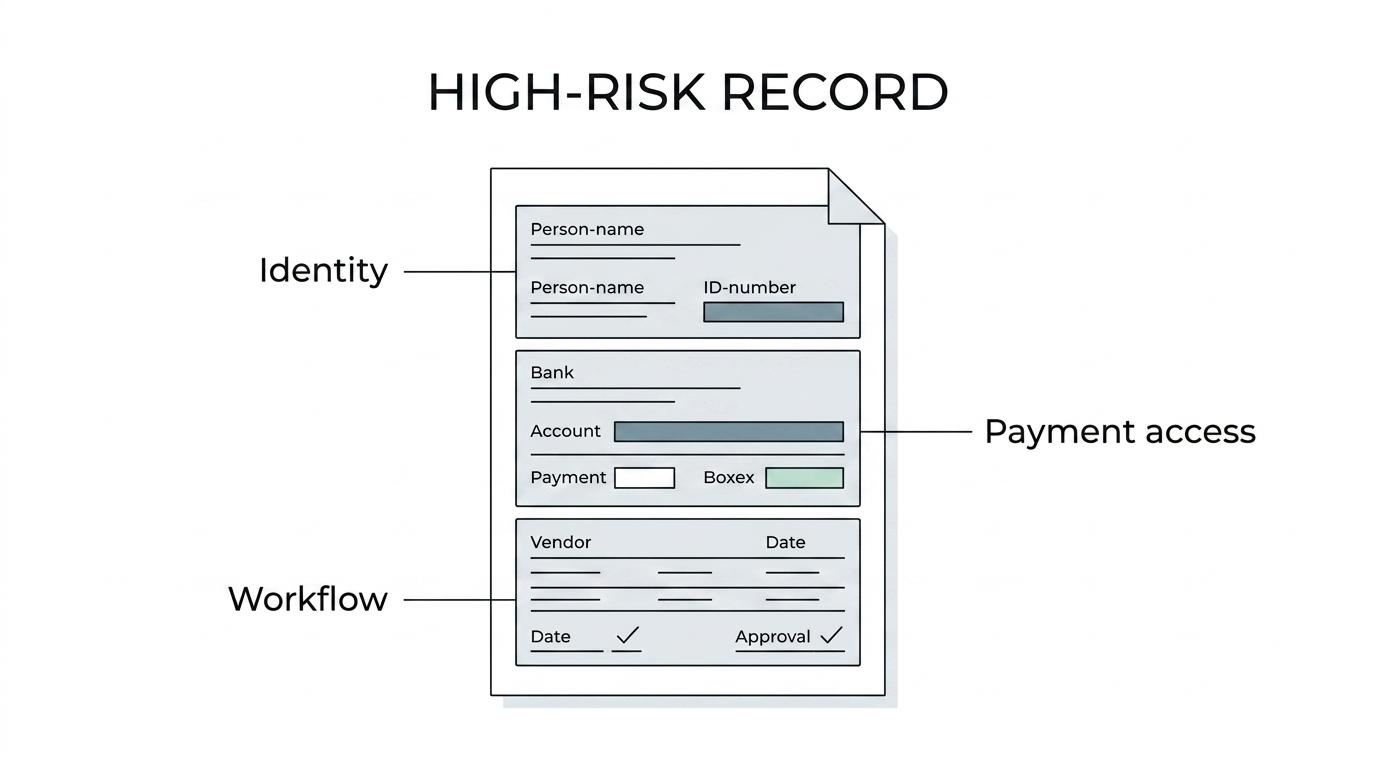
The same principle applies to contractors. W-9s, 1099 details, and payment setup forms may not sit inside the payroll system, yet they often contain tax identification numbers, addresses, and payment instructions that can be abused just as easily.
Bank account, payment, and transaction records are prime fraud targets
If tax and payroll data are ideal for identity theft, payment data is ideal for fast-moving financial fraud. Accounting departments hold the records that determine who gets paid, how they get paid, and when a transaction looks normal.
That includes checking account numbers, routing numbers, ACH batches, wire templates, merchant account information, payment card activity, vendor remittance details, and customer payment histories. FTC guidance specifically recognizes account numbers, payment history, loan or deposit balances, and card purchase activity as sensitive financial information.
Attackers value this data because it helps them mimic legitimate behavior. A criminal who can see historical invoice amounts, vendor names, payment timing, and approval patterns has a better chance of slipping a fraudulent request past busy staff.
Sometimes the most sensitive file is not a bank statement. It is the spreadsheet that lists top vendors, average payment amounts, and the employee authorized to release funds.
Financial statements, balances, and internal reports also deserve strict protection
Many leaders focus on identity data and forget how revealing internal accounting reports can be. Yet balance sheets, cash flow reports, borrowing base reports, accounts receivable aging, and accounts payable aging can expose a company’s financial stress, available cash, debt position, and operational priorities.
That information can support extortion, social engineering, unfair competitive advantage, and targeted fraud. If someone knows a business is carrying a high receivables balance and watching cash closely, they can craft more convincing fake collection messages or urgent payment requests.
A balance report may not look personal, but it can still be highly sensitive.
Sensitive accounting data exists in more places than most teams expect
The risk is not limited to the accounting system itself. Sensitive data often spreads as work gets done. A report is exported to Excel for review. A PDF is attached to an email for approval. A scanned check copy lands in a shared folder. A printed packet goes to a conference room for signatures.
That sprawl matters because protection is rarely equal across every storage location. A secure finance platform may have role-based access and audit logs, while a synced desktop folder may not. A paper file at the front desk may be even less protected.
Sensitive accounting data commonly appears in:
- Cloud file shares
- Email attachments
- PDFs and scanned images
- Spreadsheets and CSV exports
- Printed folders and desk files
- Mobile devices used for approvals
This is one reason regulators and security professionals focus on data handling, not only data storage. The same record remains sensitive whether it is in a line-of-business application, a SharePoint library, or a manila folder.
What makes one accounting record more sensitive than another
Not every accounting document carries the same risk. The most dangerous records usually share one trait: they combine multiple forms of value in a single place.
A helpful way to rank sensitivity is to ask whether the record answers several of these questions at once:
- Identity: Does it identify a person, household, employee, owner, or customer?
- Financial access: Does it include account numbers, payment methods, or transaction authority?
- Financial condition: Does it reveal income, balances, liabilities, net worth, or tax status?
- Operational context: Does it show timing, approval workflow, vendors, or normal payment behavior?
- Reuse potential: Could someone use it for identity theft, tax fraud, wire fraud, extortion, or phishing?
A report with only one of those elements may be sensitive. A file with four or five of them deserves the highest level of control.
This is why tax packets, payroll exports, banking forms, and AP vendor setup records usually sit at the top of the list. That overlap between identity, payment authority, and business context is also what makes vendor records valuable in verification work, which Leiprices highlights in its explanation of how LEI data helps counterparty due diligence and KYC.
They offer identity, money movement, and operational context in a single package.
Practical controls for protecting sensitive accounting data
Once a business knows which records matter most, the next step is to reduce unnecessary exposure. That starts with access discipline. People should only have access to the accounting data they need for their role, and access should be reviewed regularly as responsibilities change.
It also helps to classify records by sensitivity so the team knows what deserves tighter handling. A simple internal policy can separate general financial reporting from restricted data that includes Social Security numbers, tax identification numbers, bank account details, or return information. For firms subject to regulatory requirements, a written information security program can help turn that policy into repeatable practice.
Strong protection usually includes a mix of controls:
- Access controls: Role-based permissions, least-privilege access, approval workflows
- Authentication: Multi-factor authentication for accounting, payroll, email, and cloud platforms
- Data handling rules: Limits on exports, secure file sharing, restrictions on personal devices
- Monitoring: Audit logs, alerting for unusual access, review of failed login activity
- Resilience: Encrypted backups, recovery testing, ransomware response planning
Training matters just as much. Accounting staff are frequent targets for phishing, business email compromise, and invoice fraud because they manage real money and trusted relationships. A team that can spot suspicious payment changes, fake login pages, or unusual requests is far less likely to become the weakest link.
Vendor management also deserves attention. Bookkeepers, CPAs, payroll processors, lenders, collection firms, and software providers may all touch highly sensitive accounting records. If a third party can access tax, payment, or identity information, security expectations should be clear before data changes hands.
Questions SMB firms should ask about accounting data exposure
Many firms can identify their accounting platform, yet they cannot quickly answer where their most sensitive exports go after month-end, payroll runs, or tax prep cycles. That gap is where hidden risk tends to grow.
A practical review often starts with a few direct questions:
- Where is it stored: Accounting system, shared drive, email, paper archive, employee desktop
- Who can access it: Finance staff, HR, managers, outside accountants, vendors
- How is it shared: Attachment, portal, link, printed packet, USB device
- How long is it kept: Retention policy, archived copies, duplicate exports
- How is it protected: MFA, encryption, logging, backups, disposal procedures
These questions do not require a major audit to be useful. Even a focused internal review can reveal old shared folders full of payroll reports, inboxes packed with tax documents, or vendor banking forms sitting in places they should not.
For SMB firms, that kind of clarity creates momentum. Once the most sensitive accounting data is clearly identified, better protection becomes much easier to plan, budget, and maintain.