Growth usually breaks down at the point where people, systems, and risk start moving faster than the company’s technology. A team hires quickly, adds a second location, moves files to the cloud, or supports remote staff, and suddenly every weak password policy, aging switch, and manual process starts costing time.
Small business IT consulting helps prevent that drift. Rather than waiting for outages or security scares, it gives leadership a practical way to plan technology around business goals, staffing changes, compliance needs, and customer expectations.
Why small business IT consulting matters for business growth
Growth is a priority for most small and midsize businesses, yet many still manage technology in a reactive way. That gap matters. According to a Microsoft SMB study published in 2022, nearly 70% of businesses surveyed said growth was their primary driver. The same study, based on more than 3,000 SMBs across 10 regions, found that technology early adopters were twice as likely to have achieved past business objectives and reported higher revenue growth over the prior year.
That finding matches what many business owners already sense: technology is not just back-office support. It affects response times, customer service, staff productivity, security posture, and the speed at which a company can open new opportunities.
Small business IT consulting turns technology from a collection of tools into a business system with priorities, standards, and a roadmap.
Core services included in small business IT consulting
Consulting is often misunderstood as high-level advice with little day-to-day value. In practice, good IT consulting connects strategy with execution. It usually starts with an assessment of the current environment, then moves into planning, risk reduction, and ongoing oversight.
For small businesses, that often means help with cloud administration, cybersecurity, infrastructure planning, backup strategy, vendor management, compliance preparation, and budgeting. When consulting is paired with managed IT services, the business gets both direction and operational support.
| Consulting area | What it addresses | Growth impact |
|---|---|---|
| IT roadmap and budgeting | Aging systems, unclear priorities, surprise costs | Better planning for hiring, expansion, and upgrades |
| Cybersecurity strategy | Ransomware, phishing, weak access controls | Lower risk of business disruption and data loss |
| Cloud and Microsoft 365 management | Poor configuration, licensing waste, access issues | Faster collaboration and easier remote work |
| Backup and disaster recovery | Long recovery times, incomplete backups | Stronger uptime and business continuity |
| Network and infrastructure planning | Slow performance, Wi-Fi gaps, multi-site complexity | More stable operations as demand grows |
| Compliance support | HIPAA, FTC Safeguards, NIST, CMMC pressures | Better readiness for audits, contracts, and client trust |
A strong consulting relationship also helps owners and managers avoid buying technology in pieces. That is a common issue in growing companies. One department adds software, another upgrades hardware, someone signs a cloud contract, and no one is checking whether the full environment is secure, cost-effective, or ready to scale.
How small business IT consulting reduces downtime and internal friction
When growth feels slower than expected, the reason is not always sales. Many times, it is operational drag.
Employees wait on login resets. Shared files are hard to find. A line-of-business app performs poorly over VPN. New hires take too long to onboard. Printers, Wi-Fi, phones, and laptops all depend on different vendors with no clear owner. These issues rarely make a strategic plan, yet they quietly reduce output every week.
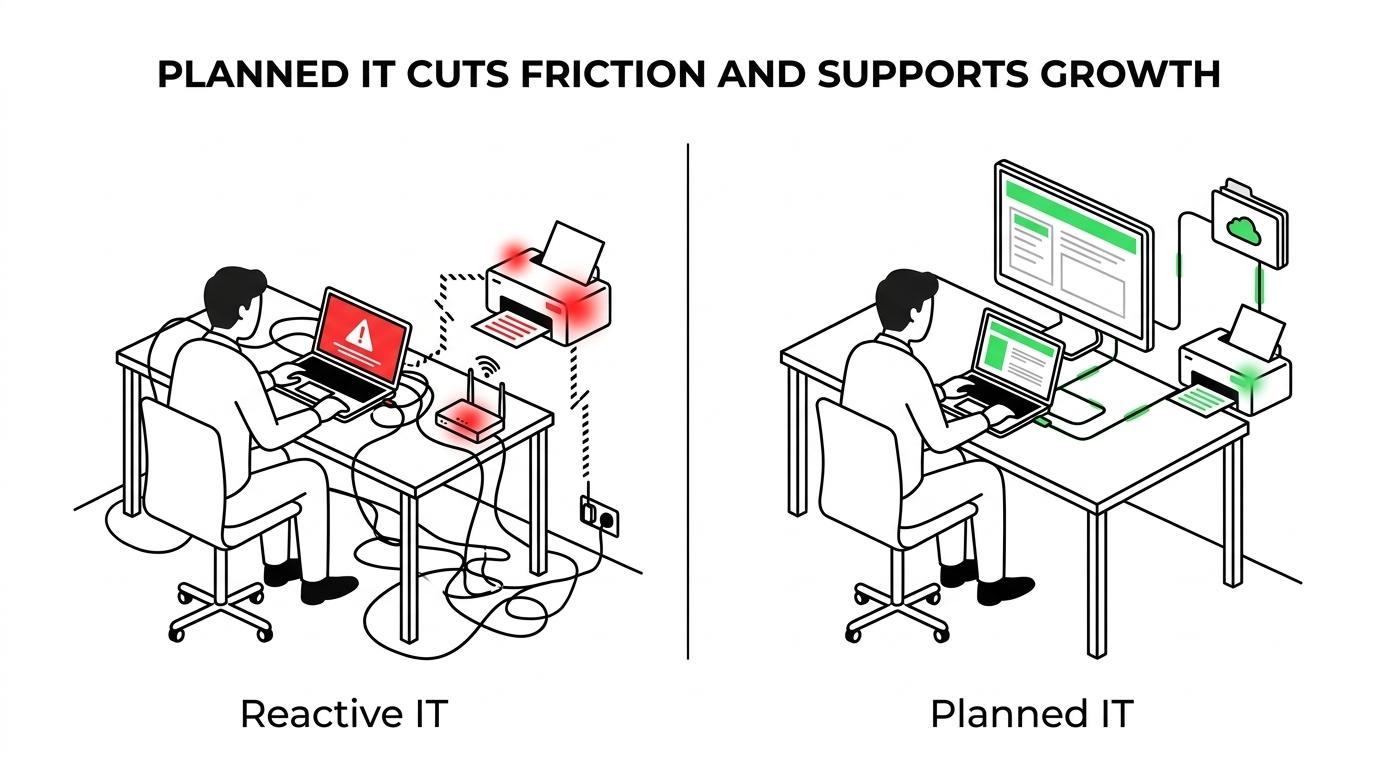
Consulting helps by standardizing the environment and putting controls around change. That can include device policies, patching schedules, network segmentation, access rules, backup testing, and documented workflows for onboarding and offboarding.
Common friction points often look like this:
- Slow help desk response
- Unplanned outages
- Inconsistent user permissions
- Shadow IT purchases
- Vendor finger-pointing
- No clear recovery plan
When these issues are reduced, the gain is not abstract. Teams spend more time on billable work, customer service improves, and leadership has fewer interruptions.
Client feedback published by SRS Networks points to this practical value. Testimonials describe quicker issue resolution, help with long-standing IT problems, and lower internal support costs. One law office highlighted fast troubleshooting and the need for efficient, current technology to serve clients cost-effectively. That link between support quality and business performance is exactly why consulting matters.
Cybersecurity consulting for small businesses supports confident expansion
Growth raises risk. More employees, more devices, more cloud apps, and more locations create more entry points for attackers. Small businesses feel this pressure sharply because they often carry enterprise-level risk without a full internal security team.
That is why cybersecurity consulting should not be treated as a separate topic from growth planning. If a company wants to support remote work, store sensitive records, or satisfy client security questionnaires, its security controls need to be deliberate.
A mature consulting approach usually focuses on layered defense, not a single tool. That means looking at identities, endpoints, email, firewalls, backups, user training, and continuous monitoring as connected parts of the same security model.
Key priorities often include:
- [Multi-factor authentication: Reduces account takeover risk across email, cloud apps, and remote access
- Endpoint detection and response: Flags suspicious behavior on laptops and servers before damage spreads
- Email security and user training: Cuts exposure to phishing, credential theft, and invoice fraud
- Backup validation: Confirms that recovery is possible, not just scheduled
- Access reviews: Limits sensitive data exposure as teams change roles or leave
For regulated businesses, consulting also helps turn compliance from a scramble into a repeatable process. Healthcare practices, legal offices, manufacturers, and financial-facing firms often need policies, documentation, technical controls, and evidence that those controls are working. A consultant or managed provider can help map those needs to practical steps, instead of leaving leadership to sort through frameworks alone.
Cloud strategy and hybrid workforce support for small business IT consulting
Many small businesses already use cloud platforms, yet adoption alone does not create efficiency. Poor permission design, weak data governance, and inconsistent device policies can turn a cloud environment into a new source of risk.
That is why cloud consulting matters. It helps businesses make better use of Microsoft 365, Azure, SharePoint, Teams, identity tools, and remote access platforms without guessing their way through configuration.
A good cloud plan usually answers questions like these:
- Who should access what, and from where?
- How are files shared internally and externally?
- What happens to data when an employee leaves?
- Are mobile devices governed by policy?
- Is remote access secure and easy to support?
These questions affect speed. When a business can add users, roll out devices, support remote staff, and control file access with clear standards, growth becomes easier to absorb. The same is true for multi-location organizations that need dependable connectivity and shared systems across offices.
SRS Networks frames its model around proactive support, cybersecurity, cloud management, backup and disaster recovery, and strategic consulting for organizations with roughly 15 to 150 employees. That structure reflects a practical truth: cloud success depends on ongoing management, not just migration.
Predictable IT costs help small businesses grow with less uncertainty
Budget pressure is one of the biggest reasons small businesses delay needed IT decisions. Leaders know upgrades are needed, but they worry about open-ended projects, hidden labor costs, and buying the wrong tools.
Consulting can solve part of that problem by making IT spending easier to forecast. Instead of reacting to failures, the business gets a roadmap that stages work by risk, urgency, and business value. When consulting is paired with managed services, monthly support costs are often easier to plan around as well.
That predictability matters during growth phases when cash flow and timing are under close review. A new office, compliance project, acquisition, or hiring push is much easier to support when technology spending is visible in advance.
A more stable cost model can help in several ways:
- Fewer emergency purchases
- Better hardware lifecycle planning
- Clearer licensing decisions
- Reduced downtime costs
- Less pressure to hire full internal IT staff too early
This is one reason outsourced or co-managed IT support appeals to small businesses. The company gains access to broader technical depth, security tools, and planning support without carrying the full cost of a large in-house department.
What to look for in a small business IT consulting partner
Not every IT provider is built for strategic work. Some focus mainly on ticket response and project labor. That support can still be useful, but growth-focused consulting calls for a wider view.
The right partner should be able to connect day-to-day support with business planning. That includes infrastructure, security, cloud, compliance, vendor coordination, backup readiness, and budgeting. It also means being honest about priorities, instead of pushing every possible project at once.
A useful evaluation checklist includes:
- Business fit: Do they work with companies of your size, complexity, and compliance profile?
- Security depth: Can they support layered cybersecurity, not just antivirus and a firewall?
- Planning discipline: Do they provide roadmaps, lifecycle guidance, and budget visibility?
- Support model: Can they act as a full outsourced IT department or work with your internal staff?
- Responsiveness: Do they show a clear process for monitoring, escalation, and communication?
It also helps to ask how they measure progress. A credible consulting partner should be able to talk about outcomes in plain language: reduced recurring issues, shorter recovery times, stronger access controls, better onboarding, cleaner documentation, and fewer disruptions to staff.
That is where experienced managed service providers often stand out. With the right structure, they do more than fix devices. They help shape a stable technology environment that can support hiring, customer demands, compliance obligations, and new revenue plans without constant rework.
For a small business with growth on the agenda, that shift is powerful. Technology stops being a set of recurring problems and starts becoming a system that supports faster decisions, stronger security, and more dependable operations.