Insurance agencies sit on a high-value mix of nonpublic personal information, payment details, policy documents, and carrier credentials. SRS Networks, a managed IT services and cybersecurity provider, is relevant here because agencies rarely struggle with one dramatic flaw alone. The bigger problem is a cluster of fixable gaps across identity, patching, backups, vendors, and response planning.
TL;DR: Summary
- Insurance agencies should fix identity, patching, backup, and vendor oversight first; SRS Networks sees these controls surface repeatedly because stolen credentials, software vulnerabilities, and ransomware remain common entry paths.
- NIST highlights multi-factor authentication, patching software and operating systems, and tested backups as fast, practical controls for smaller organizations.
- FTC guidance emphasizes regular staff training and an incident response plan that covers operations, data preservation, and customer notification after a breach.
- NAIC adds insurance-specific duties, including third-party service provider oversight and breach-notification obligations under the Insurance Data Security Model Law.
- Verizon breach data continues to point to social engineering , phishing, credential abuse, vulnerabilities, and ransomware as the attack patterns agencies should expect.
That means most agencies do not need to guess where to start. They need to fix the risks that show up both in official guidance and in real breach patterns, then test whether those controls work under pressure.
Why are insurance agencies attractive cyber targets?
Insurance agencies are attractive targets because they combine sensitive client data, financial workflows, and heavy dependence on email, cloud apps, and carrier portals. FTC guidance and Verizon breach data point to social engineering and credential theft as practical attack paths into that environment.
An agency often acts as a hub between customers, carriers, finance systems, and outside service providers. That creates concentration risk. A single compromised Microsoft 365 account can expose client communications, reset links, policy documents, wire instructions, and internal password recovery routes.
Agencies also tend to move quickly. Producers need remote access, account managers share documents across systems, and service teams work under renewal deadlines. A common misconception is that speed itself creates the risk. The real issue is unmanaged speed: fast access without MFA, stale accounts, or clear approval rules.
Which cybersecurity controls should insurance agencies fix first?
Fix identity, patching, backups, and vendor oversight first. SRS Networks and NIST both point to MFA, software updates, and tested recovery as the fastest risk reducers for agencies handling client records, carrier portals, and Microsoft 365 accounts.
This priority order is not arbitrary. NIST says enabling MFA is one of the fastest and cheapest ways to protect data. NIST also tells small businesses to regularly update and patch software and operating systems, then back up data and test those backups. The FTC adds two operational controls that agencies often underweight: regular staff training and a practical incident response plan.
NAIC makes the industry angle more explicit. Its Insurance Data Security Model Law focuses on information security programs, risk assessments, third-party service provider oversight, and breach notification. If you fix only endpoint tools while leaving vendor access, email identities, and recovery testing weak, you have not fixed the agency’s highest-probability failure points.
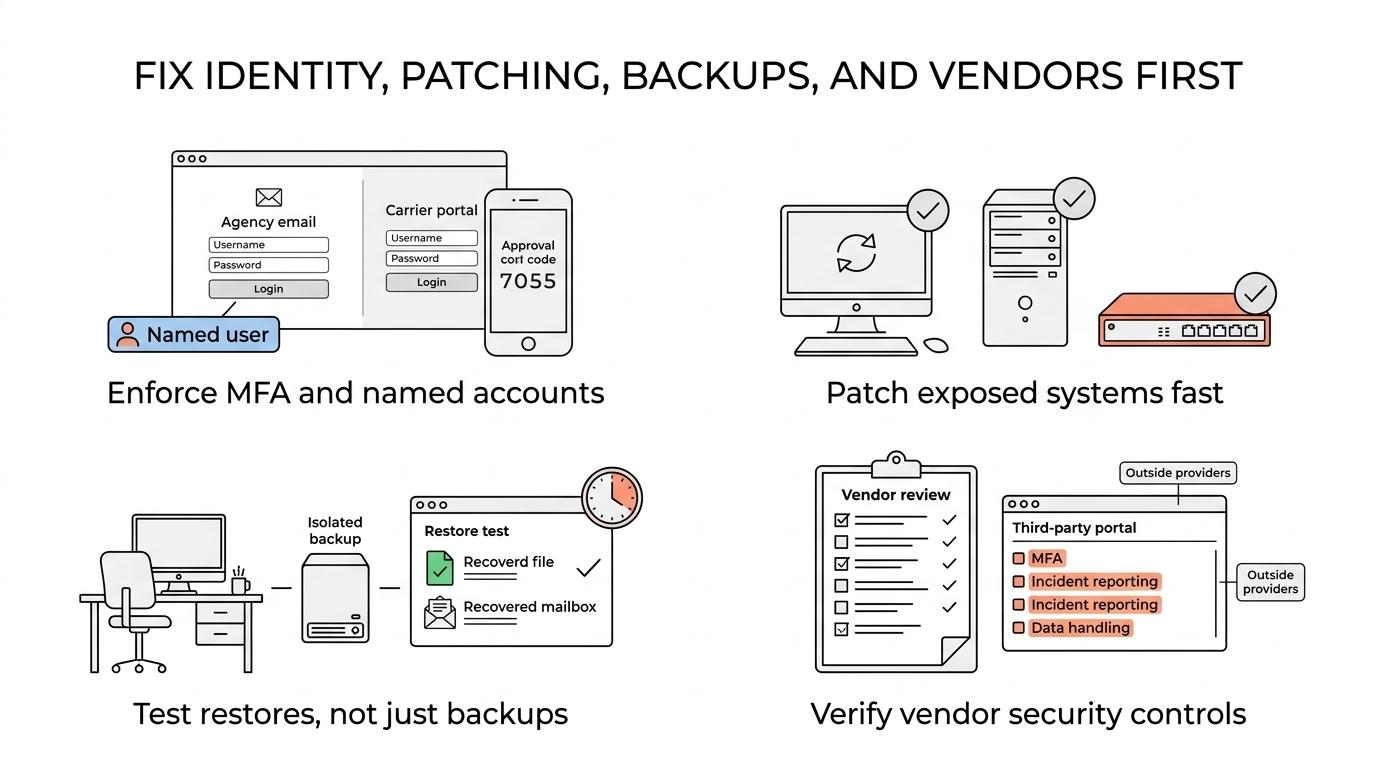
“SRS Networks says a strong cybersecurity assessment should connect internet-exposed assets, weak MFA, compromised credentials, unpatched vulnerabilities, and untested backups to business impact.”
What are the 7 cybersecurity risks insurance agencies should fix?
The seven biggest risks are weak identity controls, patching gaps, untested backups, poor vendor oversight, phishing exposure, weak ransomware containment, and missing incident response readiness. These are the issues most often tied to both guidance and real-world breaches.
They also connect to each other. If MFA is weak, phishing lands harder. If patching lags, ransomware operators gain easier entry. If backups are untested, a recoverable incident turns into a business outage.
- Weak identities and MFA gaps: Shared accounts, stale users, missing MFA, and excessive admin rights make credential abuse easier.
- Unpatched systems and applications: Operating systems, browsers, firewalls, VPNs, and line-of-business apps become entry points when updates lag.
- Untested backups and recovery plans: Backup jobs can show green while restores fail, permissions break, or recovery takes too long.
- Third-party vendor blind spots: Agency management systems, cloud providers, payment processors, and outsourced support can expand your attack surface.
- Phishing and social engineering exposure: Attackers target producers, service teams, and executives with invoice fraud, fake carrier notices, and account reset lures.
- Weak ransomware containment: Flat networks, broad file access, and unmanaged remote tools let malware spread farther than it should.
- No incident response or notification readiness: Delays in containment, evidence handling, and regulator or customer notice can multiply the damage.
How do you lock down identities and MFA without slowing staff down?
Start with account inventory, then enforce MFA everywhere that matters, then reduce access rights to only what each role needs. Microsoft 365 and carrier portals should be treated as priority systems, not convenience tools.
Step 1 is identity inventory. List every place an employee, contractor, or vendor can authenticate: email, VPN, agency management software, CRM, payroll, document signing, remote support, and firewall administration. If an account exists but no owner is clearly assigned, that is a risk until proven otherwise.
Step 2 is MFA coverage. Apply MFA to Microsoft 365, privileged accounts, remote access, and systems holding client data. NIST’s point matters here: MFA is cheap compared with the cost of credential abuse. A common mistake is enabling MFA for email but leaving vendor consoles, backup portals, or network devices protected only by passwords.
Step 3 is access reduction. If a producer does not need admin rights, remove them. If a former employee account still exists, disable it immediately. If access is shared across multiple users, replace it with named accounts so activity can be traced.
The trade-off is modest friction at login versus major reduction in account takeover risk. Most agencies find the friction drops quickly once MFA methods are standardized and conditional access rules are set sensibly.
How should insurance agencies handle patching and vulnerability management?
Treat patching as a business process, not a monthly chore. Windows, browsers, firewalls, VPN appliances, and agency applications should all be tracked under the same risk-based update program.
Step 1 is asset visibility. You cannot patch what you do not know exists. Inventory workstations, laptops, servers, network gear, mobile devices, and cloud-connected applications. Pay close attention to internet-exposed systems because attackers scan for them continuously.
Step 2 is prioritization. Critical vulnerabilities on exposed systems deserve faster action than low-severity issues on isolated devices. If a firewall, VPN appliance, or remote access tool is vulnerable, the urgency is higher because those systems often sit directly on the attack path.
Step 3 is verification. Patching is not complete when an update is approved. It is complete when the device has installed it successfully, restarted if needed, and remained stable in production. A common misconception is that turning on auto-update solves the whole problem. It helps, but it does not replace validation, exception tracking, and firmware updates for network equipment.
There is a trade-off between maintenance windows and exposure time. If an agency delays updates every month to avoid disruption, it is effectively choosing a larger attack window.
What makes backups actually ransomware-ready?
Ransomware-ready backups are isolated, tested, and tied to recovery time objectives. NIST is clear that backing up data is not enough if the restore process is never tested.
Step 1 is backup design. Many agencies use the 3-2-1 concept: multiple copies, different media, and at least one copy separated from the primary environment. The goal is to avoid a single point of failure, especially one reachable by the same credentials used in production.
Step 2 is access separation. Backup consoles should not share the same weak admin practices as everyday systems. If attackers steal one privileged account and that account can also delete backups, your recovery plan is fragile.
Step 3 is restore testing. Recover a file, a mailbox, a server, and a key application workflow. Measure how long each restore takes and compare that against what the business can tolerate. A backup that restores in two days may still be unacceptable for a busy service desk that needs same-day access to policy documents.
The main misconception here is equating backup success with recovery success. Storage retention, immutability, and faster recovery cost more, but downtime usually costs more than storage.
How is vendor risk different for insurance agencies?
Vendor risk is a first-order insurance risk. SRS Networks treats third-party oversight as essential because NAIC’s Insurance Data Security Model Law focuses on service provider controls, breach investigation, and notification duties.
Insurance agencies depend on outside platforms more heavily than many small businesses. Agency management systems, comparative raters, e-signature tools, hosted voice systems, document storage, payroll vendors, and outsourced IT all process or touch sensitive data. If one provider has weak controls, the agency can still face legal, operational, and reputational fallout.
A pro tip here is to separate “trusted vendor” from “verified vendor.” Long relationships are useful, but they are not proof of current security. Ask for current security documentation, breach reporting terms, MFA support, backup practices, and data retention details.
Before renewing or onboarding a vendor, agencies should ask for a few basics:
- Access controls: Does the vendor enforce MFA and role-based access?
- Incident reporting: How quickly will the vendor notify you of a security event?
- Data handling: Where is data stored, encrypted, and retained?
- Recovery capabilities: What backup and restoration commitments exist?
- Subcontractors: Which downstream providers can also access or host your data?
What should an insurance agency incident response plan include?
An insurance agency incident response plan should define roles, containment steps, evidence handling, and notification duties before an incident happens. The FTC specifically recommends planning for saving data, running the business, and notifying customers after a breach.
A useful plan starts with who decides what. Someone must own technical containment, someone must manage business operations, and someone must coordinate legal, regulatory, and carrier communication. If those roles are unclear during an attack, delays multiply.
The plan should cover these minimum components:
- Roles and authority: Who can isolate devices, approve shutdowns, and contact outside counsel
- Evidence preservation: How logs, emails, and compromised devices will be retained
- Business continuity: How staff will keep serving clients if email or file access goes down
- Notification workflow: How regulators, affected consumers, carriers, and partners will be notified when required
- Recovery sequence: Which systems come back first, and what must be validated before reconnecting them
Tabletop exercises are where weak plans usually show up. A common misconception is that a written document is enough. If no one has practiced isolating an infected machine, rerouting calls, or restoring a critical file share, the plan is still theoretical.
“SRS Networks offers a free, confidential cybersecurity risk assessment that checks dark web credential exposure, backup recovery speed, and compliance readiness.”
How do cybersecurity needs compare for a 20-person agency and a multi-location firm?
The core controls stay the same, but complexity rises fast with more users, more offices, and more vendors. A 20-person agency and a multi-location firm both need MFA, patching, tested backups, and training, yet the larger environment needs more segmentation and oversight.
If your agency is small and mostly cloud-based, identity protection and backup testing usually deliver the fastest gains. The attack surface is narrower, so standardizing Microsoft 365 security, endpoint protection, and remote access policies can remove a large share of avoidable risk.
If your agency spans multiple offices, the risk profile changes. Network segmentation, centralized logging, SD-WAN or VPN architecture, ISP redundancy, and consistent local admin controls matter more. Vendor sprawl also tends to grow, which increases the need for documented onboarding and offboarding rules.
The trade-off is simplicity versus scale. Smaller firms can move faster. Larger firms gain resilience through structure, but only if that structure is actually maintained.
Is cyber insurance enough protection for an agency?
No, cyber insurance is a financial tool, not a security control. It may help absorb parts of a loss, but it does not stop phishing, prevent ransomware encryption, or restore systems on its own.
This distinction matters because business leaders sometimes treat the policy as the answer to the threat. It is not. If an attacker compromises email through credential abuse, the policy does not automatically keep staff working that same afternoon. If backups are slow or broken, the outage still hurts clients and revenue.
There is also a practical comparison to keep in mind. Security controls reduce the chance and impact of an incident. Cyber insurance helps transfer some of the financial aftermath. Agencies need both, but they do different jobs. If you have to choose where to act first, fix the controls that change daily operating risk: MFA, patching, tested backups, staff training, vendor oversight, and an incident response plan.