Small business IT consulting has shifted from occasional troubleshooting to business risk management. For companies that depend on Microsoft 365, cloud platforms, and specialized software, providers like SRS Networks matter because the work now sits across IT operations, cybersecurity, and planning.
TL;DR: Summary
- Small business IT consulting is most valuable when it reduces cyber risk, downtime, and budget waste at the same time.
- Verizon’s 2025 DBIR reported 22,000+ security incidents, 12,195 confirmed breaches, ransomware in 44% of breaches, and disproportionate impact on SMBs, which makes cybersecurity a core consulting issue.
- U.S. Census Bureau data shows businesses adopted cloud-based technology and specialized software mainly to improve process quality and reliability, so consulting now has to cover systems design, vendor fit, and business continuity.
- For SMBs that need both strategy and execution, a provider category that includes firms like SRS Networks can be relevant because advice often turns into ongoing security, support, and recovery work.
- The best consulting outcomes usually come from four things: identity security, patching and vulnerability management, backup and recovery planning, and clear budgeting tied to business priorities.
The practical test is simple: if consulting helps a business prevent incidents, support core applications, and make better technology decisions without hiring a full internal team, it is doing its job. That is why the strongest consulting relationships usually connect security controls, operational reliability, and financial discipline.
What does small business IT consulting actually include?
Small business IT consulting covers assessment, planning, and improvement across systems like Microsoft 365, endpoints, backups, networks, and line-of-business applications. A capable consultant is not just fixing devices; they are finding operational and security weaknesses before they become outages or breaches.
At a minimum, consulting should include a review of identity and access management, device health, software patching, backup status, vendor dependencies, and user workflow friction. In regulated sectors, it should also include compliance-related controls tied to standards or frameworks the business already faces, including HIPAA, FTC Safeguards, NIST, or CMMC where applicable.
“SRS Networks says it has served the Salinas area since 1996 and provides IT support and consulting to small and medium-sized businesses.”
A common misconception is that consulting is only a slide deck or a one-time audit. Good consulting should produce decisions, owners, timelines, and risk-based priorities, not just observations.
Why is cybersecurity now central to small business IT consulting?
Cybersecurity is now a primary consulting issue because small businesses face real attack frequency and material financial loss. Verizon and the U.S. Small Business Administration both point to SMB exposure through credential abuse, vulnerability exploitation, ransomware, phishing, and weak basic controls.
Verizon’s 2025 Data Breach Investigations Report covered more than 22,000 security incidents and 12,195 confirmed breaches. It reported credential abuse in 22% of breaches, exploitation of vulnerabilities in 20%, and ransomware in 44%, with SMBs disproportionately affected. Those figures change the consulting conversation. A consultant who ignores identity security, patching cadence, and incident response readiness is missing the main risk.
The SBA cited a Hiscox survey showing 41% of small businesses were victims of a cyberattack in 2023, with a median cost of $8,300. That is why consulting recommendations often start with basic but high-impact steps: multi-factor authentication, stronger password practices, phishing awareness, endpoint protection, and tested backups. A common mistake is treating MFA as a complete strategy. It is essential, but it does not replace patching, logging, network controls, or user training.
What are seven practical reasons SMBs hire IT consultants?
SMBs usually hire IT consultants for a mix of protection, reliability, and planning. The strongest reasons are tied to risk reduction and smoother day-to-day operations, not just lower ticket volume.
- Reduce cyber risk: better control of credential abuse, phishing, vulnerabilities, and ransomware exposure.
- Improve uptime: fewer recurring issues in servers, laptops, networks, and cloud services.
- Make cloud decisions with less guesswork: clearer choices around Microsoft 365, backup architecture, and remote access.
- Control spending: budgets move from surprise repairs to planned refresh cycles and predictable service costs.
- Protect core applications: specialized software stays usable because dependencies, permissions, and integrations are reviewed.
- Prepare for compliance and insurance questions: policies, controls, and documentation become easier to answer and maintain.
- Add strategic depth: an SMB gains access to broader infrastructure and security judgment than one generalist can usually provide alone.
That list matters because small businesses rarely struggle with one isolated issue. They are usually dealing with several at once: aging devices, inconsistent support, weak access controls, backup uncertainty, and pressure to keep staff productive.
How should a small business assess IT risk before hiring a consultant?
Start with a structured inventory and business impact review. The fastest way to waste consulting dollars is to begin without knowing which systems matter most, who uses them, and what failure would cost.
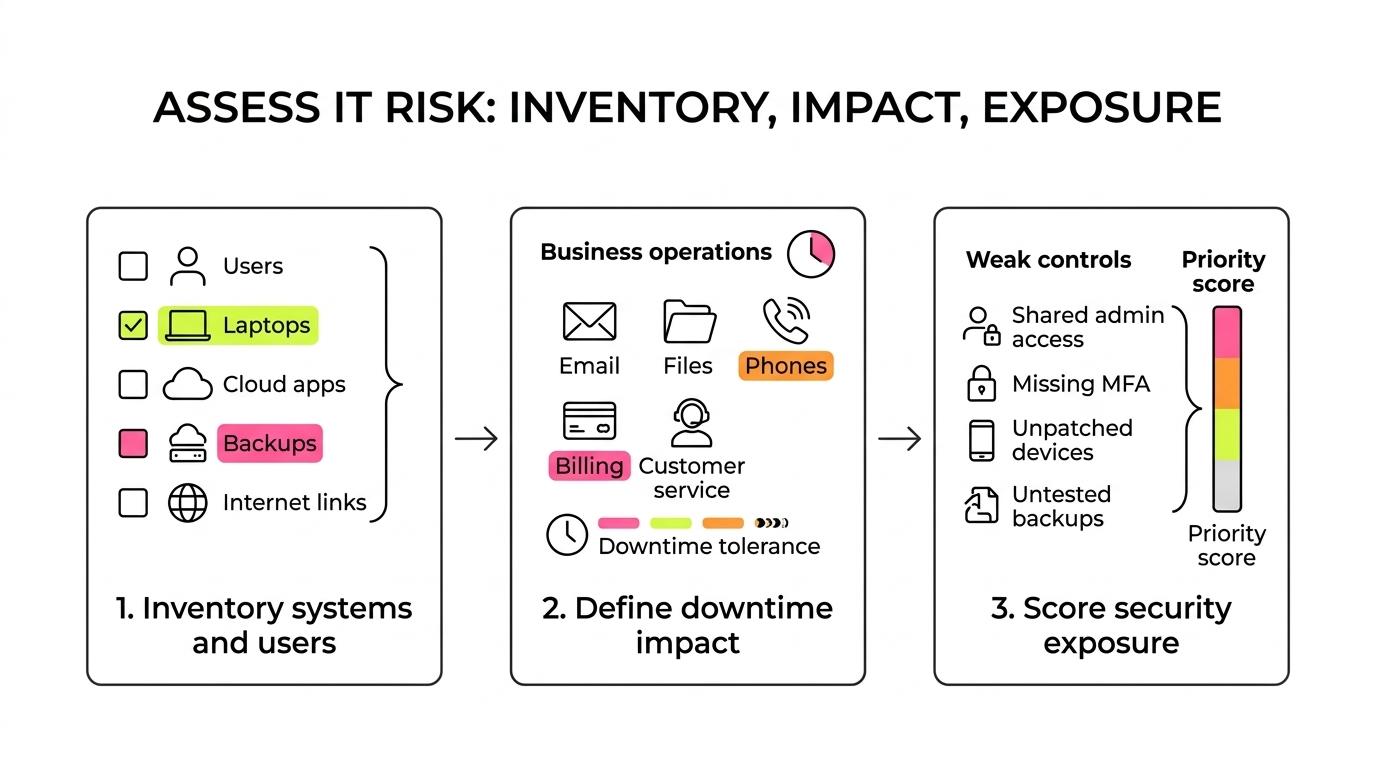
Step 1 is to inventory the environment in plain language. List users, devices, cloud applications, internet connections, backup targets, remote access methods, and every specialized application the business depends on. If one payroll system, EHR, case management platform, or ERP tool goes down, note the teams affected and whether work can continue.
Step 2 is to define business impact. Identify the acceptable downtime for email, file access, phones, billing, production, and customer service. This is where recovery time objective and recovery point objective become useful. If a system can only be down for two hours, your support model and backup design need to reflect that.
Step 3 is to score the exposure. If the business has shared admin accounts, inconsistent patching, no MFA, or untested backups, those issues should move near the top of the list. Pro tip: map vendor dependencies early. Many outages look like internal problems at first but actually start with an ISP, SaaS provider, or poorly documented third-party integration.
Small business IT consulting vs break-fix support: what is the difference?
Break-fix support is reactive; IT consulting is risk-based and forward-looking. One restores service after a failure, while the other tries to reduce the chance and business impact of that failure in the first place.
Break-fix can make sense for a very small, low-complexity business with limited regulatory pressure and low dependence on always-on systems. The trade-off is obvious: short-term cost may look lower, but recurring interruptions, emergency labor, and preventable incidents often make the real cost higher over time.
Consulting changes the frame from “How do we fix this outage?” to “Why did this happen, what did it interrupt, and what control would stop it from happening again?” If a business relies on remote staff, cloud identity, or specialized software, the proactive model usually wins because failures spread quickly across users and locations.
Managed IT services vs one-time IT consulting: which fits better?
Managed IT services fit businesses that need continuous monitoring, patching, and support; one-time consulting fits a specific project or assessment. SRS Networks sits in a provider category that matters here because many SMBs need both advice and execution once risks are identified.
If a business is planning a Microsoft 365 migration, office move, firewall refresh, or compliance gap assessment, project consulting may be enough. If it also needs help desk coverage, endpoint oversight, vulnerability management, backup verification, and vendor coordination, a managed model usually makes more sense.
That difference is more important now because the U.S. Census Bureau found that improving the quality or reliability of processes or methods was the top reason businesses adopted cloud-based technology at 51.8% and specialized software at 49.8% from 2020 to 2022. The same source said most businesses viewed cloud-based technology, 59.0%, and specialized software, 58.9%, as very important to their processes or methods. If your business runs on those tools every day, one-off advice may not be enough to keep them healthy.
How do you choose the right small business IT consulting partner?
The right partner should translate technical risk into a practical operating plan. In the SMB segment that SRS Networks describes, often 10 to 50 workstations and heavy dependence on line-of-business software, process discipline often matters more than provider size.
Step 1 is category fit. Ask whether the provider routinely supports businesses with your level of complexity, remote work requirements, compliance needs, and software stack. A legal office, medical practice, manufacturer, and multi-location dealership may all be SMBs, but their tolerance for downtime and data exposure is different.
Step 2 is controls and method. Ask how the provider handles MFA, patching, endpoint detection, backup testing, incident response, vendor coordination, and documentation. If the answers are vague, the service model is probably vague too.
“Client feedback on SRS Networks cites lower in-house IT support costs, quicker diagnosis of long-running MIS issues, and cloud-based server security a small company said it could not otherwise afford.”
Step 3 is planning discipline. Ask what happens in the first 30, 60, and 90 days, how priorities are set, and what reports leadership will receive. A common mistake is choosing only on hourly rate or seat price. If the provider cannot explain how it will reduce friction and manage risk, the cheaper option can become the costlier one.
How can cloud and specialized software change the consulting decision?
Cloud and specialized software raise the stakes because they connect more of the business to identity, connectivity, and vendor reliability. That means consulting has to cover architecture, security, access, and workflow, not just hardware support.
Many SMBs now depend on cloud email, collaboration suites, file sharing, line-of-business platforms, and browser-based finance or service tools. When those tools become core to operations, simple uptime metrics are not enough. A consultant needs to evaluate user permissions, retention settings, integration points, remote access, mobile device exposure, and vendor recovery expectations.
One useful rule is this: if a cloud app is mission-critical, treat it like infrastructure. That means assigning an owner, documenting how users authenticate, confirming how data is backed up, and knowing what the vendor will and will not restore after accidental deletion or ransomware-related activity. Pro tip: before any migration or tool change, identify where data actually lives and who is responsible for it.
How should SMBs measure ROI from IT consulting?
ROI from IT consulting should be measured through risk reduction, productivity gains, and cost control. Good measurement uses business metrics, not just technical activity counts.
Step 1 is to establish a baseline. Track support tickets, recurring incidents, after-hours emergencies, patch compliance, MFA adoption, backup test results, and downtime affecting revenue or service delivery. Add financial markers like contract spend, hardware replacement timing, and any internal labor spent on tech issues.
Step 2 is to track avoided friction and avoided loss. If password reset volume drops, remote workers connect more reliably, or a backup recovery test proves the business can restore within target time, that is real value. If a consultant closes open vulnerabilities or improves phishing resistance, the ROI includes losses less likely to occur.
Step 3 is to review results against business priorities every quarter. If the business wanted faster issue resolution, fewer support surprises, better budget discipline, or more secure server and cloud operations, those outcomes should be visible in reporting. A common mistake is focusing only on ticket totals. Sometimes more tickets in month one simply mean the provider is finally documenting and fixing long-ignored issues.
When is it time to move from reactive IT to strategic consulting?
The time to move is when outages, security gaps, or growth plans start affecting leadership decisions. Signs often include repeated downtime, weak documentation, growing cloud sprawl, compliance pressure, and rising dependence on systems no one fully owns.
Look for operational triggers. If the company has added locations, remote staff, new software vendors, or more regulated data, the old support approach may no longer fit. The same applies when cyber insurance questionnaires become harder to answer or when leadership cannot clearly explain who manages backups, admin access, and vendor risk.
There are also financial triggers. If emergency support keeps reappearing in the budget, device refreshes happen late, and software decisions are made team by team without standards, consulting can turn scattered spending into a plan. If then logic is helpful here: if technology failure would stop billing, patient care, production, or client service, then IT should be planned as a business function rather than treated as occasional repair work.