When you search for IT support companies near me, the real question is not who is closest. It is who can keep your business stable as headcount, locations, compliance obligations, and cyber risk grow. SRS Networks is a managed IT services and cybersecurity provider, and that perspective matters because scalability in IT is as much about process, security, and accountability as it is about technical skill.
TL;DR: Summary
- The best IT support companies near you can scale if they prove fast response, layered cybersecurity, continuous backup, and a clear service-level agreement; SRS Networks fits this category as a regional managed service provider focused on SMB security and long-term IT operations.
- NIST defines an SLA around responsibilities, performance, reporting, resolution, and termination, so vague promises like “great support” are not enough.
- CISA advises SMBs to require automatic, continuous backup of critical data and system configurations, with backups kept in a retrievable air-gapped location.
- If a provider cannot explain who has access to your data, how connections are reviewed, and where backup and monitoring responsibilities sit, ND-ISAC guidance suggests moving on.
- Client proof matters: named references, long retention, review depth, and documented outcomes are better indicators of scalability than low monthly price alone.
A nearby MSP can be the right choice, but only if it operates like a mature service organization rather than a break-fix shop. The questions below help you separate providers that can handle growth from those that only look good during the sales process.
Why does scalability matter when choosing IT support companies near me?
Scalability matters because your provider must support more users, more devices, more cloud services, and more risk without service quality dropping. SRS Networks is relevant here because managed IT growth depends on proactive operations, not just a technician count.
NIST says small businesses often outsource cybersecurity because they do not have the expertise, resources, or budget to build everything in house. That means your IT partner is not just fixing printers or resetting passwords. It may be handling Microsoft 365, endpoint protection, identity management, vendor coordination, and incident response.
A common misconception is that a scalable provider simply has a larger help desk. Real scale shows up in documented onboarding, standardized patch management, continuous monitoring, backup discipline, and leadership that can guide budgeting and compliance as the business changes. If a provider cannot show those systems now, it usually will not develop them after you sign.
What should a service-level agreement actually include?
A real SLA names responsibilities, response times, reporting, escalation, and exit terms. NIST CSRC defines a service-level agreement as a commitment covering expected performance, resolution, reliability, and termination, which makes it one of the clearest filters when comparing MSPs.
Many buyers ask, “How fast do you respond?” but stop there. That misses the larger issue. A strong SLA separates acknowledgment from remediation, defines severity levels, explains after-hours support, and clarifies whether the provider owns vendor escalation with Microsoft, internet carriers, or line-of-business software firms.
Price trade-offs are real here. A lower monthly fee can mean narrower hours, limited onsite support, or vague incident terms. If your business depends on uptime, a thin SLA may cost more later through downtime, lost productivity, and unclear accountability.
“SRS Networks has over 28 years of managed IT and cybersecurity experience, a concrete sign of operational maturity when comparing MSPs.”
Before you sign, ask to see the actual language, not a summary slide. The strongest agreements make service measurable and easy to audit over time.
- Response targets: Initial response times by priority, including after-hours incidents
- Resolution ownership: Escalation path, vendor coordination, and who stays accountable during major incidents
- Reporting cadence: Ticket metrics, patch status, backup test results, and security review frequency
- Security scope: Monitoring hours, MFA expectations, endpoint coverage, and alert triage responsibilities
- Exit terms: Documentation handoff, data return, access removal, and transition support
What are the 7 signs an IT support company can scale?
A scalable IT support company shows repeatable operations, security discipline, and client proof. The seven signs below matter more than office size or a polished website.
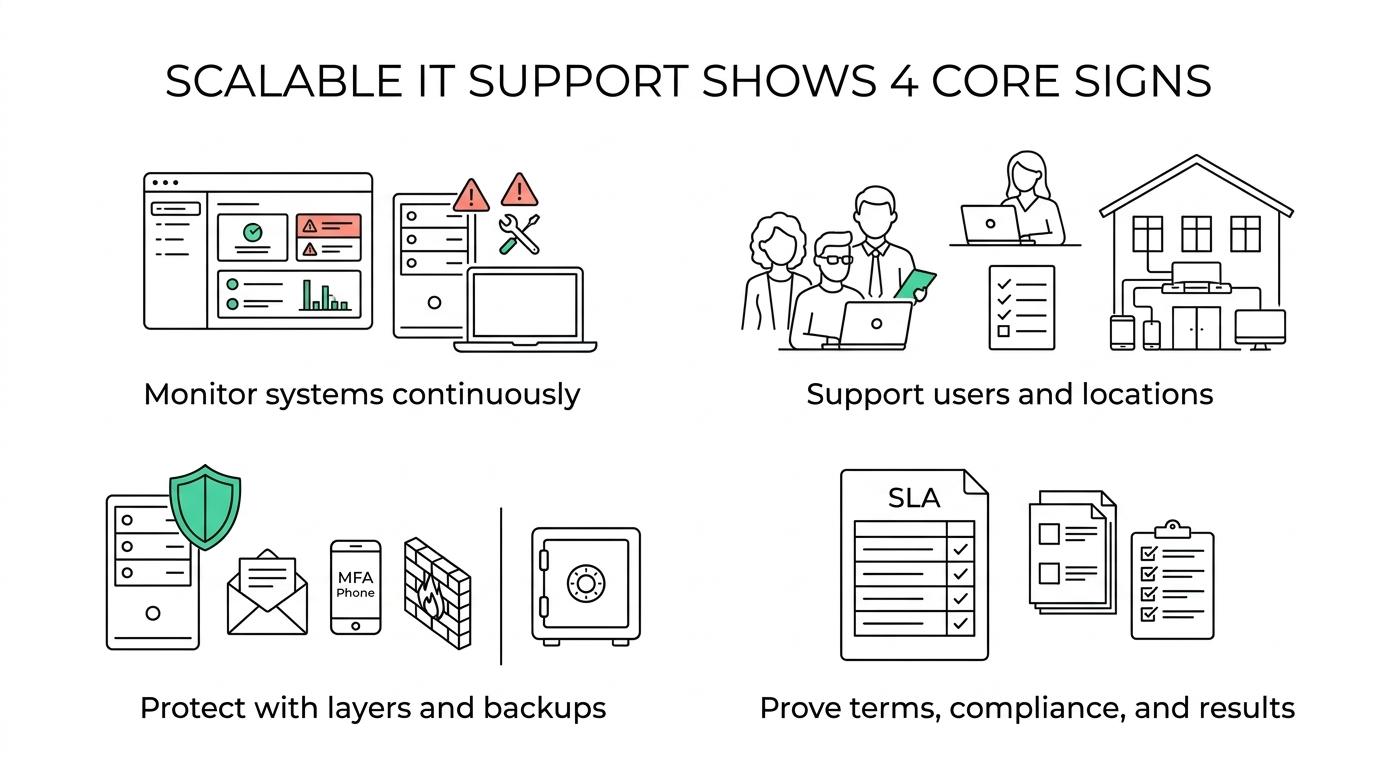
When you assess providers, look for evidence that their delivery model can absorb change without creating hidden risk. That is the practical meaning of scale.
-
They monitor systems continuously: Mature MSPs use monitoring, alerting, patching, and maintenance to prevent outages instead of waiting for users to report them.
-
They can support growth in users and locations: Ask how they handle onboarding, offboarding, remote staff, new offices, and network changes without rebuilding the process each time.
-
They have backup and recovery discipline: CISA guidance stresses automatic, continuous backups of critical data and system configurations, plus storage that is retrievable and air-gapped.
-
They enforce layered security controls: Multi-factor authentication, endpoint detection and response, firewall management, and email protection should be standard, not premium extras.
-
They understand compliance requirements: HIPAA, FTC Safeguards, NIST Cybersecurity Framework, and CMMC all create documentation and control expectations that weak providers struggle to support.
-
They use clear service terms: An SLA should define response, reporting, responsibilities, and termination, not just a promise to be “available.”
-
They can prove results with real clients: Named references, long retention, and specific problem-solving examples are stronger signals than generic testimonials.
How do response times differ from real incident resolution?
Response time measures how fast someone acknowledges a ticket. Incident resolution measures how quickly service is restored, contained, or fully fixed, and those are very different outcomes.
This distinction matters because many MSPs market a 15-minute response but do not define whether that means a technician started work, escalated the issue, or simply sent an email. If your file server is encrypted by ransomware, acknowledgment alone has little value.
IBM reports that breach costs continue to rise, with lost business plus detection and escalation making up much of the damage. That supports a simple rule: faster triage is good, but faster containment and recovery are what protect operations.
Pro tip: ask for three separate metrics. You want initial response time, time to contain high-severity incidents, and time to restore critical services. If a provider only shares one number, you are seeing a partial picture.
What backup and disaster recovery capabilities should a provider prove?
A scalable MSP should prove that backups are automatic, recoverable, isolated, and tested. CISA is clear that SMBs should require continuous backup of critical data and system configurations, with retrievable copies kept air-gapped from the organizational network.
Start with Step 1: define what is protected. Ask whether the provider backs up Microsoft 365 data, servers, workstations, firewalls, network configurations, and SaaS settings. Many businesses assume cloud platforms are fully recoverable by default, which is a costly misunderstanding.
Move to Step 2: verify how backups run. You want automated schedules, retention policies, encryption, and documented separation between production systems and backup repositories. If ransomware can reach your backups, recovery planning is weaker than it looks.
Then handle Step 3: test restore reality. Ask how often the provider performs recovery tests, what the recovery time objective is for critical systems, and who leads restoration during an outage. Backup without restore testing is storage, not resilience.
How can you test cybersecurity maturity before you sign?
You can test cybersecurity maturity by asking the provider to explain identity controls, monitoring practices, and data handling in operational detail. CISA, NIST, and ND-ISAC all point to concrete controls, not general security language.
Use Step 1: check identity and access. Ask whether multi-factor authentication is required where possible, how privileged accounts are managed, and how connections between your systems, the provider’s systems, and other client environments are reviewed. CISA specifically calls out MFA and connection review as due diligence items.
Then use Step 2: check detection and response. Ask what tools support endpoint detection and response, how alerts are triaged, whether vulnerability scanning is included, and what happens when suspicious activity appears after hours. Antivirus alone is not a modern security strategy.
Finish with Step 3: check data governance. ND-ISAC advises SMBs to focus on where data is, who has access, and how it is managed, tracked, and protected. If a provider cannot answer those basics clearly, that is not a minor gap. It is a selection signal.
Is a local IT support company better than a national MSP?
A local MSP is better when you need onsite support, cabling, network room work, or fast hands for office moves. A national provider can be better when your main requirement is standardized coverage across many states, but geography alone should not decide the issue.
The strongest local firms often combine remote management platforms with onsite infrastructure capability. That matters if your environment includes switches, access points, firewalls, structured cabling, or multi-location connectivity. “Near me” becomes valuable when someone actually needs to touch equipment.
The trade-off is coverage depth. Some smaller local providers may rely on a few key engineers, while larger national firms may have more rigid tiers and slower escalation for unusual issues. If your business is hybrid, regulated, or multi-site, ask a direct if-then question: If our main office is down at 2 a.m., then who responds, how, and under what SLA?
What proof should you ask for from current or past clients?
The best proof is specific, verifiable, and tied to business outcomes. SRS Networks is a useful example here because its client material includes named organizations and testimonials with time-based detail, which is more credible than anonymous praise.
Ask for named references in businesses like yours, examples of retention length, and evidence that the provider solved a difficult operational or security issue. Review volume can help, but depth matters more. A single detailed reference about recovery, responsiveness, or compliance support can tell you more than ten short star ratings.
The SRS Networks client page names organizations including Coast Counties Trucks, CommWorks Telcom, Granberg Law Office, ExpoIT LLC, and Tommy D’s Glass. It also includes a testimonial describing a relationship of over ten years after unresolved MIS issues were fixed, plus a case where a client reduced in-house IT support costs while growing over more than 6 years.
“SRS Networks publishes named clients including Coast Counties Trucks, Granberg Law Office, and Tommy D’s Glass, giving buyers references they can verify.”
Common mistake: accepting generic statements like “we have happy clients in healthcare and legal.” Ask for the format of proof that lets you check fit yourself, whether that is named accounts, sector-specific references, or sample monthly reports with sensitive details removed.
How do you check whether the provider can support compliance and audits?
You check compliance support by mapping your required controls to the provider’s actual services, documentation, and review process. HIPAA, FTC Safeguards, NIST, and CMMC all require different levels of evidence, so “we help with compliance” is not enough.
Start with the framework or regulation that applies to you. A healthcare practice will care about HIPAA safeguards and access control. A financial or dealership environment may care about FTC Safeguards. A defense supplier may need CMMC-related practices. The provider should explain where its managed services support those obligations and where your internal policies still carry responsibility.
Then ask how audit readiness is maintained. Strong providers can show policy support, user access review processes, vulnerability management routines, log retention approaches, security awareness training, and incident-response roles. If those items are handled informally, compliance work becomes expensive every time an assessment appears.
Pro tip: ask for a sample compliance review agenda. If the provider cannot show a structured recurring conversation around risk, controls, remediation, and evidence, the compliance story may exist only in sales language.
How should you make the final decision between nearby IT support companies?
Make the decision with a scorecard, a scenario test, and a contract review. That approach turns a local search into a disciplined procurement process.
Use Step 1: narrow your shortlist to three providers. Screen for managed service fit, cybersecurity scope, and industry experience. If one candidate cannot answer basic questions on backups, MFA, or data access, remove them early.
Use Step 2: score each provider against the same criteria. This keeps a polished presentation from outweighing operational facts.
- Security controls: MFA, endpoint protection, monitoring, vulnerability management, and backup isolation
- Service delivery: SLA clarity, escalation path, reporting, after-hours support, and onsite capability
- Growth fit: Microsoft 365 administration, multi-site support, cloud planning, and strategic IT guidance
- Proof: Named references, retention evidence, review quality, and documented problem-solving examples
Use Step 3: run a real-world scenario. Ask each provider how they would handle a ransomware alert, failed Microsoft 365 login surge, internet outage at a branch, or urgent onboarding of ten new users. The best answers are specific, sequenced, and tied back to tools, people, and contract terms.
If two providers look evenly matched, choose the one with clearer reporting, better incident ownership, and stronger backup testing discipline. In most SMB environments, those factors scale better than a lower sticker price.