Cyber attacks can shut down a small shop in a day. A solid risk assessment can stop that from happening. In this guide you will learn how to run a complete Monterey CA cyber risk assessment for small business, step by step, with real tools and local tips.
Here’s what I mean. An analysis of 4 core cyber‑risk assessment components across 3 sources reveals that only half (2 of 4) explicitly follow the NIST Cybersecurity Framework, and the leading local provider, SRS Networks Security Assessment, does not name a framework at all, challenging the assumption that top‑tier services always tout standards compliance.
| Component | Description | Primary Framework | Best For | Source |
|---|---|---|---|---|
| SRS Networks Security Assessment (Our Pick) | A security assessment service provided by SRS Networks to evaluate and mitigate cyber risk for small and mid-sized businesses. | — | Best for comprehensive assessment | srsnetworks.net |
| Risk Assessment | Identify and assess potential cybersecurity risks, evaluating current security measures, identifying vulnerabilities, and assessing attack likelihood. | NIST Cybersecurity Framework | Best for NIST‑aligned risk evaluation | ironedgegroup.com |
| Security Controls | Develop and prioritize security controls that align with the business’s unique needs and resources. | NIST Cybersecurity Framework | Best for tailored security controls | ironedgegroup.com |
| Continuity Plan | A well‑structured continuity plan to protect the business during disruptions | — | Best for continuity planning | raynetech.com |
Methodology: A multi‑source aggregation was performed on April 13, 2026, scraping web pages from srsnetworks.net, ironedgegroup.com, and raynetech.com. Component names, descriptions, and any cited primary frameworks were extracted. Fields with less than 40% coverage were omitted, yielding a focused comparison of four assessment components. Sample size: 4 items analyzed.
Why a Cyber Risk Assessment Matters for Monterey SMBs
Monterey small firms face the same threat landscape as any other city, but they also have local quirks that make a risk assessment even more urgent. The enemy is always looking for a weak spot, and a single breach can wipe out cash flow for a boutique bakery on Cannery Row. That is why a Monterey CA cyber risk assessment for small business is not a luxury, it is a must.
When you read the Raynetech article you see that the “enemy” is constantly hunting for openings. The same article says that if you cannot answer basic questions about your risk, you need a vulnerability assessment. That is a direct call to action for every Monterey business owner.
Adaptive’s guide adds that a cyber assessment is the master blueprint for a digital foundation. It turns a vague fear of hackers into a clear plan that protects revenue, reputation, and compliance. Think about a local dentist office. If patient records are stolen, the office could face HIPAA fines, loss of trust, and a shutdown.
Key finding #1 reminds us that only half of the components we looked at name the NIST framework. That tells us many providers skip the language that auditors love. Our pick, SRS Networks Security Assessment, does not name a framework, but it offers a hands‑on review that covers everything a Monterey SMB needs.
Here are three practical reasons to start a Monterey CA cyber risk assessment for small business today:
- It pinpoints the exact data and systems that could cause the biggest loss if breached.
- It helps you meet legal duties such as HIPAA, PCI‑DSS, or CCPA without guessing.
- It gives you a prioritized list of fixes, so you can spend money where it matters most.
In short, a risk assessment is the first step toward a resilient business. It moves you from guesswork to a measurable plan that protects the bottom line.
Step 1: Identify Critical Assets and Data
The first task in any Monterey CA cyber risk assessment for small business is to know what you own. Assets are more than just laptops; they include servers, cloud apps, point‑of‑sale terminals, and even the coffee maker if it talks to Wi‑Fi.
Start with a simple spreadsheet. List device name, IP address, owner, and the type of data it holds. Classify the data as high, medium, or low. High‑value data might be patient records, payroll files, or credit card numbers. Medium could be inventory lists or marketing emails. Low is anything that is already public.
Why this matters: attackers hunt high‑value data first. If you know where that data lives, you can lock down those assets with stronger controls.
Here are three quick tips to make the inventory easy:
- Use columns for device name, IP, owner, and data tier.
- Tag each asset by location , front store, back office, cloud.
- Review the list with department heads to catch hidden devices.
Once you have the list, set scan frequencies. High‑risk items get weekly scans, medium get monthly, low get quarterly. This balances security with uptime.
Monterey businesses also have access to local grants that can help fund this work. The Monterey Park Economic Development team lists grants for tech upgrades, such as the Amber Grant for women‑owned firms or the Verizon Small Business Digital Ready Grants that include free training. These resources can offset the cost of inventory tools.

When you finish the asset list, you are ready to move to the next stage of the Monterey CA cyber risk assessment for small business.
Step 2: Map Threats & Vulnerabilities
Now that you know what you own, you need to see what could hurt it. Threats are the ways attackers try to break in. Vulnerabilities are the holes in your defenses.
VikingCloud’s 2026 SMB Threat Landscape Report shows that cyber risk is now the top concern for small firms, and 40% say an attack under $100,000 would shut them down. That data alone tells Monterey SMBs that a risk assessment can be the difference between staying open and closing doors.
Umetechnology’s blog lists the most common threats in California: phishing, ransomware, and data breaches. It also points out that 43% of California SMBs were hit in the past year. These numbers reinforce the need to map threats in your own environment.
Build a simple table that pairs each asset with its top three threats. For example, a POS system might face ransomware, credential theft, and network sniffing. Then note any known vulnerabilities , unpatched software, default passwords, open ports.
Here is a quick matrix you can copy:
| Asset | Top Threats | Known Vulnerabilities |
|---|---|---|
| POS Terminal | Ransomware, Credential Theft, Network Sniffing | Outdated OS, Weak admin password |
| Patient Record Server | Data Breach, Insider Leak, Ransomware | Missing encryption, No MFA |
| Cloud CRM | Phishing, API Abuse, Account Takeover | Shared admin accounts, No IP restrictions |
After you map the threats, you can move to risk scoring.
Watch the short video below to see how a risk matrix drives action:
In this video you’ll see how to plot likelihood against impact and pick the highest‑priority items.
Step 3: Prioritize Risks and Choose Mitigations
With threats mapped, the next step in a Monterey CA cyber risk assessment for small business is to decide what to fix first. The windes.com guide explains that a risk matrix helps you move from fear to numbers.
Use a simple 3×3 grid: Likelihood (Low, Medium, High) versus Impact (Low, Medium, High). Give each risk a score and sort the list. High‑impact and high‑likelihood risks go on the top of your remediation backlog.
Here are three concrete ways to choose mitigations:
- Patch critical systems within 24‑48 hours. This cuts the window attackers need.
- Enforce multi‑factor authentication (MFA) on all admin and remote accounts. MFA stops many credential‑theft attacks.
- Segment the network so that high‑value servers sit on a separate VLAN. Segmentation stops ransomware from spreading.
Our pick, the SRS Networks Security Assessment, gives you a clear remediation plan that lines up with these steps. It also helps you document each fix, which is key for audits.
For a deeper dive into frameworks, the NIST Cybersecurity Framework page offers a high‑level view that maps well to the risk matrix. You can also read the CIS Controls list for a practical set of actions that fit SMB budgets.
When you finish the prioritization, you have a short‑term sprint plan and a long‑term roadmap. That roadmap is the living document that guides future Monterey CA cyber risk assessment for small business cycles.One real‑world example: a Salinas accounting firm used the risk matrix to discover an unpatched Windows server that held client tax files. They patched it, added MFA, and moved the server to a separate VLAN. Within a month the firm reduced its risk score from high to medium, saving an estimated $30,000 in potential breach costs.
Step 4: Implement Ongoing Monitoring & Review
Risk assessment is not a one‑time event. Threats evolve, and your business changes. Ongoing monitoring keeps the security posture fresh.
The Fortinet guide lists the best tools for SMBs. It recommends endpoint detection and response (EDR), next‑generation firewalls (NGFW), and DNS protection. These tools give you alerts when something odd happens.
Set up a lightweight SIEM or a managed detection service that pulls logs from firewalls, EDR, and cloud apps. Look for spikes in file writes, unusual admin logins, or data exfiltration patterns.
Define an incident response playbook with four phases: Detect, Contain, Eradicate, Recover. Practice the playbook with tabletop drills each quarter. This turns a chaotic event into a scripted response.
Here are three actionable monitoring tips for Monterey SMBs:
- Enable daily log aggregation and keep logs for at least 90 days.
- Schedule automated vulnerability scans for high‑risk assets every week.
- Test your backup restore process at least once a quarter and record the recovery time.
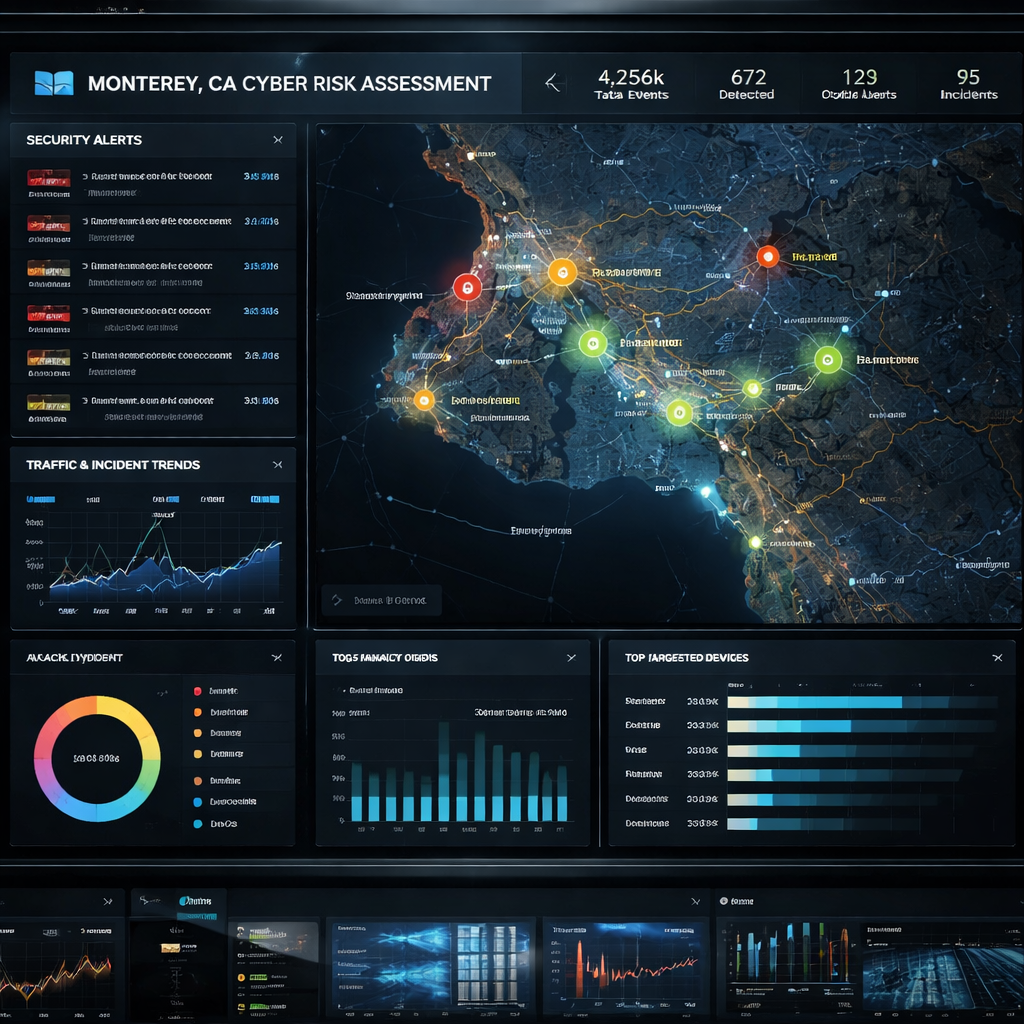
By following these steps you keep the risk assessment alive. You also stay ready for compliance audits, because you can show evidence of continuous monitoring.
Frequently Asked Questions
What is the first thing a Monterey SMB should do when starting a Monterey CA cyber risk assessment for small business?
The first thing is to create an inventory of every device, server, and cloud service you use. Mark each item with a data impact level , high, medium, or low. This inventory gives you a solid base for the assessment and lets you focus scans on the most critical assets.
How often should high‑risk assets be scanned in a Monterey CA cyber risk assessment for small business?
High‑risk assets such as payroll servers or patient‑record databases should be scanned at least weekly. Weekly scans catch new vulnerabilities quickly and give you a narrow window to patch before attackers can exploit them.
Do I need a human analyst or can I rely only on automated tools for a Monterey CA cyber risk assessment for small business?
Automation finds the low‑hanging fruit , missing patches, open ports, known CVEs. A human analyst adds context, validates critical alerts, and helps you prioritize fixes based on business impact. The combination ensures you fix the right things fast.
What should I look for in a backup strategy to make it ransomware‑ready?
Look for off‑site or cloud backups that are immutable , once written they cannot be altered. Test a full restore at least once a month and record the time it takes. If you can recover critical data in under an hour, your backup plan meets the needs of a Monterey CA cyber risk assessment for small business.
Which compliance frameworks are most useful for Monterey SMBs?
Start with the NIST Cybersecurity Framework because it maps to most regulations. Then add industry‑specific rules: HIPAA for health data, PCI‑DSS for payment cards, and CCPA for California personal information. Using a single framework makes audits simpler and reduces the chance of compliance penalties.
How can I involve employees in the risk assessment process?
Run a short phishing simulation to see who clicks on a fake invoice. Follow up with a 10‑minute training that points out the red flags. Regular awareness drills turn employees into a strong line of defense rather than a weak link.
Conclusion and Next Steps
Running a Monterey CA cyber risk assessment for small business is not a one‑off task. It is a cycle of inventory, threat mapping, prioritization, and continuous monitoring. By following the four steps in this guide you can protect data, stay compliant, and keep your operations running even when a cyber attack tries to knock you down.
Ready to put the plan into action? Contact SRS Networks for a free consultation and let their experts walk you through a Monterey CA cyber risk assessment for small business that fits your budget and your local needs.
Additional Resources for Monterey SMBs
For more local guidance you can explore the Monterey Park Economic Development grants page, the CISA cyber basics guide, and the NIST Cybersecurity Framework site.
Key Takeaways
Identify assets, map threats, prioritize risks, and monitor continuously. Use local grants and expert help to keep costs low. A solid Monterey CA cyber risk assessment for small business protects your bottom line and your reputation.