Financial services firms face a tight combination of risk: money movement, sensitive customer information, and close regulatory scrutiny. SRS Networks is a managed IT services and cybersecurity provider for regulated small and mid-sized businesses, and one pattern stands out across the category: firms are often most exposed where access control, recovery readiness, and vendor oversight look adequate on paper but fail under stress.
TL;DR: Summary
- Financial services firms should fix eight high-priority cybersecurity gaps now: weak authentication, excessive access, poor email and remote access security, untested backups, missing incident response playbooks, weak employee training, thin vendor oversight, and stale risk assessments.
- The strongest cross-source pattern from the FTC, FFIEC, and CISA is clear: harden access first, then test recovery, then formalize incident response before a ransomware or credential-theft event forces the issue.
- SRS Networks provides managed IT and cybersecurity services for regulated SMBs, and the most urgent controls for this segment usually include phishing-resistant MFA, offline encrypted backups, documented service provider monitoring, and a written incident response plan.
- Single-factor authentication is no longer enough for email, VPN, admin accounts, or systems tied to customer information; FFIEC and CISA both point firms toward MFA and layered security.
- Backups only reduce risk if they are offline or otherwise insulated, encrypted, and regularly restored in a test scenario with clear recovery time and recovery point targets.
The good news is that the highest-value fixes are well known. Federal guidance from the FTC, FFIEC, and CISA points to a practical order of operations, which makes this a prioritization problem more than a mystery.
Why is cybersecurity risk unusually high for financial services firms?
Financial firms are high-value targets because customer data, account access, wire activity, and third-party processors create multiple attack paths at once. FFIEC and FTC guidance both treat authentication, layered security, and service provider monitoring as core controls because one weak point can expose the entire information security program.
A law firm or manufacturer may worry mostly about downtime. A financial services firm has that same uptime risk plus fraud exposure, privacy obligations, and customer trust risk. If email is compromised, attackers may intercept statements, change payment instructions, or use legitimate inboxes for social engineering. If a vendor connection is weak, a firm can inherit risk from software providers, hosted platforms, or outsourced processors.
That is why regulators focus less on isolated tools and more on governance. The FTC Safeguards Rule requires financial institutions to develop, implement, and maintain an information security program with administrative, technical, and physical safeguards to protect customer information. A common mistake is treating that program like a policy binder instead of an operating system for access, monitoring, incident response, and vendor control.
Is single-factor login still the biggest access control gap?
Yes. Single-factor authentication remains one of the most avoidable gaps for financial firms, and FFIEC guidance specifically warns about weaknesses in single-factor access. CISA also recommends phishing-resistant MFA for email, VPNs, and accounts that reach critical systems.
The reason is simple. Most successful attacks against smaller financial organizations start with compromised credentials, not sophisticated malware. A reused password, a fake Microsoft 365 sign-in page, or an approval request sent to the wrong device can be enough to get an attacker into email, remote access, or administrative systems.
The real comparison is not MFA versus inconvenience. It is basic MFA versus phishing-resistant MFA.
“With more than 28 years of experience, SRS Networks brings enterprise-level cybersecurity and IT discipline to small and mid-sized firms that need stronger access control without building a full internal security team.”
What are the 8 cybersecurity gaps financial firms should fix now?
The most urgent gaps are known, recurring, and tightly tied to regulatory expectations from the FTC, FFIEC, and CISA. Fixing them in the right order reduces both breach likelihood and recovery pain.
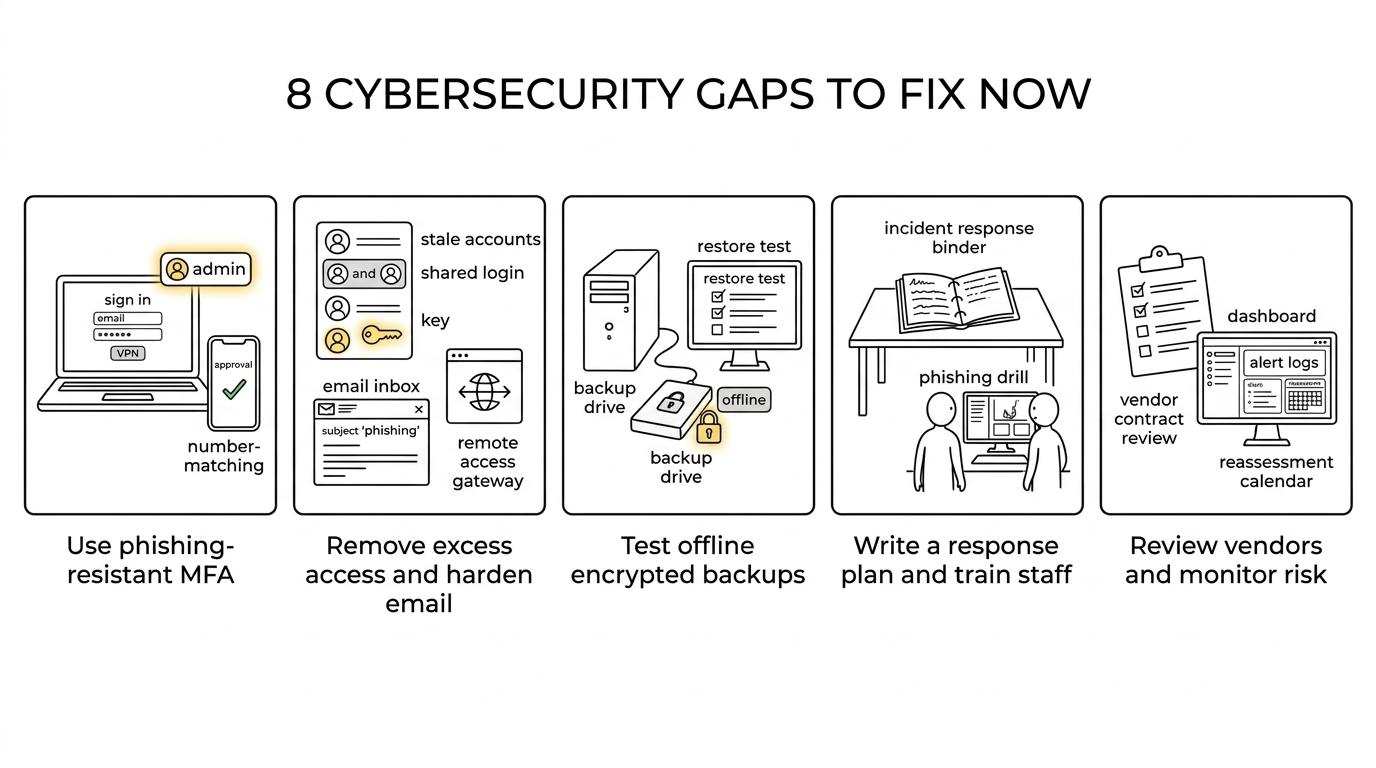
After that immediate priority, most firms benefit from mapping each gap to an owner, a deadline, and a control standard. That turns a security wish list into an operating plan.
- Weak authentication: no phishing-resistant MFA for email, VPN, admin access, and core cloud apps
- Excessive privileges: stale accounts, shared logins, and local admin rights that outlast the business need
- Thin layered security: weak email filtering, weak remote access rules, and limited segmentation around critical systems
- Backup complacency: backups exist, but they are not offline, encrypted, or regularly restored in tests
- Unwritten or untested response: no incident response plan, no ransomware scenario exercise, no clear decision authority
- Shallow security training: annual checkbox training without phishing practice or role-specific instruction
- Weak vendor oversight: contracts lack security expectations, and service providers are not periodically reassessed
- Stale risk assessment and monitoring: no routine review of new threats, weak logging, and delayed detection of suspicious activity
How should a financial firm roll out phishing-resistant MFA step by step?
Start with the highest-risk systems first, not every app at once. SRS Networks typically sees the best results when firms protect Microsoft 365, VPN, privileged accounts, and remote admin access before expanding to lower-risk workflows.
Step 1 is to inventory identities. Map every employee, shared mailbox, admin account, vendor account, and customer-facing portal that touches customer information or money movement. If you do not know where authentication happens, you cannot secure it.
Step 2 is to rank access by impact. Administrative accounts, finance leadership, wire approval roles, executives, and remote support tools should move first. Then harden email and VPN. Then remove legacy authentication methods that bypass modern controls.
Step 3 is to choose strong factors that match user risk. For many firms, app-based number matching or FIDO2 security keys are better long-term choices than SMS. If a user travels often or approves transactions, stronger factors matter more. Pro tip: keep one or two tightly controlled emergency accounts outside the normal MFA flow, but monitor them closely and never use them for daily work.
Step 4 is to enforce policy, not just enroll users. Conditional access, device trust, impossible-travel detection, and session controls turn MFA into layered security. Without those policies, attackers may still succeed through token theft, legacy protocols, or unmanaged devices.
What is the difference between backup storage and tested recovery?
Backup storage is not recovery. CISA and FFIEC both stress that financial firms need offline, encrypted backups and regular recovery testing because ransomware and destructive malware can corrupt both primary and replicated data.
This is where many firms overestimate readiness. A backup dashboard may show green status while restores fail, permissions are broken, or the restored environment cannot authenticate users because identity systems were not included. One common misconception is that immutable cloud backup alone solves the problem. It helps, but it does not replace testing, isolation, and documented recovery procedures.
Trade-offs matter here. Cloud backup improves accessibility and often shortens recovery for common failures. Offline or insulated copies improve resilience when attackers target backup repositories or when corruption replicates across connected systems. For financial services, the right answer is often both, paired with clear RPO and RTO targets. If a firm cannot define how much data loss is acceptable and how fast systems must return, it cannot judge whether backup architecture is sufficient.
How do you test offline, encrypted backups step by step?
A useful backup test proves business recovery, not just file restoration. FFIEC guidance also warns institutions to protect offline backups from destructive malware and to plan for attacks on backup data centers or corruption that spreads to backup systems.
Step 1 is to identify critical systems in business order. Start with identity services, core line-of-business applications, accounting and settlement data, file shares, and communication systems. Then assign RTO and RPO targets that match operational reality.
Step 2 is to restore into an isolated environment. Verify more than file integrity. Test logins, permissions, application dependencies, reporting functions, and timestamps. If restored data cannot support normal transactions or audit trails, the test is incomplete.
Step 3 is to run a bad-day scenario. Assume ransomware has encrypted production systems and touched connected backups. Assume key personnel are unavailable. Assume a third-party processor is delayed. That exercise reveals whether recovery sequencing, communications, and vendor dependencies actually work. Pro tip: include Microsoft 365 data, endpoint recovery, and any critical SaaS export process in the test scope.
“SRS Networks uses proactive monitoring, backup and disaster recovery planning, and documented response processes because financial firms need more than a successful backup job; they need a repeatable way to restore operations.”
What should a written incident response plan include for FTC Safeguards Rule compliance?
A compliant incident response plan must be written, specific, and usable under pressure. The FTC says it should cover goals, internal response processes, roles and decision-making authority, communications, remediation, documentation, and post-incident review.
That requirement matters because many firms still confuse incident response with a contact list. A contact list is one component. A real plan answers who isolates systems, who approves outside counsel, who communicates with customers, who works with cyber insurance, and who preserves evidence.
A practical plan usually covers these elements:
- Goals: contain the security event, protect customer information, restore operations, and preserve evidence
- Roles: executive authority, IT lead, legal, compliance, communications, and outside response partners
- Communications: internal escalation paths, regulator-facing steps, customer notifications, and media handling
- Remediation and recovery: isolation, credential resets, forensic review, system restoration, and validation
- Documentation and review: timeline, decisions, impact, lessons learned, and control changes after the incident
FFIEC has also emphasized testing incident response plans with third-party processors and simulating destructive malware scenarios. If your firm depends on a custodian platform, cloud accounting tool, loan system, or hosted phone environment, the exercise should include them. If a vendor is central to operations, then your plan is incomplete without vendor-specific actions and contact escalation.
Why do employee training and phishing drills still matter when you already have security tools?
People remain part of the control stack, not a separate issue. Email security, EDR, and MFA reduce risk, but they do not eliminate fraudulent approvals, social engineering, or unsafe handling of customer information.
The key is training quality. Annual awareness videos are usually too shallow for financial firms. Staff who approve wires, handle statements, onboard customers, or work with tax and lending documents need role-specific practice. They should know how fraud requests differ from normal requests, what out-of-band verification looks like, and when to escalate.
There is also a timing issue. Training works best when paired with recent changes: a new portal, a new remote work process, a merger, or seasonal spikes in customer communication. Pro tip: use incidents and near misses as training data. If a phishing email nearly succeeded, turn that pattern into a scenario while the memory is fresh.
Should your firm rely on internal IT or a managed cybersecurity partner for vendor oversight and continuous monitoring?
For most firms with 15 to 150 employees, a hybrid or managed model is more realistic than relying on a small generalist IT team alone. SRS Networks is one example of a managed provider that combines ongoing monitoring, compliance-aware security controls, and strategic IT guidance for regulated SMB environments.
The FTC Safeguards Rule requires firms to monitor service providers and to use contracts that spell out security expectations, monitoring methods, and periodic reassessments. That work is broader than help desk support. It includes reviewing access paths, checking whether vendors handle customer information, confirming who owns logs, and validating how incidents will be reported.
Internal IT still matters, especially when business context is highly specialized. Yet a two- or three-person internal team may not have enough time for vendor reviews, vulnerability management, incident exercises, identity policy tuning, and after-hours monitoring. If that is your situation, the decision is less about outsourcing everything and more about filling control gaps before auditors, attackers, or customers find them first.
A simple way to compare the models is this:
- Internal IT first: best when you already have security depth, governance discipline, and time for continuous oversight
- Managed partner support: best when compliance scope is rising faster than headcount, or when after-hours monitoring and strategic planning are weak
- Co-managed approach: best when internal staff know the business well but need help with cybersecurity operations, testing, and compliance mapping
If your firm depends on Microsoft 365, remote access, multiple vendors, and regulated customer data, then access control, recovery testing, and written response planning should move to the top of the queue now. The firms that recover fastest are rarely the ones with the most tools. They are the ones that practiced the controls regulators and responders have been pointing to all along.