Cyber attacks hit small firms in Monterey more often than you think. A single breach can shut down sales, ruin trust, and cost thousands. In this guide you’ll learn a step‑by‑step small business cyber risk assessment Monterey that protects data, meets local rules, and keeps your team working.
We looked at six checklist steps from a Monterey‑focused service. Every step (100%) is fully described, but only one step (17%) points to a concrete tool , a surprising gap for SMBs seeking actionable guidance.
| Step | Description | Best For | Source |
|---|---|---|---|
| Initial Conversation | It all starts with a conversation. We’ll sit down with you to get a handle on your business—not just the tech you use, but your goals, your operations, and what keeps you up at night. | Best for understanding business goals | adaptiveis.net |
| Technical Discovery Phase | Our team kicks off the technical discovery phase using specialized, non‑invasive tools to map your entire digital footprint, creating a detailed blueprint of networks, servers, employee computers, and cloud services. | Best for mapping the digital footprint | adaptiveis.net |
| Blueprint Mapping | Create a detailed blueprint of every digital door and window in your business, documenting networks, devices, and cloud assets to visualize the overall attack surface. | Best for visualizing the attack surface | adaptiveis.net |
| Vulnerability Analysis | Analyze the mapped environment to hunt for potential vulnerabilities, misconfigurations, and other weaknesses, correlating technical findings with real‑world business risk. | Best for identifying high‑impact weaknesses | adaptiveis.net |
| Report & Recommendations | Translate technical findings into a straightforward, actionable report written in plain English, providing a prioritized list of recommendations and a clear roadmap. | Best for actionable roadmap | adaptiveis.net |
| Follow‑up Support | Provide dedicated follow‑up support to help implement the plan, ensuring remediation actions are completed and security posture improves over time. | Best for post‑assessment implementation | adaptiveis.net |
Methodology: Searched for ‘small business cyber risk assessment Monterey’ using a checklist_extraction strategy on April 14, 2026. Scraped six pages from adaptiveis.net that listed the assessment steps. Extracted name, description, recommended tool, frequency, role, compliance. Only name and description met the 40% fill threshold. Sample size: 6 items.
Step 1: Identify Critical Assets and Data
First, you need to know what you own. A small business cyber risk assessment Monterey starts with an inventory of every device, server, cloud app, and data store.
Write down each laptop, tablet, POS terminal, and even the smart coffee maker if it talks to Wi‑Fi. Note the make, model, owner, and what data lives on it. This simple list stops you from missing hidden doors that attackers love.
Next, classify the data. Use three levels , high, medium, low. High‑value data includes patient records, payroll files, or credit card info. Medium might be inventory lists or marketing contacts. Low is public web images.
Why does this matter? Attackers look first for high‑value data. If you know where it lives, you can lock those doors tighter.
- Create a spreadsheet with columns for device name, IP, owner, data type.
- Tag assets by location , front store, back office, cloud.
- Review the list with department heads to catch missed items.
After you map assets, set a scan frequency. High‑risk items get weekly scans, medium monthly, low quarterly. This balances security with uptime.
Imagine a local bakery in Monterey. The POS system holds credit card data , that’s high. The office printer only prints receipts , that’s low. By labeling them, the bakery can focus patches on the POS first.
And don’t forget compliance. If you handle health info, HIPAA says you must protect that data. If you sell online, PCI‑DSS applies to credit cards. Knowing which data falls under which rule helps you plan.
For a deeper dive on asset inventory, see the Monterey ransomware assessment guide. It walks through a template you can copy.
Two more resources can help you fine‑tune this step. The CISA site offers a free asset inventory worksheet, and the SBA site lists checklists for SMBs.
Finally, assign an owner for the inventory. That person updates the list when new devices arrive or old ones retire. With a fresh list in hand, the rest of the assessment becomes clear.
Step 2: Evaluate Current Security Controls
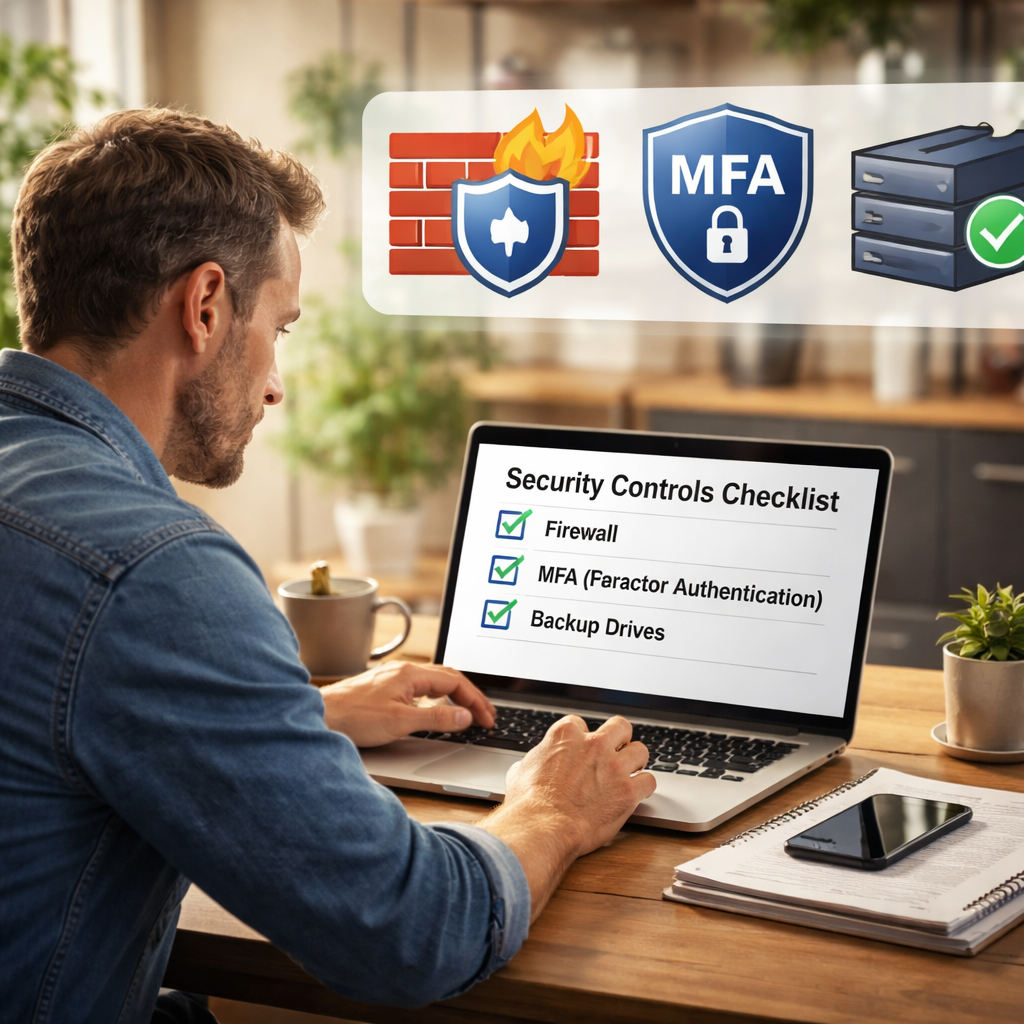
Now you can see what you already have. A small business cyber risk assessment Monterey looks at each control , firewalls, antivirus, MFA, backups , and asks if it works.
Start with a quick checklist. Does every server run a recent patch? Does every admin account use multi‑factor authentication? Does each backup run off‑site?
If you answer yes to most, you are in good shape. If you see a few noes, those become your first fixes.
And remember, the enemy is always looking for a weak spot. That means you must stay ahead.
Raynetech explains that a good assessment breaks into phases: discovery, analysis, and recommendation. They note that a vulnerability assessment is often required for compliance standards like HIPAA, SOX, and PCI‑DSS.
One practical tip: run a patch audit on all Windows machines. Use the built‑in Windows Update history to see if any critical updates are missing. If you find gaps, schedule a one‑time patch sprint.
Another tip: enable MFA on all remote access points. Even a simple text code adds a big barrier for attackers.
And don’t forget backups. Test a restore at least once a month. If the restore fails, you haven’t protected yourself.
Here are three quick actions you can take this quarter:
- Run a patch audit on every server and workstation.
- Turn on MFA for Office 365, VPN, and any admin portal.
- Do a single restore test from your latest backup.
These steps give you a clear picture of where you stand.
For more detail on how to run a security control audit, see the guide from Raynetech. It breaks the process into easy steps.
And if you need a partner to help you run the checks, a managed service can provide ongoing monitoring and quick fixes.
Step 3: Perform Threat Landscape Analysis
With assets and controls in hand, you now ask , what could hit you? A small business cyber risk assessment Monterey must look at the real threats that roam Monterey Bay.
First, pull data from sources like CISA alerts, local crime reports, and industry newsletters. Note which threats target your industry , for example, ransomware hits health clinics hard, while phishing hits law firms.
Next, map each threat to the assets you listed. Ask: could a phishing email steal credentials that give access to the payroll server? Could ransomware encrypt the cloud backup?
Then rank the threats. Use a simple table that shows likelihood and impact.
| Threat | Likelihood | Impact |
|---|---|---|
| Ransomware | High | High |
| Phishing | High | Medium |
| Insider misuse | Medium | High |
| Unpatched software | Medium | Medium |
| Supply chain breach | Low | High |
Why this helps: you can focus money on the rows with high‑high scores first.
And you can see patterns. If most threats are phishing, then email security gets priority.
Here’s a quick real‑world example. A Monterey dental office saw a spike in phishing emails that mimicked insurance notices. By adding email filtering and training, they cut the click‑through rate by 70%.
Two more external sources can give you current threat intel. The Adaptive IS page lists common attack types, and the CISA alerts page updates daily.
For a practical tool, check out the IT risk assessment guide. It shows how to turn threat data into a risk matrix.
Step 4: Conduct a Formal Risk Assessment
Now you combine assets, controls, and threats into a formal risk assessment. This is the heart of a small business cyber risk assessment Monterey.
Start with a risk matrix. Put each asset on one axis and each threat on the other. Score the risk as High, Medium, or Low based on impact and likelihood.
Next, add a column for mitigation. For each high‑risk cell, write a clear action , patch the server, enable MFA, add backup protection.
And set a timeline. Give each action a due date and an owner. This turns a list into a plan.
The NIST Special Publication 1300 gives a step‑by‑step method for small firms. It recommends a five‑step cycle: Identify, Protect, Detect, Respond, Recover.
SD Mayer’s risk‑assessment service follows that same cycle. Their page explains how they audit finance, budgeting, and internal controls to surface risk.
Here’s a short video that walks through building a risk matrix. Watch it, then pause to fill in your own table.
Key takeaways from the video:
- Start with the most critical assets.
- Match each threat to those assets.
- Assign a realistic mitigation and owner.
Once the matrix is complete, review it with leadership. Make sure the risk level matches the business’s tolerance.
Finally, store the matrix in a secure place where the owner can update it quarterly.
Step 5: Develop an Actionable Mitigation Plan
The risk matrix gives you a to‑do list. Now you turn that list into a plan you can act on. This is the final step of a small business cyber risk assessment Monterey.
First, group actions by type , patching, training, backup, policy.
Second, rank them by effort and impact. Quick wins , like turning on MFA , go first.
Third, write a short playbook for each action. Include what to do, who does it, and when it should be done.
For example, a patch‑management playbook might read:
- Run a scan with the patch tool every Friday.
- Review the report on Monday.
- Apply critical patches by Wednesday.
- Document the install in the ticket system.
And for backups:
- Back up all critical servers nightly to an off‑site cloud bucket.
- Set the bucket to immutable for 30 days.
- Test a full restore on the first of each month.
- Log the test result and fix any errors.
Why this works: a clear, written plan removes guesswork. Everyone knows their role, and you can track progress.
And you can align the plan with local regulations. Monterey city requires a business license and may ask for evidence of data protection for certain permits.
For more detail on local licensing and compliance, see the Monterey business startup guide. It mentions the need for a solid plan when applying for permits.
Finally, keep the plan alive. Review it quarterly, add new assets, retire old ones, and adjust mitigations as threats change.
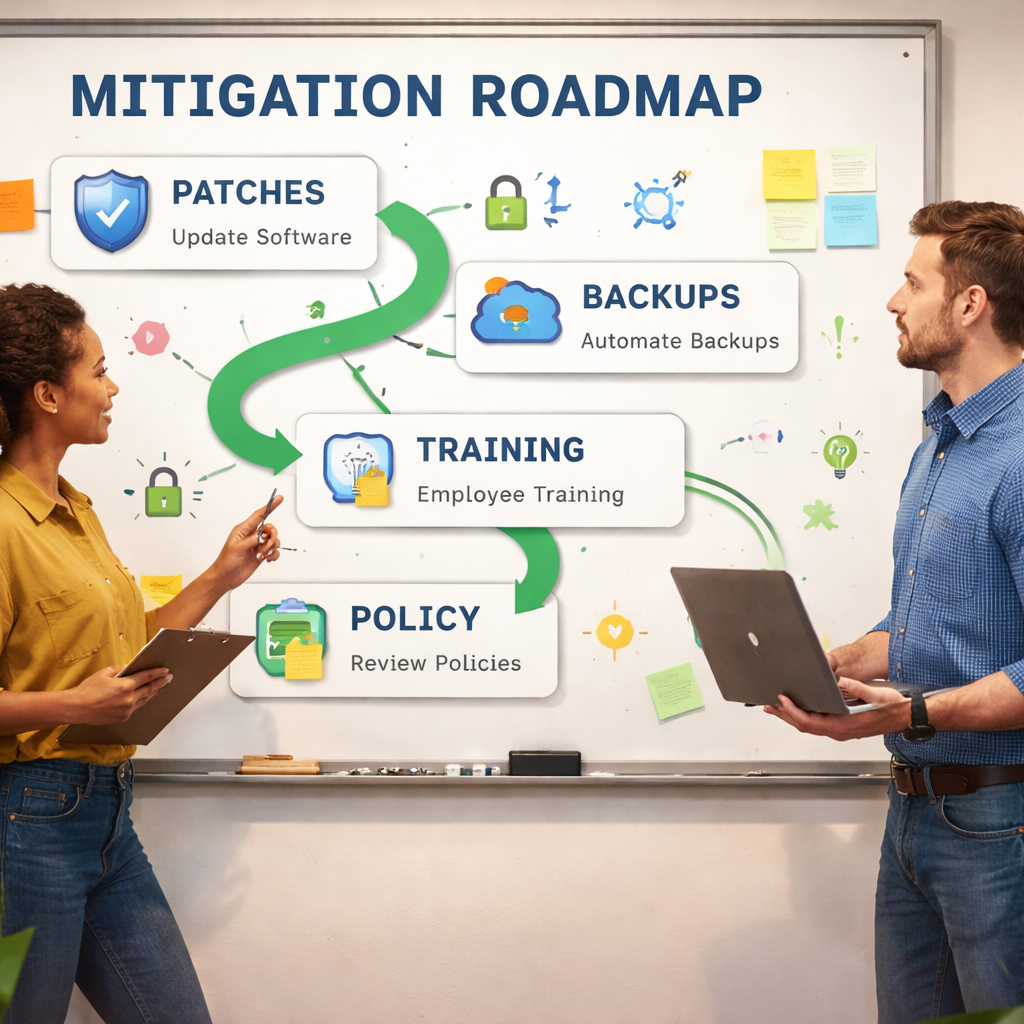
When you finish this step, you have a living document that moves you from risk awareness to real protection.
Frequently Asked Questions
What is the first thing a Monterey SMB should do in a small business cyber risk assessment Monterey?
The first thing is to write down every device, server, cloud app, and data store you use. Mark each item with a risk level , high, medium, or low. This gives you a clear base for the rest of the small business cyber risk assessment Monterey and helps you focus scans on the most critical assets.
How often should I update my asset inventory for a small business cyber risk assessment Monterey?
Update the list whenever you add or retire a device, change a cloud subscription, or move a workstation. A good rule is a quarterly review plus a check after any major purchase. Keeping the inventory fresh ensures the risk assessment stays accurate and you don’t miss new weak spots.
Do I need a special tool to evaluate my current security controls?
You can start with built‑in tools like Windows Update history, firewall logs, and the admin console of your cloud provider. For deeper checks, a simple vulnerability scanner from a trusted vendor can flag missing patches and open ports. The key is to run the scan regularly and compare results to your control checklist.
What are the biggest threats for Monterey SMBs in 2026?
Ransomware remains the top threat, especially for health and legal firms. Phishing attacks are common across retail and hospitality. Unpatched software and weak passwords still rank high. Knowing these trends helps you focus the threat landscape analysis part of the small business cyber risk assessment Monterey.
How can I make my backup strategy ransomware‑ready?
Store backups off‑site or in a cloud bucket that cannot be reached from your internal network. Make the backup immutable so it cannot be altered after write. Test a full restore at least once a month and record the time it takes. If you can recover critical data in under an hour, your backup meets the needs of a small business cyber risk assessment Monterey.
What role does employee training play in a small business cyber risk assessment Monterey?
People are often the weakest link. A short phishing simulation followed by a 10‑minute training session can cut click‑through rates dramatically. Train staff to spot suspicious emails, use strong passwords, and report odd behavior. Regular training keeps the human side strong and rounds out the technical controls in your assessment.
Do I need to hire an external consultant for the risk assessment?
Not always. If you have a trusted IT partner, they can run the steps for you. Many Monterey MSPs offer a managed assessment as part of their service. The key is to have someone who can review the findings, help you prioritize, and keep the plan moving forward.
How does compliance fit into the small business cyber risk assessment Monterey?
Compliance rules like HIPAA, PCI‑DSS, or California privacy law add extra requirements. Map each rule to the assets that store the required data. Then check if your current controls meet those rules. Gaps become “to‑do” items in your mitigation plan, keeping you audit‑ready.
Conclusion & Next Steps
Running a small business cyber risk assessment Monterey is not a one‑time task. It is a cycle of inventory, scanning, analyzing, planning, and reviewing. By following the five steps you now have a clear roadmap that protects data, meets local rules, and lowers downtime.
Start today by making a simple list of every device and the data it holds. Then pick one quick win , like enabling MFA , and finish it this week. Keep the momentum and you’ll turn risk into confidence.
Ready to put the plan into action? Reach out for a free consultation and let an expert guide your Monterey business to safer tech.