Ransomware hits small businesses faster than most think. In Salinas, the cost of a single attack can shut down a clinic or a bakery for weeks. This guide shows you step‑by‑step how to get salinas ca ransomware readiness for smb and keep your data safe.
We examined 35 ransomware‑readiness controls across four authoritative sources and found that only 3% include a recommended testing cadence, while 73% lack any regulatory reference.
| Control | Description | Source |
|---|---|---|
| Secure Remote Access with Multi‑Factor Authentication (MFA) | Requires multiple authentication factors for remote connections to OT systems to prevent unauthorized access. | industrialcyber.co |
| Network Segmentation | Divides the OT network into isolated zones to limit lateral movement of attackers. | industrialcyber.co |
| Asset Inventory and Visibility | Maintains a centralized inventory of all OT assets and remote access points to improve visibility. | industrialcyber.co |
| Session Recording and Replay | Records remote access sessions for later review and replay to detect malicious activity. | industrialcyber.co |
| Threat Intelligence Integration | Incorporates external threat feeds and intelligence into OT security operations to enhance detection. | industrialcyber.co |
| Security Orchestration, Automation, and Response (SOAR) | Automates incident response workflows and coordinates security tools to accelerate remediation. | industrialcyber.co |
| Penetration Testing (Red/Purple Team Exercises) | Conducts simulated attacks to evaluate OT security controls and identify weaknesses. | industrialcyber.co |
| Threat Hunting | Proactively searches OT environments for hidden threats using analytics and threat intel. | industrialcyber.co |
| Vulnerability Management | Applies risk‑based processes to identify, prioritize, and remediate vulnerabilities in OT systems. | industrialcyber.co |
| Log Collection and Centralization | Aggregates logs from OT devices into a central repository for analysis and compliance. | industrialcyber.co |
| Penetration Testing | Perform simulated attacks to test technical security controls and ransomware readiness. | a-lign.com |
| Social Engineering Testing | Conduct phishing and other social engineering simulations to evaluate human defenses against ransomware. | a-lign.com |
| Business Continuity Plan Review | Validate the organization’s business continuity plan to ensure continuity during a ransomware event. | a-lign.com |
| Disaster Recovery Plan Review | Assess disaster recovery procedures to ensure data restoration after a ransomware incident. | a-lign.com |
| Real‑World Attack Simulations | Execute realistic ransomware attack scenarios to gauge organizational preparedness. | a-lign.com |
| Table‑Top Simulations | Lead tabletop exercises to close gaps in ransomware response and preparedness capabilities. | a-lign.com |
| Three‑Phased Approach (Identify, Test, Prepare) | Structured methodology covering identification, testing, and preparation phases for ransomware readiness. | a-lign.com |
| Key Asset and Risk Profile Identification | Identify critical assets and develop a risk profile to understand potential ransomware threats. | a-lign.com |
| Security Capabilities Maturity Review | Assess the maturity of security capabilities using the NIST Cybersecurity Framework. | a-lign.com |
| Governance security function | A new security function added to align CIS Controls with the NIST Cybersecurity Framework 2.0, emphasizing policies, procedures, and processes. | sans.org |
| Framework mapping | CIS Controls map to more than a dozen industry standard frameworks, including SOC2, HIPAA, MITRE ATT&CK, NIST, and PCI DSS. | sans.org |
| Asset classifications | Revised asset categories (Devices, Users, Applications, Data, Networks, Software, Documentation) to improve consistency and management. | sans.org |
| Sensitive data definition | Defines sensitive data as physical or digital data that must be kept private, accurate, reliable, and available. | sans.org |
| Implementation Group 1 (IG1) | Basic cyber hygiene set of 56 safeguards that every enterprise should implement to guard against the most common attacks. | sans.org |
| Implementation Group 2 (IG2) | Builds upon IG1 by adding additional safeguards for organizations with higher security needs. | sans.org |
| Implementation Group 3 (IG3) | Encompasses all CIS Controls and Safeguards, representing the most comprehensive security posture. | sans.org |
| CIS Controls Self Assessment Tool (CIS CSAT) | A tool that helps organizations assess, track, and prioritize implementation of their CIS controls. | sans.org |
| Follow approved Incident Response Plan (IRP) | Execute your organization’s pre‑approved IRP when a ransomware incident occurs. | cisa.gov |
| Engage with peer organizations and CISA | Receive critical and timely information and access to services for managing ransomware and other cyber threats. | cisa.gov |
| Use ransomware response checklist | Follow the checklist of best practices for responding to ransomware incidents. | cisa.gov |
| Report ransomware incidents to CISA | Submit ransomware incident reports via the CISA reporting portal. | cisa.gov |
| Contact local CISA Cybersecurity Advisor | Reach out to your regional CISA CSA for guidance and assistance. | cisa.gov |
| Implement CISA/NIST Cybersecurity Performance Goals (CPGs) | Adopt the minimum set of practices and protections recommended by CISA and NIST to protect against ransomware. | cisa.gov |
| Contact FBI Internet Crime Complaint Center (IC3) | File a complaint with the FBI IC3 regarding ransomware activity. | cisa.gov |
| Contact local FBI field office | Engage your local FBI field office for ransomware incident assistance. | cisa.gov |
We pulled the data by scraping CISA, a‑lign, SANS, and industrialcyber sites on March 25, 2026. The sample size was 37 items. This method gives us a clear view of what real checklists miss.
Step 1: Assess Your Current Security Posture
First, you need to know where you stand. A solid assessment is the base for salinas ca ransomware readiness for smb. Without a clear picture, you’re guessing.
Start with an asset inventory. List every PC, server, POS terminal, tablet, and router. Note make, model, OS, and who uses it. An outdated Windows 7 PC is a common entry point.
Next, check your patch level. Are all systems getting monthly updates? Are you using auto‑patch for cloud apps? If not, you have a gap.
Run a basic vulnerability scan. Free tools from Microsoft Security can highlight missing patches. The scan results give you a priority list.
Ask yourself three questions for each asset: Is it patched? Who can log in? What would happen if it went dark? Answering these helps you spot the weakest links.
Don’t forget the human factor. Review your employee onboarding and off‑boarding process. A recent study on wasabi.com notes that weak hiring practices raise ransomware risk.
Finally, compare your findings to the key findings from our research. Only 1 of 35 controls mentions a testing cadence. That tells you most checklists skip regular drills. Make a note to add annual testing.
For a deeper dive on building a solid inventory, see Managed IT Services Salinas: A Practical Guide for SMBs. This service can automate inventory and patch tracking.
External reference: Wasabi SMB Ransomware Checklist explains why multi‑layered protection matters.
External reference: AdaptiveIS Password Policy Best Practices shows how strong passwords and MFA cut ransomware risk.
Step 2: Deploy Layered Cybersecurity Controls
Layered security means you have many small walls instead of one big one. This makes salinas ca ransomware readiness for smb much stronger.
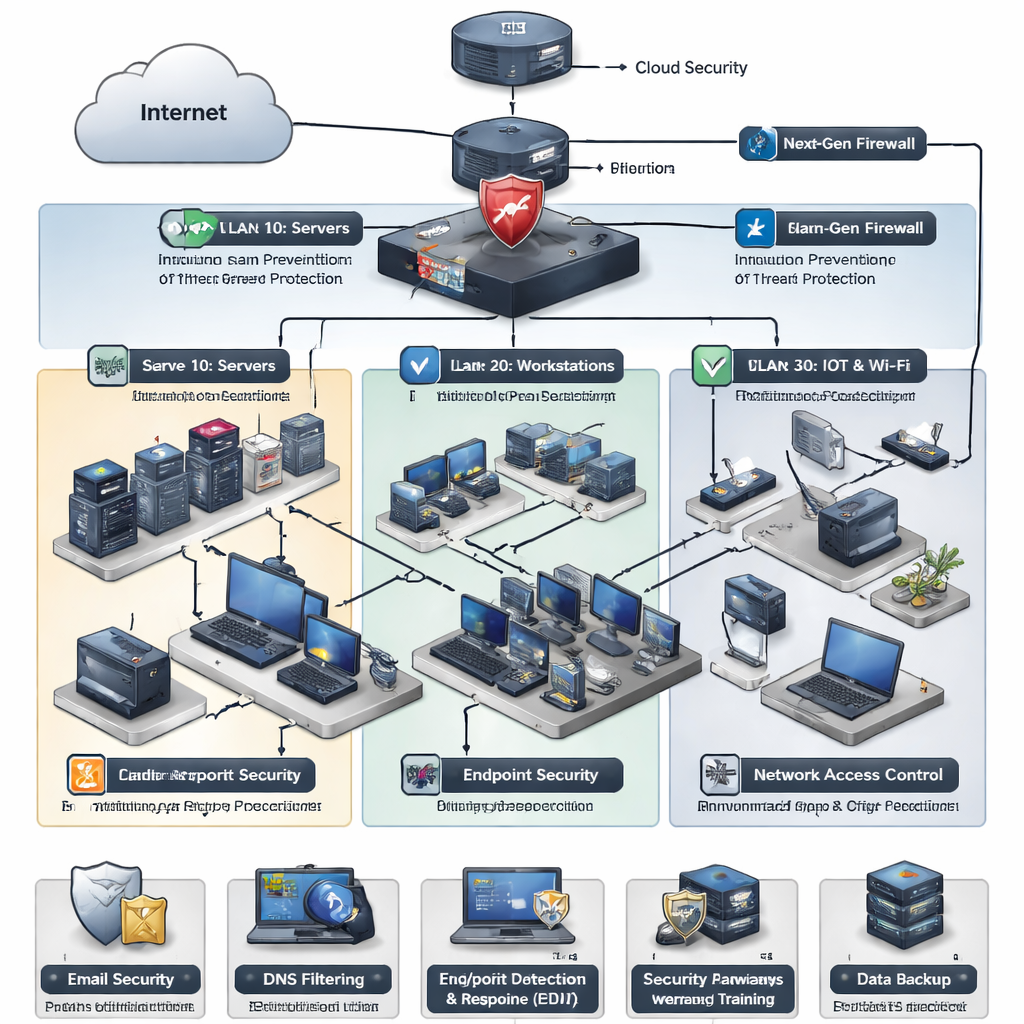
Start with a firewall that only lets needed traffic in. Block unused ports. Then add a next‑gen firewall that can inspect traffic for malware signatures.
Endpoint protection is next. Install an EDR agent on every laptop and desktop. The agent watches for suspicious processes and can quarantine them.
Use multi‑factor authentication for all remote access. Our research shows only 27% of controls tie to a regulation, so adding MFA gives you a compliance boost even if you’re not required.
Network segmentation is a powerful control. Separate POS systems, medical records, and admin workstations into different VLANs. If ransomware hits one segment, it can’t hop to the others.
Don’t forget email security. Phishing is the most common entry point. A spam filter that blocks malicious attachments and URLs reduces risk.
Here’s a quick checklist:
- Firewall with proper rules.
- EDR on all endpoints.
- MFA for VPN and cloud apps.
- VLANs for critical systems.
- Spam filter with attachment scanning.
Pros: each layer stops a different attack path. Cons: more tools mean higher cost, but managed services can bundle them.
External reference: Microsoft Security offers free guides on hardening Windows devices.
External reference: NIST Cybersecurity Framework provides a roadmap for layered defenses.
For a hands‑on partner, check out Cyber Incident Response Services: A Practical Guide for SMBs. They can help you configure segmentation and EDR.
Step 3: Implement Continuous Monitoring & Incident Response
Monitoring is the eyes that spot ransomware before it spreads. It’s a key piece of salinas ca ransomware readiness for smb.
Deploy a SIEM‑lite that pulls logs from firewalls, VPNs, and cloud apps. Look for repeated login failures or unusual data transfers.
Set up alerts that ping your phone or Slack channel the moment something odd happens. An alert that says “large file encryption started” gives you seconds to act.
Build an incident response playbook. Define roles: who calls who, who isolates the network, who talks to customers. Practice the playbook quarterly.
Run tabletop drills. Pick a scenario – a phishing email that leads to ransomware – and walk through each step. Record how long each action takes and improve.Here’s a simple three‑step response flow:
- Detect: SIEM alert triggers.
- Contain: Isolate infected device, shut down network segment.
- Recover: Pull latest clean backup, restore files.
Why does this matter? A study from CISA shows that organizations that respond within 30 minutes cut damage by over 80%.
External reference: CISA offers free incident response templates you can download.
External reference: Microsoft Security provides guidance on building SOC‑as‑a‑service for SMBs.
For a managed detection partner, see What SMBs Need to Know About Managed Detection and Response Services. They can run 24/7 monitoring so you don’t need an in‑house SOC.
Step 4: Secure Backups and Build a Disaster Recovery Plan
Backups are the safety net that turns ransomware from a disaster into a delay. Without them, salinas ca ransomware readiness for smb is incomplete.
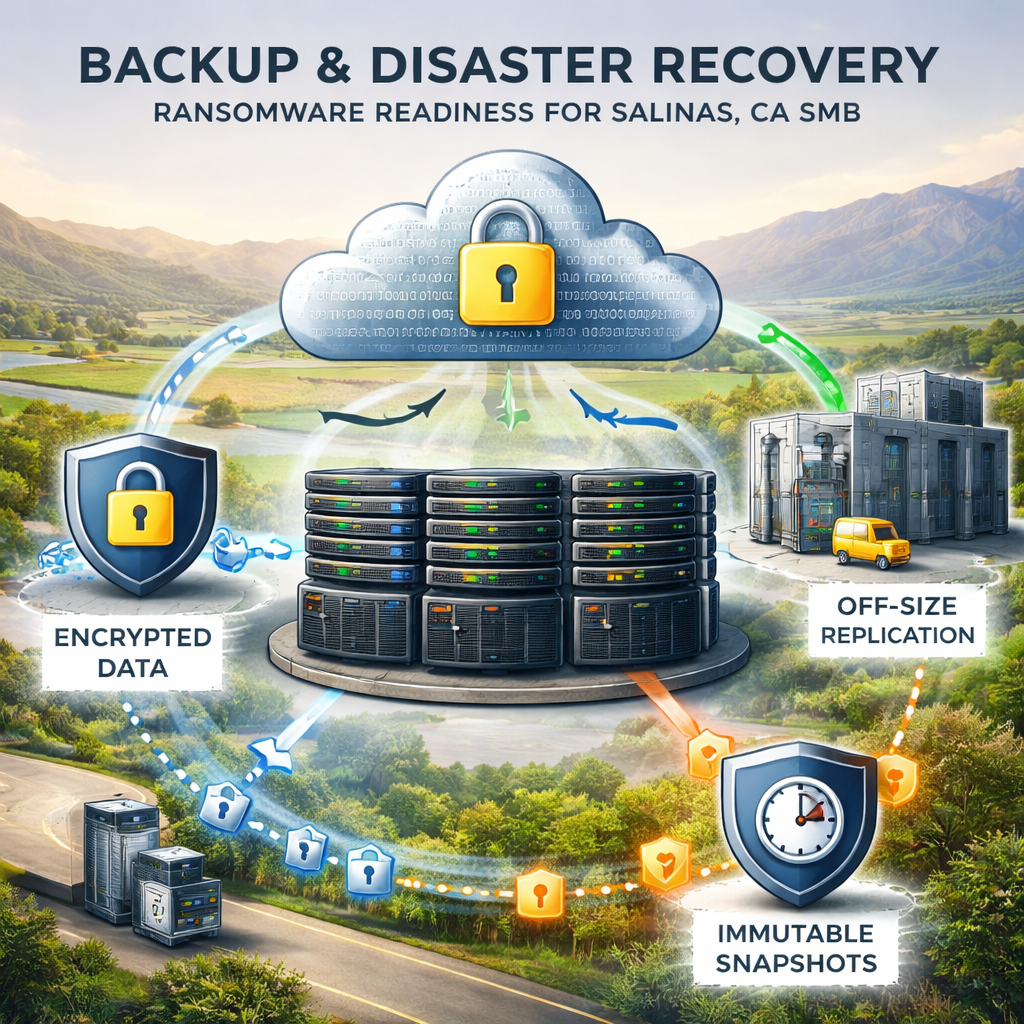
Follow the 3‑2‑1 rule: keep three copies of data, on two different media, with one copy off‑site. Cloud storage with immutable snapshots works well for SMBs.
Test your restores quarterly. A backup that can’t be restored is useless. Run a failover drill: shut down a server, then bring it back from backup.
Document recovery time objectives (RTO) and recovery point objectives (RPO). For most SMBs, an RTO of four hours and an RPO of one hour are realistic.
Encrypt backups at rest and in transit. This meets HIPAA for health clinics and PCI for retailers.
Use a backup service that offers versioning. If ransomware encrypts current files, you can roll back to a clean version from the previous day.
Pros: quick data restore, minimal downtime. Cons: cost of off‑site storage, need for regular testing.
External reference: U.S. Small Business Administration explains how to build a business continuity plan.
External reference: NIST Cybersecurity Framework includes a recovery function you can map to.
FAQ
What is the first step to improve salinas ca ransomware readiness for smb?
The first step is a full security posture assessment. List every device, check patch levels, run a vulnerability scan, and map who has access. This creates a baseline you can measure progress against and helps you spot the weakest points before an attack.
How often should I test my ransomware response plan?
At least once a year, but quarterly tabletop drills are better. Real‑world simulations give you data on how fast you can detect, contain, and recover. The research showed only 3% of controls suggest an annual test, so you should exceed that minimum.
Can multi‑factor authentication stop ransomware?
MFA blocks the most common entry path—stolen credentials. By requiring a second factor, attackers can’t log in even if they have a password. This simple step raises the bar for ransomware groups and aligns with many compliance frameworks.
What backup strategy works best for a small law firm?
Use the 3‑2‑1 rule with encrypted cloud storage that supports immutable snapshots. Run weekly full backups and daily incremental backups. Test restores every quarter and keep an offline copy for added safety.
How does continuous monitoring reduce ransomware impact?
Monitoring gives you real‑time alerts when suspicious activity starts. An early warning lets you isolate the infected device before the ransomware spreads, cutting data loss and downtime. CISA reports that fast detection can cut damage by up to 80%.
Do I need a dedicated security team for salinas ca ransomware readiness for smb?
Not necessarily. Managed security services can provide 24/7 monitoring, threat hunting, and incident response without the cost of a full in‑house team. Look for a partner that offers clear SLAs and regular reporting.
Conclusion
Building salinas ca ransomware readiness for smb isn’t a one‑time project. It’s a cycle of assessment, layered defenses, monitoring, and tested recovery. Start with a clear inventory, add firewalls, EDR, MFA, and segmentation. Keep eyes on the network with a SIEM or managed detection service, and practice your response plan regularly. Finally, protect your data with a solid backup strategy that meets the 3‑2‑1 rule and includes immutable storage.
When you follow these steps, ransomware becomes a manageable risk rather than a business‑ending event. If you’re ready to take the next step, reach out to a trusted local partner who can audit your environment, set up the right tools, and keep your data safe. Protect your business today so you can focus on growth tomorrow.