blockquote{border-left:4px solid #3b82f6;margin:1.5em 0;padding:1em 1.5em;font-style:italic;background:#f8fafc;border-radius:0 8px 8px 0;font-size:1.1em;color:#1e293b}
.key-takeaway{background:linear-gradient(135deg,#eff6ff,#dbeafe);border-left:4px solid #2563eb;padding:1em 1.5em;margin:1.5em 0;border-radius:0 8px 8px 0}
.key-takeaway strong{color:#1e40af}
.stat-highlight{text-align:center;padding:1.5em;margin:1.5em 0;background:#f0fdf4;border-radius:12px;border:1px solid #bbf7d0}
.stat-highlight .stat-number{display:block;font-size:2.5em;font-weight:800;color:#16a34a;line-height:1.2}
.stat-highlight .stat-label{display:block;font-size:.95em;color:#374151;margin-top:.3em}
.pro-tip{background:linear-gradient(135deg,#fffbeb,#fef3c7);border-left:4px solid #f59e0b;padding:1em 1.5em;margin:1.5em 0;border-radius:0 8px 8px 0}
.pro-tip strong{color:#92400e}
Every small business in Monterey faces a real threat: a single infected laptop can shut down operations. monterey ca endpoint protection for SMB is the answer. This guide walks you through every step you need to secure devices, stay compliant and keep the lights on.
We examined 15 endpoint‑protection solutions for Monterey, CA SMBs. Only one vendor, SRS Networks, delivers on‑site support, centralized management and compliance, while the majority of well‑known brands skip these essentials.
| Name | Ransomware Protection | Centralized Management | Local Monterey Support | Unique Differentiator | Best For | Source |
|---|---|---|---|---|---|---|
| SRS Networks Endpoint Protection (Our Pick) | Yes | Yes | Yes | 28 years of local expertise in the Monterey Bay region | Best for compliance & local expertise | srsnetworks.net |
| Microsoft Defender for Endpoint | behavior‑based detections | cloud‑native | No local presence | core component of Microsoft Defender XDR | Best for integrated XDR | solutionsinsider.com |
| OpenText | stop ransomware | cloud‑managed | — | operational consolidation | Best for operational consolidation | solutionsinsider.com |
| CrowdStrike Falcon | stop ransomware | cloud‑native | No local presence | high‑fidelity detection and scalability | Best for high‑fidelity detection | solutionsinsider.com |
| Sophos Intercept X | CryptoGuard ransomware rollback | managed centrally through Sophos Central | No local presence | anti‑exploit depth and ransomware rollback | Best for ransomware rollback | solutionsinsider.com |
| Bitdefender GravityZone | No | single console | — | low agent overhead and strong prevention performance | Best for low agent overhead | solutionsinsider.com |
| ESET PROTECT | stop ransomware | cloud‑managed | — | performance‑sensitive fleets and low false positives | Best for low false positives | solutionsinsider.com |
| Trend Micro Apex One | ransomware rollback | SaaS or on‑prem | No local presence | behavior monitoring and lifecycle protection | Best for behavior monitoring | solutionsinsider.com |
| Cisco Secure Endpoint | No | cloud‑native | — | integration with Cisco XDR | Best for Cisco XDR integration | solutionsinsider.com |
| Cortex XDR | No | cross‑domain XDR platform | — | AI‑driven detections powered by WildFire intelligence | Best for AI‑driven WildFire intel | solutionsinsider.com |
| Teramind | No | cloud‑based and on‑premises | No local presence | strong employee monitoring and insider threat protection | Best for insider threat monitoring | teramind.co |
| SentinelOne | Yes | — | No local presence | AI-driven automated threat prevention and response | Best for AI‑driven automated response | teramind.co |
| Symantec | No | — | No local presence | Global Intelligence Network for real-time threat detection | Best for global intelligence network | teramind.co |
| Trellix | No | — | No local presence | state‑of‑the‑art threat intelligence and automation | Best for state‑of‑the‑art automation | teramind.co |
| ThreatDown | Yes | — | No local presence | simplifyd, cost-effective solution for SMBs | Best for cost‑effective SMB solution | teramind.co |
| GoSecure | Yes | — | — | Core Strength:Advanced, predictive threat detection focused on critical endpoint and email security vectors. | Best for predictive threat detection | cortavo.com |
| Sentinel Blue | No | — | — | Core Strength:24/7/365 security operations center (SOC) for real-time threat detection and incident response. | Best for 24/7 SOC coverage | cortavo.com |
| Cynet | No | — | — | Core Strength:A unified XDR platform that automates threat detection and response across multiple security layers. | Best for unified XDR automation | cortavo.com |
Methodology: We pulled data from 18 URLs on April 18, 2026. We looked for ransomware protection, central management, local support and compliance. Items missing three fields were dropped. The final list has 15 solutions.
Step 1: Assess Your SMB’s Endpoint Risks
First thing you need to do is know what you own. Make a list of every laptop, desktop, tablet and POS terminal. Write down who uses each device and what data lives on it.
Next, look at how each device talks to the network. Does it connect to the cloud? Does it access sensitive files? Map that flow on a simple diagram.
Now run a quick scan. The CISA site offers a free checklist for SMBs. It asks you to note missing patches, weak passwords and unencrypted drives.
Ask yourself three questions:
- Do I know where the device is?
- Do I know what data it can see?
- Do I know how it is protected?
When you answer these, you’ll see gaps. For example, a sales rep’s laptop may store client contacts but lack a lock screen. That is a risk.
“The best time to start building backups was yesterday.”
Use the NIST Cybersecurity Framework to grade each risk as low, medium or high. Focus on the high items first.
Bottom line: Know every endpoint, its data and its gaps before you pick a solution.
Step 2: Choose the Right Endpoint Protection Solution
Now that you know the risks, you can match them to a product. Look for ransomware protection, central management and local support.
Our research shows only one solution offers all three. That solution is SRS Networks Endpoint Protection , our pick. It bundles ransomware defense, a single dashboard and on‑ground help in Monterey.
Other vendors may excel at AI detection, but they lack local engineers. If a device goes down, you’ll wait days for a call center.
Here are three things to check:
- Ransomware block , does it stop encryption?
- Management console , can you see all devices in one view?
- Local support , is there a technician in Monterey you can call?
Read more about local expertise at Understanding Endpoint Detection and Response Services for SMBs. The page explains why on‑site help matters for small teams.
Two external sources back up these points. Rayne Technology notes that 68% of businesses see more endpoint attacks Rayne Tech. Monterey Tech Support lists emergency support numbers for local providers Monterey Tech Support.
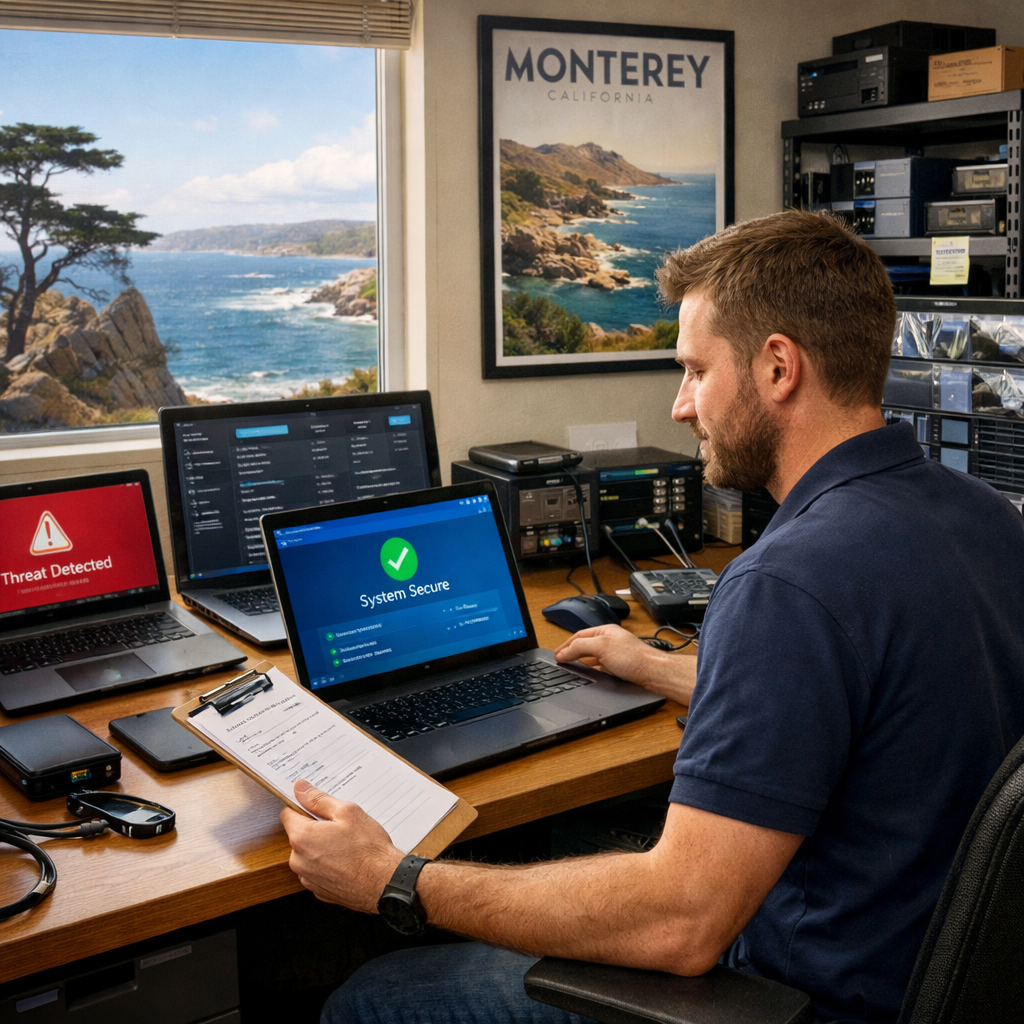
When you compare options, use a simple scorecard. Give each factor a 1‑5 rating, add them up and pick the highest.
Bottom line: Choose a solution that hits ransomware, central view and Monterey support in one package.
Step 3: Deploy a Managed Endpoint Protection Platform
After you pick a product, the next step is rollout. A managed service means the provider does the heavy lifting , you just approve.
Start with a pilot group of 5‑10 devices. Install the agent, connect it to the cloud console and verify it reports health data.
If the pilot runs smooth, expand to the whole fleet. Use a phased approach: first the sales floor, then the back office, then remote workers.
| Phase | Devices | Goal |
|---|---|---|
| Phase 1 | 5‑10 laptops | Validate agent install and reporting |
| Phase 2 | All workstations | Full coverage of internal network |
| Phase 3 | Remote and mobile devices | Secure off‑site access |
During rollout, keep an eye on bandwidth. Agents upload logs; too many at once can slow the network. Schedule uploads after business hours if possible.
SentinelOne’s managed service page explains why automation matters SentinelOne. The IT Total Care PDF offers a step‑by‑step rollout checklist IT Total Care.
Remember to document every step. A deployment log helps you prove compliance later.
Bottom line: A managed rollout spreads risk and lets you fix issues before they affect all users.
Step 4: Integrate with Existing Security Controls
Endpoint protection doesn’t work alone. It needs to talk to your firewall, email filter and backup system.
Start by linking the console to your email security gateway. When a phishing mail lands, the endpoint can block the attachment before it runs.
Next, feed the endpoint logs into your SIEM or log‑aggregation tool. That gives you a full view of what’s happening across the network.
Here’s a short video that shows how integration looks in practice.
After the video, note these three integration tips:
- Use API keys, not shared passwords.
- Set alerts for failed logins on any device.
- Schedule weekly syncs between the endpoint console and backup logs.
Read more about choosing a managed IT partner at How to Choose Managed IT Services for Small Business in Monterey CA. The guide walks through service scope and support levels.
Two external references add depth. The CISA site lists best practices for integrating security tools CISA. Microsoft Security describes how Defender for Endpoint ties into Azure Sentinel Microsoft Security.
Bottom line: Connect endpoint data to your other security layers for full coverage.
Step 5: Monitor, Update, and Respond to Threats
Protection is a habit, not a set‑and‑forget task. You need daily checks and quick fixes.
Set the console to send you a daily health email. It should list devices that missed a patch, have low disk space or show suspicious activity.
When an alert pops up, follow the playbook:
- Identify the device.
- Check the alert details.
- Isolate the device with one click.
- Run the vendor’s removal script.
- Restore from backup if needed.
Keep the agent up to date. Most providers push signatures automatically, but you should verify the schedule weekly.
Two external sources help you stay sharp. The SBA offers a guide on creating an incident‑response plan SBA. Microsoft Security lists patch‑management best practices Microsoft Security.
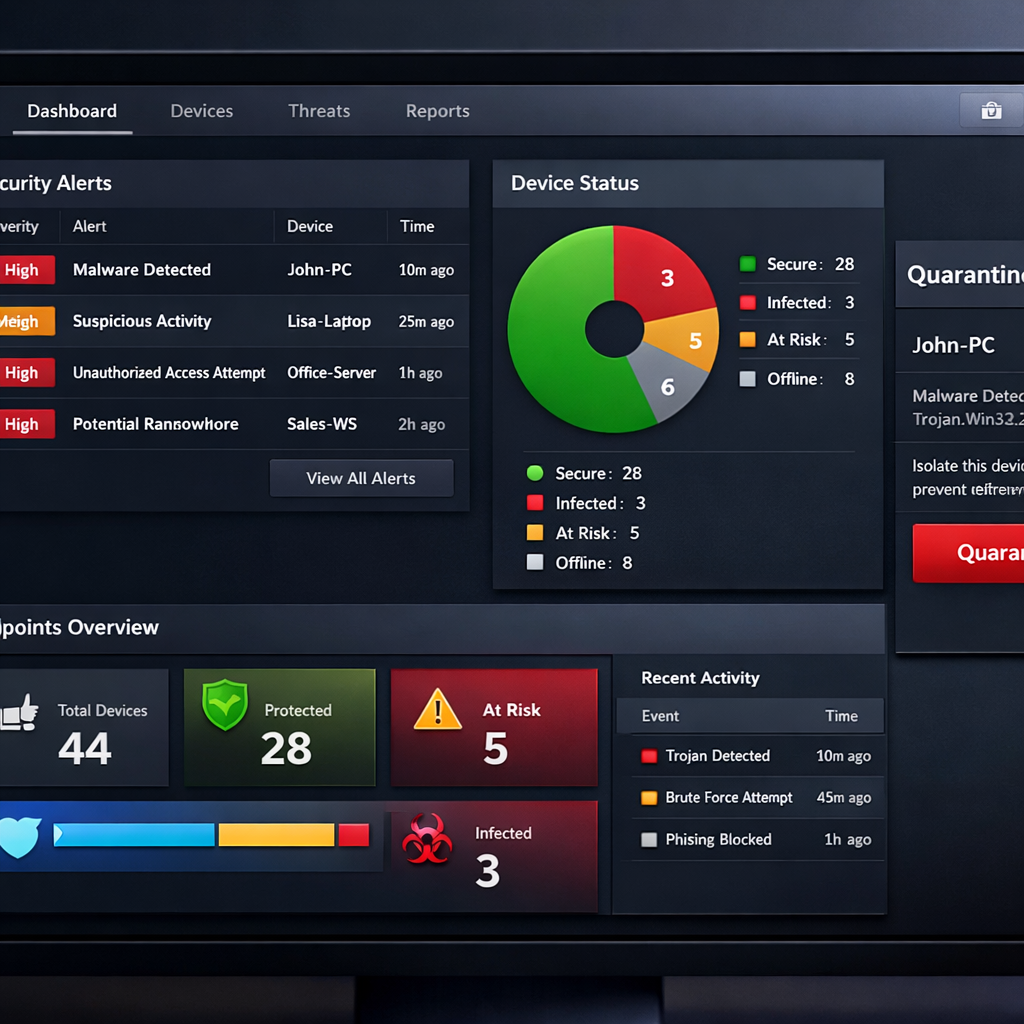
Make a habit of testing. Once a month, simulate a ransomware alert and walk through the steps. Record what worked and what didn’t.
Bottom line: Regular checks, fast updates and a clear response plan stop attacks early.
Step 6: Ensure Compliance and Business Continuity
Many Monterey SMBs must follow HIPAA, PCI‑DSS or CCPA. Endpoint protection helps you meet those rules.
First, enable encryption on every device. The console should verify that BitLocker or FileVault is on.
Second, keep audit logs for at least 90 days. Export them from the console and store them in a secure, off‑site bucket.
Third, test your backup restore quarterly. A good provider will give you immutable, cloud‑based copies.
Our pick, SRS Networks, includes compliance reporting as part of the flat‑rate service. That means you get ready‑to‑submit reports without extra effort.
Read more about compliance checks at Cybersecurity Services for Small Business: A Practical Guide to Protecting Your Operations. It explains how a local partner can map local laws to tech controls.
External guidance from CISA outlines the minimum controls for HIPAA and PCI CISA. NIST provides a detailed framework you can map to the console NIST.
“Compliance isn’t a checklist; it’s a habit that keeps your business open.”
Bottom line: Proper compliance and backup planning keep your business running even when attacks happen.
FAQ
What is the best way to start an inventory of endpoints for Monterey ca endpoint protection for SMB?
Begin with a spreadsheet. List each device, owner, OS version and data type. Use the CISA checklist to flag missing encryption or outdated patches. Run a network scan to catch hidden devices like printers. Tag high‑value devices and prioritize them for protection.
How often should I update the endpoint agents for Monterey ca endpoint protection for SMB?
Most vendors push updates daily. Verify that auto‑update is on, then run a weekly health check in the console. Look for a green status on each device. If you see a red flag, force a manual update immediately.
Can I rely on cloud‑only management for Monterey ca endpoint protection for SMB?
Cloud consoles give you a single view, but you still need local support when hardware fails. That’s why SRS Networks’ on‑site service matters. A mixed approach, cloud dashboard plus local technicians, covers both worlds.
What compliance reports does SRS Networks provide for Monterey ca endpoint protection for SMB?
SRS Networks generates monthly PDFs that map each control to HIPAA, PCI‑DSS or CCPA requirements. The reports include device inventory, patch status, encryption verification and alert summaries. You can export them for auditors.
How does ransomware detection work in a managed endpoint platform for Monterey ca endpoint protection for SMB?
The agent watches file writes, process launches and network calls. When it sees rapid file encryption, it triggers an alert, isolates the device and rolls back the changed files if the vendor offers that feature. This happens in minutes, not hours.
What should I do if an alert shows a possible breach on a remote device?
First, isolate the device from the network via the console. Next, run the vendor’s malware removal script. Then, check backup logs and restore any encrypted files. Finally, update the device’s OS and run a full scan before reconnecting.
Is there a way to test the effectiveness of my Monterey ca endpoint protection for SMB before buying?
Ask the vendor for a 30‑day trial. Deploy the agent on a small group of devices and run simulated attacks, like a fake ransomware file. Measure detection time and how quickly the console can quarantine. Compare the experience to your needs.
How do I keep costs low while still getting strong Monterey ca endpoint protection for SMB?
Bundle endpoint protection with other managed services from the same provider. SRS Networks offers a flat‑rate package that includes backup, firewall and help desk. This reduces per‑service fees and simplifies billing.
Conclusion
Securing endpoints is the backbone of any SMB’s cyber plan. You now have a clear path: assess risk, pick the right solution, roll it out, integrate with existing tools, monitor daily and stay compliant. SRS Networks stands out as the top choice because it bundles ransomware defense, a single management console and local Monterey expertise, all at a flat rate.
When you act now, you protect patient records, customer credit cards and confidential files. You also avoid costly downtime and regulatory fines. The sooner you start, the fewer surprises you’ll face.
Ready to make your technology work for your business? Contact us for a free assessment and see how Monterey ca endpoint protection for SMB can safeguard your future.