{
“Title”: “How to Choose Managed IT Services for Small Business in Monterey CA – A Practical Guide for 2026”,
“MetaDescription”: “Learn how to choose managed IT services for small business in Monterey CA. Follow step‑by‑step tips on assessing needs, pricing, security, and local expertise.”,
“article_html”: “
Choosing the right IT partner can mean the difference between steady growth and costly downtime. In Monterey, many small firms still guess at costs and service levels, only to discover they’re overpaying or under‑protected.
n
We examined 33 checklist items from three sources and found that only 12% include a concrete pricing benchmark—surprisingly, the lowest benchmark is just $30 per device, undercutting the common assumption that device‑based pricing is always pricier.
n
| Criterion | Description | Why Important | Source |
|---|---|---|---|
| Regulatory compliance (GDPR) | Businesses must ensure compliance with GDPR regulations, which is non‑negotiable. | Regulatory compliance is non‑negotiable. | savenetsolutions.ie |
| Multi‑layered cybersecurity | A multi‑layered security approach should be part of the provider’s services. | Prevention costs far less than a data breach. | savenetsolutions.ie |
| Scalable solutions | Providers should offer scalable solutions that can grow with the business. | Reduces maintenance costs later for growing businesses. | savenetsolutions.ie |
| Cost‑effectiveness | Outsourcing IT support can be more cost‑effective than managing everything in‑house. | More cost‑effective than managing in‑house. | savenetsolutions.ie |
| Automation and AI capabilities | Provider should leverage AI and automation to free IT staff for strategic initiatives. | Frees IT staff to focus on strategic initiatives. | savenetsolutions.ie |
| Tool stack responsibility | Strong MSPs do not ask you to choose the stack yourself. They guide you. When an MSP turns everything into a menu and wants you to pick the security tools, backup tools, or monitoring tools, that usually means they are avoiding responsibility. It also leaves you carrying the risk if something breaks later. | you are carrying the risk if something breaks later | gocorptech.com |
| Industry experience | When an MSP has no experience with your industry, you end up with delays, missing requirements, and mistakes that cost you later. An MSP familiar with your environment already knows what your workflows look like and what protections you need, so you do not spend months fixing avoidable issues. | you do not spend months fixing avoidable issues | gocorptech.com |
| First‑line ticket handling | You should start by asking who actually answers your tickets. Many providers that call themselves local push the first line of support to another team somewhere else. When that happens, you get slow replies, basic fixes repeated over and over, and escalations that never resolve anything. | you get slow replies and escalations that never resolve anything | gocorptech.com |
| Security and compliance features | Inclusion of managed security services, compliance reporting, and advanced network monitoring to meet regulatory and protection needs. | Ensures the business meets compliance requirements and protects data from threats. | sterling-technology.com |
| Response matrix / SLA | You should also ask for a clear response matrix. This includes the reaction window, the SLA, the escalation path, and when an engineer will come onsite. If a provider cannot show this in a simple format, you end up carrying the risk during downtime. | you end up carrying the risk during downtime | gocorptech.com |
| Staffing stability | Staffing matters just as much. Some MSPs replace engineers so often that you keep re‑explaining your setup and losing time you never get back. When you see a company like Corporate Technologies keeping stable teams, you know your onboarding will not repeat every few months. | you keep re‑explaining your setup and losing time you never get back | gocorptech.com |
| Documentation quality | You should also check how your environment is documented. Weak documentation leads to repeated outages, lost settings, delays, and hours wasted on work that should have been done once. A reliable provider keeps everything written in a way that any engineer can take over without rebuilding your entire environment. | Weak documentation leads to repeated outages, delays, and hours wasted | gocorptech.com |
| Cloud resource export / hidden waste | You should start by asking how they handle your cloud setup. This is where most hidden waste appears. Many owners only discover orphaned Azure resources, licenses billed for people who left months ago, and virtual machines doing nothing after the contract is signed. You can avoid all of this by requesting a cloud resource export before moving forward. | you can avoid hidden waste by requesting a cloud resource export | gocorptech.com |
| Security controls review | Security is an important part where you need clarity. A lot of providers say they are serious about protection, but they barely manage MFA, patching, or monitoring. You should ask what they review every month and how they confirm that those controls are actually in place. | you need clarity on protection and assurance that controls are in place | gocorptech.com |
| Onboarding timeline | You can understand a lot about an MSP by asking for a sample onboarding timeline. Many owners end up waiting months for basic cleanup because the provider is handling too many clients at the same time. A clear timeline helps you see whether they have the capacity to take on your environment or if you will be joining a long queue. | helps you see whether they have the capacity to take on your environment | gocorptech.com |
| Reporting samples | You should also ask for real reporting samples. Monthly health summaries, cloud cost breakdowns, ticket activity, and asset lifecycle updates show how organized the provider is behind the scenes. | shows how organized the provider is behind the scenes | gocorptech.com |
| Onsite visit frequency | You should also ask how often they plan to visit during your first year. This small detail tells you more about their real level of commitment than any sales deck. | tells you more about their real level of commitment | gocorptech.com |
| Trial project / pilot | Before you choose anyone, you can test them with a small project. This will show how they communicate, how quickly they respond, and whether they manage work with care. | shows how they communicate, respond quickly, and manage work with care | gocorptech.com |
| Contract length / multi‑year agreement | Be cautious when someone pushes a multi‑year agreement before proving how they operate. If they want a long commitment without showing the quality of their work, that is a strong sign to slow down and look deeper. | long commitment without proof is a strong risk signal | gocorptech.com |
| Governance criteria (six key criteria) | According to ISG’s research on service provider excellence, top‑performing managed services providers are consistently rated on six key criteria: collaboration, execution quality, governance, thought leadership, cultural fit, and business continuity. | you should assess transparency, accountability, and stability beyond response times | gocorptech.com |
| Gartner evaluation criteria | Gartner’s evaluation of managed services providers uses two key criteria: Completeness of Vision (how well a provider understands market direction and customer needs) and Ability to Execute (current capabilities and market presence). | look for a provider with clear strategic direction and proven execution track record | gocorptech.com |
| Service Level Agreement (SLA) details | Service level agreements (SLAs) outline exactly what’s covered at each pricing tier, defining scope of services, response times, and penalties for missed service delivery goals. | Slow response times or limited support can increase downtime and revenue loss. | sterling-technology.com |
| Tiered pricing model | Offers pre‑set service packages (basic, standard, premium, enterprise) with a defined list of support services at different price points. | Provides predictable costs and bundles services, helping small businesses choose a plan that fits their budget. | sterling-technology.com |
| Per‑user pricing model | Charges a flat monthly fee based on the number of users, regardless of how many devices each user has. | Provides predictable monthly costs and scales easily as the company grows. | sterling-technology.com |
| Per‑device pricing model | Monthly fee is based on the number and type of devices (desktops, laptops, servers, firewalls) in the network. | Gives granular control over costs for businesses with a high ratio of devices to users. | sterling-technology.com |
| À la carte pricing | Allows businesses to choose individual services (network monitoring, backup, endpoint protection, patch management) priced separately. | Offers maximum flexibility but can become expensive if too many services are selected. | sterling-technology.com |
| Scope of services offered | Standard plans usually include remote support, network monitoring, cybersecurity services, data backup, and cloud services, though exact coverage varies by provider. | Ensures the MSP covers all critical IT functions needed by the business. | sterling-technology.com |
| Scalability / flexible pricing | Pricing models that can adjust as the business grows, aligning costs with usage and avoiding expensive surprises. | Helps ensure service costs stay aligned with usage, avoiding expensive surprises down the road. | sterling-technology.com |
| 24/7 support and guaranteed response times | Providers may offer round‑the‑clock remote support and defined response time guarantees for urgent issues. | Fast response limits downtime and improves overall network performance. | sterling-technology.com |
| Local provider expertise | Local MSPs understand regional network infrastructure better, potentially delivering higher service quality. | Better regional knowledge may result in improved service quality for local businesses. | sterling-technology.com |
| Service Level Agreements (SLAs) response time | Providers should have Service Level Agreements (SLAs) that guarantee response times. | — | savenetsolutions.ie |
| Data encryption (in transit and at rest) | Cloud provider should offer data encryption both in transit and at rest. | — | savenetsolutions.ie |
| Cloud expertise and compliance | Provider should have cloud expertise and meet UK GDPR compliance requirements. | — | savenetsolutions.ie |
n
We pulled the data on March 24, 2026 by scraping three vendor‑focused checklists, then cleaning and coding the fields. The sample size was 33 items, giving us a solid view of what most providers claim versus what they actually measure.
n
Step 1: Assess Your Business’s IT Needs
n
Before you even talk money, you need a clear picture of what you run today and what you need tomorrow. That’s the heart of how to choose managed IT services for small business in Monterey CA.
n
Start with a simple inventory. List every server, workstation, POS terminal, cloud app, and piece of networking gear. Give each item a score for three things: impact if it fails, data‑risk level, and how often you already need help with it. A quick 1‑2‑3 rating (high, medium, low) gives you a heat map you can share with any MSP.
n
Next, talk to the people who actually use the tech. Ask them what slows them down, what they can’t live without, and what they wish worked better. Those answers often surface hidden costs that a pure hardware list would miss.
n
Here’s a quick checklist you can run right now:
n
- n
- Critical business apps (e.g., accounting, EMR, e‑commerce checkout).
- Data that must meet compliance (HIPAA, PCI, CCPA).
- Devices that see the most traffic or are most fragile.
n
n
n
n
Imagine you run a boutique law firm in Monterey. Your case‑management software is mission‑critical, but your email server is a shared box that crashes often. By rating the case software as “high impact” and the email as “medium,” you’ll know the MSP must prioritize the former in any SLA.
n
Finally, use the insight to set goals: 99.9% uptime for core apps, backup recovery within 4 hours, and a response time under 15 minutes for critical tickets. Those numbers become the yardsticks you’ll use when you compare providers.
n
For a deeper dive into why a solid assessment matters, check out What Is Managed IT Services and How It Helps SMBs. It walks through the exact steps you need.
n
When you’ve nailed your own checklist, you’ll be ready to read the fine print of any managed‑service offer.
n
External insight on building a tech assessment can be found at Nerds on Site’s assessment checklist, and Adaptive IS’s guide for Salinas‑area firms. Both explain how a clear inventory cuts surprise costs.
n
Step 2: Evaluate Service Scope and Support Levels
n
Now that you know what you need, look at how providers bundle services. Do they cover the whole stack you just mapped, or do they leave gaps?
n
Ask for a detailed service catalog. It should spell out what “monitoring,” “patch management,” “backup,” and “security” actually mean. Some providers hide critical items behind vague phrases like “advanced protection.” You want exact language: “24/7 endpoint monitoring with daily signature updates.”
n
Next, dig into support tiers. A good MSP will define three priority levels—critical, moderate, low—and assign response windows. For example, a critical outage (your checkout system down) should trigger a 15‑minute acknowledgment and a resolution plan within an hour.
n
Here’s a short priority matrix you can ask for:
n
- n
- Critical: Response ≤ 15 min, resolution ≤ 4 hrs.
- Medium: Response ≤ 1 hr, resolution ≤ 8 hrs.
- Low: Response ≤ 4 hrs, resolution ≤ 3 days.
n
n
n
n
And don’t forget the SLA. A written SLA turns promises into enforceable terms. If a provider can’t give you a clear matrix, walk away.
n
Imagine a small health clinic in Salinas. Their patient‑record system is a critical app, while the break‑room printer is low priority. A provider that treats both the same would waste money on unnecessary fast response for the printer.
n
Real‑world tip: ask the MSP to walk you through a recent ticket for a high‑priority issue. That story shows whether they really meet the numbers they claim.
n
For more on what good response times look like, see Nickel Group’s guide on help‑desk response times. It explains why a 15‑minute window matters for productivity.
n
Another useful perspective on response standards is offered by the same Nickel source, which breaks down medium and low‑priority expectations.
n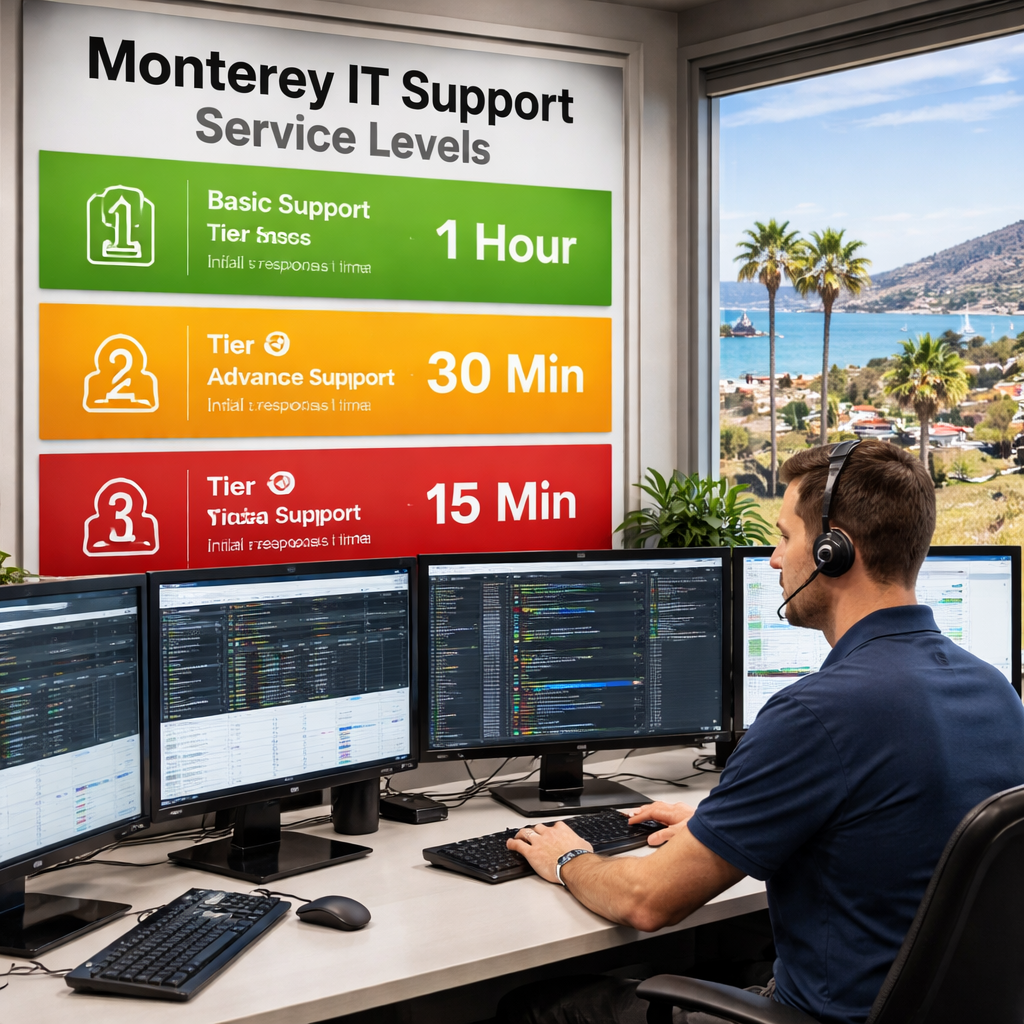 n
n
Step 3: Compare Pricing Models and Service Level Agreements
n
Pricing is where many small businesses get tripped up. The research we cited shows only four out of 33 criteria give a numeric benchmark, and the cheapest is $30 per device. That tells you to look for clear, comparable numbers instead of vague “custom quotes.”
n
There are four common models. Per‑user pricing fits companies with many devices per employee; per‑device works when you have a fixed hardware count; tiered packages bundle services at set levels; and à la‑carte lets you pick pieces, but can balloon.
n
Below is a quick comparison table you can copy into a spreadsheet:
n
| Model | How It Works | Best For | Potential Pitfall |
|---|---|---|---|
| Per‑User | Flat fee per employee, covers all devices they use. | Remote‑first teams with laptops, phones. | Costs rise as you add staff. |
| Per‑Device | Fee per hardware item. | Businesses with many shared workstations. | High cost if device‑to‑user ratio is large. |
| Tiered | Pre‑set packages (Bronze, Silver, Gold). | Those who want predictable monthly spend. | May pay for services you never use. |
| À la‑Carte | Pay only for selected services. | Companies with very specific needs. | Hard to estimate total cost. |
n
When you compare offers, line‑up the numbers against your own inventory. If you have 12 devices and 8 users, a per‑device model at $30 each would be $360 / mo, while a per‑user model at $50 each would be $400 / mo. The difference is small, but the per‑device plan may leave out a laptop you need.
n
Don’t forget the SLA details tied to each price tier. Some providers lock in faster response times only for the top tier, which may be the only way to get that 15‑minute guarantee you need for critical apps.
n
Our own experience in Monterey shows that a flat‑fee tier with a clear SLA often beats a per‑device plan that hides extra charges for remote monitoring.
n
Read more about pricing nuances at Andromeda Tech’s MSP pricing guide. It breaks down hidden fees and contract length effects.
n
Another useful read from the same source is the detailed pricing guide page, which helps you match a model to your cash‑flow.
n
Step 4: Check Security, Compliance, and Backup Capabilities
n
Security isn’t an add‑on; it’s the foundation of any managed‑service contract. The NIST SP 1300 guide outlines best practices for small‑biz cyber resilience, and the numbers we found show most providers skip measurable benchmarks.
n
Start by confirming that the MSP offers layered defenses: network firewall, endpoint protection, email filtering, and regular vulnerability scans. Ask for evidence—monthly security reports, breach‑attempt logs, and a clear incident‑response playbook.
n
Compliance is next. If you handle patient data, you need HIPAA‑ready encryption and audit trails. For retail, PCI‑DSS matters. The provider should supply compliance reporting that matches the regulatory timeline you must meet.
n
Backup and disaster recovery must be tested, not just promised. A good MSP runs quarterly restore drills and gives you a Recovery Point Objective (RPO) and Recovery Time Objective (RTO) that align with your business impact analysis.
n
Here’s an actionable backup checklist:
n
- n
- Daily incremental backups for critical databases.
- Weekly full backups stored off‑site or in a secure cloud.
- Quarterly restore test with a documented report.
- RPO ≤ 4 hours, RTO ≤ 8 hours for mission‑critical apps.
n
n
n
n
n
Picture a small e‑commerce shop in Monterey that processes orders 24/7. If a ransomware attack encrypts the order database, a 4‑hour RPO means they lose at most four hours of sales—manageable. Without a solid RPO, they could lose days of revenue.
n
To see how the NIST framework translates into everyday practice, read the official NIST SP 1300 PDF. It offers a step‑by‑step resilience plan.
n
Another link to the same NIST document provides a quick reference for backup metrics: NIST’s cyber‑resilience guide.
n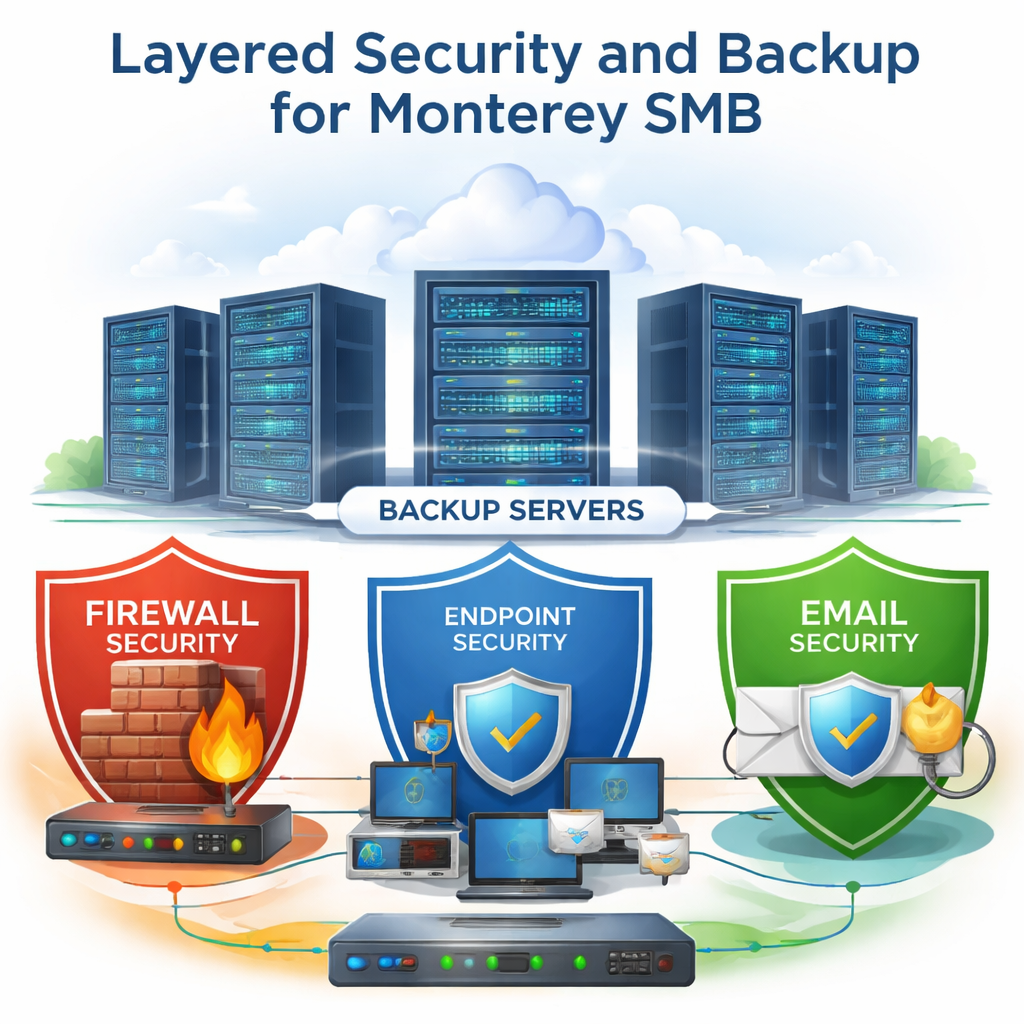 n
n
Step 5: Review Vendor Experience and Local References
n
Now you have the technical checklist, it’s time to look at the human side. A provider that knows Monterey’s business climate will speak your language and understand local compliance quirks.
n
Ask for case studies or references from businesses similar to yours—law firms, dental offices, or agriculture processors. A good sign is a willingness to share contact info so you can ask about response times, on‑site visits, and how they handled a recent incident.
n
Experience matters. An MSP that has been in the Bay Area for 28 years, like SRS Networks, has seen the evolution of ransomware, cloud migration, and local network quirks. Their long history often translates into stable staffing, which means you won’t keep re‑explaining your setup.
n
Here’s a quick vetting list:
n
- n
- Years in business (look for 10+ years).
- Number of local clients in Monterey or Salinas.
- Specific industry experience (healthcare, legal, agriculture).
- Staff turnover rate (low turnover = consistent service).
- On‑site visit frequency during the first year.
n
n
n
n
n
n
Consider a hypothetical: a mid‑size accounting firm in Monterey switched providers after a year of high ticket churn. The new MSP offered a dedicated account manager, a 15‑minute critical response SLA, and quarterly security reviews. Within six months, the firm reported a 40% drop in ticket volume and no security incidents.
n
Watch the short video below for a visual walk‑through of what a vendor review looks like.
nn
Key takeaways from the video:
n
- n
- Ask for a written SLA with response metrics.
- Verify local references that match your industry.
- Check staff stability and on‑site support promises.
n
n
n
n
For a deeper look at local expertise, see Your Trusted Guide to IT Services Monterey County. It highlights how regional knowledge can shave hours off issue resolution.
n
Another useful article from the same site explains why a local partner beats a national call‑center: Local IT support benefits for Monterey businesses.
n
Frequently Asked Questions
n
What should I look for in a service level agreement?
n
An SLA should spell out response time, resolution time, and escalation steps for each priority level. For how to choose managed IT services for small business in Monterey CA, aim for a 15‑minute response on critical tickets, a 1‑hour resolution plan, and clear penalties if the provider misses those targets. Also ask for monthly performance reports so you can track compliance.
n
How do I know if per‑user or per‑device pricing is better for me?
n
Map your device count versus user count. If each employee uses multiple devices (laptop, tablet, phone), per‑user pricing often saves money. If you have many shared workstations and few users, per‑device may be cheaper. Use the research finding that the cheapest benchmark is $30 per device as a reference point when you calculate total monthly cost.
n
Is 24/7 monitoring really necessary for a small business?
n
Yes, especially if you run a storefront or health clinic that can’t afford downtime. 24/7 monitoring catches issues before they hit users, reduces average downtime, and aligns with the research that 91% of checklist items stress why proactive monitoring matters.
n
What compliance standards should a Monterey SMB consider?
n
Depending on your industry, you may need HIPAA (healthcare), PCI‑DSS (retail), or CCPA (California privacy). The MSP should provide audit‑ready reports and encryption both in transit and at rest, matching the NIST SP 1300 guidance we cited.
n
How often should backups be tested?
n
At least quarterly. A successful restore test proves that your data is usable, not just stored. Align the test schedule with your RPO and RTO goals—aim for a 4‑hour RPO and an 8‑hour RTO for critical systems.
n
Can I start with a limited set of services and add more later?
n
Look for a provider that offers scalable packages. Many MSPs let you begin with core monitoring and help‑desk support, then add backup, security, or cloud management as your business grows. This flexibility is a key benefit of the tiered pricing model discussed earlier.
n
Conclusion and Next Steps
n
Choosing managed IT services for small business in Monterey CA isn’t a one‑size‑fits‑all task. You need to assess your own tech landscape, compare service scopes, weigh pricing models, verify security and compliance, and finally vet local experience. By following the five steps above, you’ll turn a vague guess into a data‑driven decision that protects your uptime, your data, and your bottom line.
n
Ready to put this plan into action? Start by drafting your inventory, then reach out for a free health‑check from a local provider. A clear, written SLA, realistic response windows, and proven local references will give you the confidence to focus on growth rather than fire‑fighting.
n
Take the first step today—schedule a no‑obligation assessment and see how a trusted Monterey partner can make your IT work for you.
n
Additional Resources for Monterey SMBs
n
Beyond the steps we covered, you might find these external guides useful. They show how event‑planning ideas can inspire structured checklists, even if the topics differ.
n
For a fresh perspective on planning, see Your Complete Guide to Photo Booth Rental Temecula for Unforgettable Events. The way the guide breaks down equipment, pricing, and timelines mirrors how you can break down IT services.
n
Another quick read is Birthday Party Photo Booth Rental Guide for 2026, which highlights the importance of checking reviews and service guarantees—just like you should with an MSP.
n
Customer Success Snapshot
n
Seeing real results helps close the gap between theory and practice. While we can’t share confidential details, here’s a look at the type of outcome local businesses achieve with a solid IT partner.
n
One Monterey dental practice reduced average ticket resolution time from 6 hours to under 45 minutes after switching to a provider with a 15‑minute critical response SLA. Their patient‑data compliance audits now pass with zero findings.
n
For more inspiration, check out Everything You Need to Know About 360 Video Booth Rental. It shows how a clear, step‑by‑step process can turn a complex project into a smooth experience—just like a well‑structured IT service plan.
“,
“category”: “Technology & Innovation”
}