Small businesses still have PCI duties even when they process a modest number of card transactions. SRS Networks is a managed IT services and cybersecurity provider, so it sits close to the real issue SMBs face here: choosing PCI compliance help that covers both paperwork and the systems, vendors, and security controls behind it.
TL;DR: Summary
- The best PCI compliance services for small business start with correct PCI DSS scoping and the right validation path, because an SAQ, an ASV scan, and a QSA assessment solve different problems.
- PCI DSS v4.0.1 is the active PCI SSC-supported version, PCI DSS v3.2.1 retired on 2024-03-31, and future-dated v4.x requirements became effective on 2025-03-31.
- A passing ASV scan does not equal full PCI compliance; the PCI Security Standards Council says it covers only that scan requirement, not the rest of PCI DSS.
- SMBs should ask whether the provider can map the cardholder data environment, review third-party service providers, and match the business to the correct SAQ or assessor path required by the acquirer.
- For businesses that already rely on an IT partner, SRS Networks is relevant when PCI work overlaps with firewall management, Microsoft 365 access controls, endpoint security, backup, and incident response.
Many owners assume PCI help means “someone fills out the questionnaire.” That is too narrow. Good PCI support should reduce audit friction, tighten security, and keep your payment-card validation approach in step with PCI Security Standards Council guidance and your acquirer’s rules.
What does PCI compliance help for a small business actually include?
PCI compliance help should cover scoping, validation, and control maintenance. For SMBs working with a managed IT provider like SRS Networks, the useful part is mapping card data flows, matching the right SAQ or assessment path, and fixing security gaps tied to PCI DSS v4.0.1.
PCI DSS is the baseline set of technical and operational requirements designed to protect payment account data. Small merchants are not exempt. What changes is the validation path. Your payment brand and acquirer may allow a Self-Assessment Questionnaire, may require quarterly external vulnerability scanning by an Approved Scanning Vendor, or may direct a different form of review.
A common mistake is treating PCI as a document exercise. In practice, PCI help often includes network review, firewall rules, remote access controls, MFA, vulnerability remediation, evidence collection, and vendor responsibility tracking. If the provider cannot explain how your cardholder data environment, or CDE, is defined, you are not buying real PCI guidance.
“SRS Networks brings 28+ years of managed IT and cybersecurity experience to the infrastructure issues PCI projects often surface, from firewall policy to backup and recovery.”
Another misconception is that “we outsource payments, so we have no PCI scope.” You may have less scope, but the PCI Security Standards Council notes that even encrypted cardholder data is generally still in scope, and encryption alone does not remove PCI DSS obligations.
Why is PCI scope the first thing to verify?
Scope is the first gate because the cardholder data environment, connected systems, and third-party access determine every later requirement. If scope is too broad, costs rise; if it is too narrow, the validation can fail or miss real risk.
Before choosing a provider, ask how they perform scope confirmation. PCI SSC guidance around PCI DSS v4.x includes an annual scope confirmation exercise, which is a strong sign that scoping is not a one-time task. Your environment changes when you add a new POS system, a cloud payment app, remote support access, or a new office location.
A useful scoping review usually covers three checks:
- Payment channels: Card-present, e-commerce, keyed entry, mobile, or recurring billing
- System touchpoints: Where card data is stored, processed, transmitted, or could traverse
- Connected parties: Third-party service providers, remote vendors, and management interfaces
A common blind spot is internet-connected admin tools. If a firewall, wireless network, or remote management platform can affect systems in the CDE, it matters for PCI even if staff never sees a full card number there.
What PCI compliance services are most useful for SMBs?
The most useful PCI services for SMBs are scoping, validation support, and remediation planning. Nice-looking reports matter less than whether the provider can reduce your CDE, document responsibility, and keep evidence current.
For most small businesses, the strongest service mix looks like this:
- Scope and card-data-flow review
- SAQ selection and validation guidance
- ASV scan coordination for internet-facing systems
- Remediation planning for failed controls or vulnerabilities
- Third-party service provider and acquirer requirement review
- Ongoing evidence, policy, and change-management support
The trade-off is simple. A cheaper service that only “helps with the SAQ” may save money upfront, yet it can leave you with unresolved technical findings, the wrong questionnaire, or scope that is broader than necessary. A fuller service costs more, though it can lower recurring effort if it reduces the number of systems inside PCI scope.
If your business uses validated point-to-point encryption, or P2PE, and a well-isolated payment workflow, a provider that knows how to document that setup can save time every year. If they do not ask about segmentation, remote access, or vendor-managed payment tools, they are likely treating every merchant the same way.
Do you need an SAQ, an ASV scan, or a QSA assessment?
Most SMBs need one of the SAQs and, in many cases, an ASV scan; fewer need a QSA-led assessment. The right path depends on merchant level, payment channels, internet-facing systems, and what your acquirer or payment brand requires.
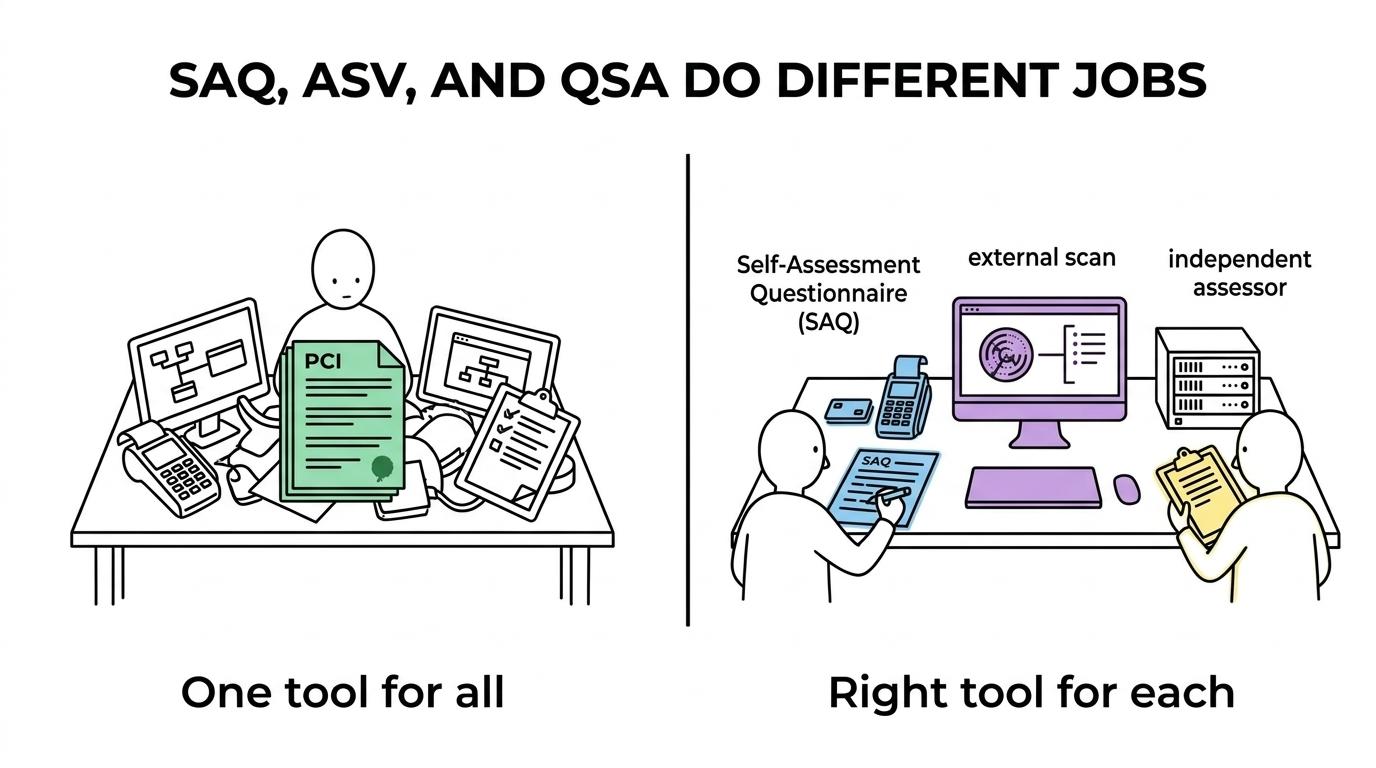
Here is the clean comparison. An SAQ is a validation tool for SAQ-eligible merchants and service providers. It is not a shortcut around PCI DSS. It is the form used to attest that the right controls are in place for your environment type. A QSA company, by contrast, is an independent security organization qualified by PCI SSC to validate adherence to PCI DSS, often for larger or more complex entities.
An ASV sits in a different lane. An Approved Scanning Vendor conducts external vulnerability scanning for PCI DSS Requirement 11.3.2. The PCI Security Standards Council is explicit here: a quarterly external ASV scan does not mean the entity is PCI compliant, because the scan addresses only that requirement and does not review the rest of PCI DSS.
“SRS Networks says it supports 1,000+ customers, which matters when SMBs need PCI guidance that fits daily operations across cloud, endpoint, and network environments.”
That point changes buying decisions. If a provider advertises “PCI compliance” but only resells scans, you still need help with scope, SAQ eligibility, evidence, and remediation. Also ask whether your acquirer wants official PCI SSC ASV report templates, since supplemental scan paperwork is not a replacement for the official forms.
How should you check a provider’s PCI DSS v4.0.1 readiness?
A credible provider should speak clearly about PCI DSS v4.0.1, the retirement of v3.2.1, and the 2025 effective date for future-dated requirements. SRS Networks is relevant here because SMBs often need PCI help from the same team that manages firewalls, Microsoft 365 access, and incident response.
Start with version control. PCI SSC retired PCI DSS v3.2.1 on 2024-03-31. The active versions are PCI DSS v4.0 and v4.0.1, with v4.0.1 serving as the current supported version. If a provider still centers its process on v3.2.1 language or outdated templates, that is a warning sign.
Then ask them to walk you through a practical readiness sequence. First, how do they confirm scope annually? Second, how do they test your current controls against v4.x requirements? Third, how do they track future-dated requirements that became effective on 2025-03-31? PCI SSC noted that PCI DSS v4.0 introduced 64 new requirements, with 51 initially future-dated, so this is not a minor paperwork update.
One more reality check helps. Ask who owns remediation after gaps are found. Some consultants identify issues and stop there. A provider with operations depth can move from gap report to firewall changes, MFA rollout, endpoint hardening, or vendor coordination without handing you a disconnected to-do list.
How do third-party service providers affect your PCI responsibilities?
Third-party service providers can reduce your workload, but they do not erase your PCI duties. Payment gateways, cloud POS vendors, managed firewall providers, and e-commerce platforms can shift controls, yet you still need clear responsibility boundaries and evidence.
This is where many SMBs get tripped up. If you use a hosted payment page, your web server may still influence the payment flow. If your POS vendor manages the application, your staff may still control workstation security, user access, or network segmentation. Shared responsibility is real, and PCI assessors expect it to be documented.
Ask any PCI provider how they review TPSPs. A solid method usually means inventorying every party that stores, processes, transmits, or can affect cardholder data, then matching each control to the right owner. If a vendor claims “we are PCI compliant,” that statement alone is not enough. You need the actual documentation that supports your own validation path.
P2PE can help narrow scope, but it is not a magic exemption. The better question is, “What remains in our environment that can affect payment security?” That framing usually reveals the systems you still need to manage closely.
How does managed PCI support compare with one-time consulting?
Managed PCI support fits most SMBs better when card processing is ongoing, systems change often, or compliance overlaps with HIPAA, FTC Safeguards, NIST, or CMMC work. One-time consulting can work for a stable environment with limited card data and a disciplined internal owner.
The trade-off comes down to change rate and internal capacity. If your environment is simple, your payment workflow rarely changes, and one person owns evidence, vendor follow-up, and remediation, a focused consulting engagement may be enough. If your business adds users, cloud apps, sites, or remote access routinely, drift will creep in between annual validation cycles.
For organizations already using SRS Networks for managed IT or cybersecurity operations, adding PCI governance can be simpler than splitting responsibility across several vendors. That matters when the same systems touch patching, vulnerability response, disaster recovery, secure remote access, and payment-card controls.
A pro tip here is to compare service models by outcome, not by hours. Ask which model gives you current scope diagrams, a remediation tracker, evidence retention, and a named process for quarterly scans and annual reviews.
How do you verify that a PCI provider can actually remediate gaps?
A provider is only useful if it can close findings, not just list them. The best test is whether they can connect policy gaps to technical changes across endpoints, networks, remote access, logging, and backups.
Ask for their remediation workflow. A mature answer should explain how failed requirements become action items, how risk is prioritized, who implements changes, how retesting works, and how evidence is stored for your next validation cycle. If the answer is vague, the engagement may stop at advisory work.
Also ask how they handle failed ASV scans or segmentation issues. Those are common pain points for SMBs, and they often involve several teams at once. If then logic helps here: if the provider finds a vulnerability, then who patches it; if the patch breaks a payment application, then who coordinates rollback and retest; if a vendor controls the system, then who escalates and documents the exception.
The best providers make PCI sustainable. They do not treat it as a once-a-year rush.
What questions should you ask before signing a PCI compliance services agreement?
Ask direct questions about scope, validation path, remediation ownership, and reporting. The right agreement should tell you who does what, which PCI artifacts you will receive, and how the service stays current with PCI DSS v4.0.1.
Use these questions to separate real PCI support from generic IT help:
- How will you determine our PCI scope and cardholder data environment?
- Which SAQ type or assessment path do you think fits us, and why?
- Do we need quarterly ASV scans, and who manages failed findings?
- How do you handle third-party service provider review and responsibility mapping?
- What changes in PCI DSS v4.0.1 affect us now?
- Who implements remediation for firewalls, MFA, endpoints, and remote access?
- What evidence, reports, and official templates will we receive?
- How will you support annual scope confirmation and year-round control maintenance?
Listen for specifics. Strong providers talk about acquirer requirements, official PCI SSC reporting formats, annual scope confirmation, change management, and shared responsibility. Weak providers stay at the slogan level. That difference is usually visible in the first call.