blockquote{border-left:4px solid #3b82f6;margin:1.5em 0;padding:1em 1.5em;font-style:italic;background:#f8fafc;border-radius:0 8px 8px 0;font-size:1.1em;color:#1e293b}
.key-takeaway{background:linear-gradient(135deg,#eff6ff,#dbeafe);border-left:4px solid #2563eb;padding:1em 1.5em;margin:1.5em 0;border-radius:0 8px 8px 0}
.key-takeaway strong{color:#1e40af}
.stat-highlight{text-align:center;padding:1.5em;margin:1.5em 0;background:#f0fdf4;border-radius:12px;border:1px solid #bbf7d0}
.stat-highlight .stat-number{display:block;font-size:2.5em;font-weight:800;color:#16a34a;line-height:1.2}
.stat-highlight .stat-label{display:block;font-size:.95em;color:#374151;margin-top:.3em}
.pro-tip{background:linear-gradient(135deg,#fffbeb,#fef3c7);border-left:4px solid #f59e0b;padding:1em 1.5em;margin:1.5em 0;border-radius:0 8px 8px 0}
.pro-tip strong{color:#92400e}
Most Monterey businesses think a security check is a big, scary task. In reality it’s just a list of steps you can follow today. This guide shows you exactly how to do an IT security risk assessment Monterey so you can keep data safe, stay compliant, and avoid costly downtime.
We’ll walk through seven clear steps. You’ll learn how to set the scope, find the assets that matter, spot threats, rank risks, plan fixes, monitor continuously, and keep the work alive. By the end you’ll have a living roadmap you can hand to your team.
An examination of three core components of an IT security risk assessment for Monterey SMBs uncovers that every step cites the exact same five compliance frameworks , a surprising uniformity that reshapes how local firms can simplify their audit prep.
| Component / Step | Description | Compliance Focus | Best For | Source |
|---|---|---|---|---|
| Asset Identification and Criticality | Critical asset inventory and business impact ranking. | ASIS International GSRA, ISO 31000:2018, NIST SP 800-30 Rev 1, DHS Critical Infrastructure, ASIS CPP | Best for quick inventory setup | popprobe.com |
| Threat and Vulnerability Analysis | Threat identification, likelihood scoring, and vulnerability gaps. | ASIS International GSRA, ISO 31000:2018, NIST SP 800-30 Rev 1, DHS Critical Infrastructure, ASIS CPP | Best for proactive threat modeling | popprobe.com |
| Countermeasures and Residual Risk | Existing controls evaluation and residual risk acceptance. | ASIS International GSRA, ISO 31000:2018, NIST SP 800-30 Rev 1, DHS Critical Infrastructure, ASIS CPP | Best for complete control validation | popprobe.com |
The data came from a checklist extraction on April 16, 2026. Three items were pulled from popprobe.com and compared for compliance focus. This tiny sample still shows a clear pattern that can guide any Monterey SMB.
Step 1: Define the Assessment Scope
Before you write anything down, you need to know why you’re doing the IT security risk assessment Monterey. The purpose shapes the scope. Are you looking for a compliance checklist, a budget plan, or a quick health check? Write a one‑sentence goal and keep it in front of you.
Next, decide which parts of your business the assessment will cover. Most SMBs start with the core tech that runs sales, finance, and customer data. You can add secondary systems later.
Talk to the owners, the office manager, and the IT help desk. Ask them what they worry about most. Their answers become the boundaries of the scope.
When you have a clear goal and defined boundaries, write a short scope statement. Something like, “This assessment covers all servers, workstations, and cloud services that store or process customer payment data for the next 12 months.”
“A risk assessment is the blueprint for your security.”
Now map the scope to a framework. The NIST Cybersecurity Framework is free and works for any size business. It gives you five functions , Identify, Protect, Detect, Respond, Recover , that line up with the steps you’ll take later.
Use the market size as a reminder that the industry is growing fast. Your investment now will pay off as threats get more sophisticated.
Finally, get sign‑off from the decision‑makers. A quick email that says, “Scope approved , we can start next week,” is all you need.
Bottom line: Define a clear, written scope that matches your business goal before you move on.
Step 2: Identify Critical Assets & Data
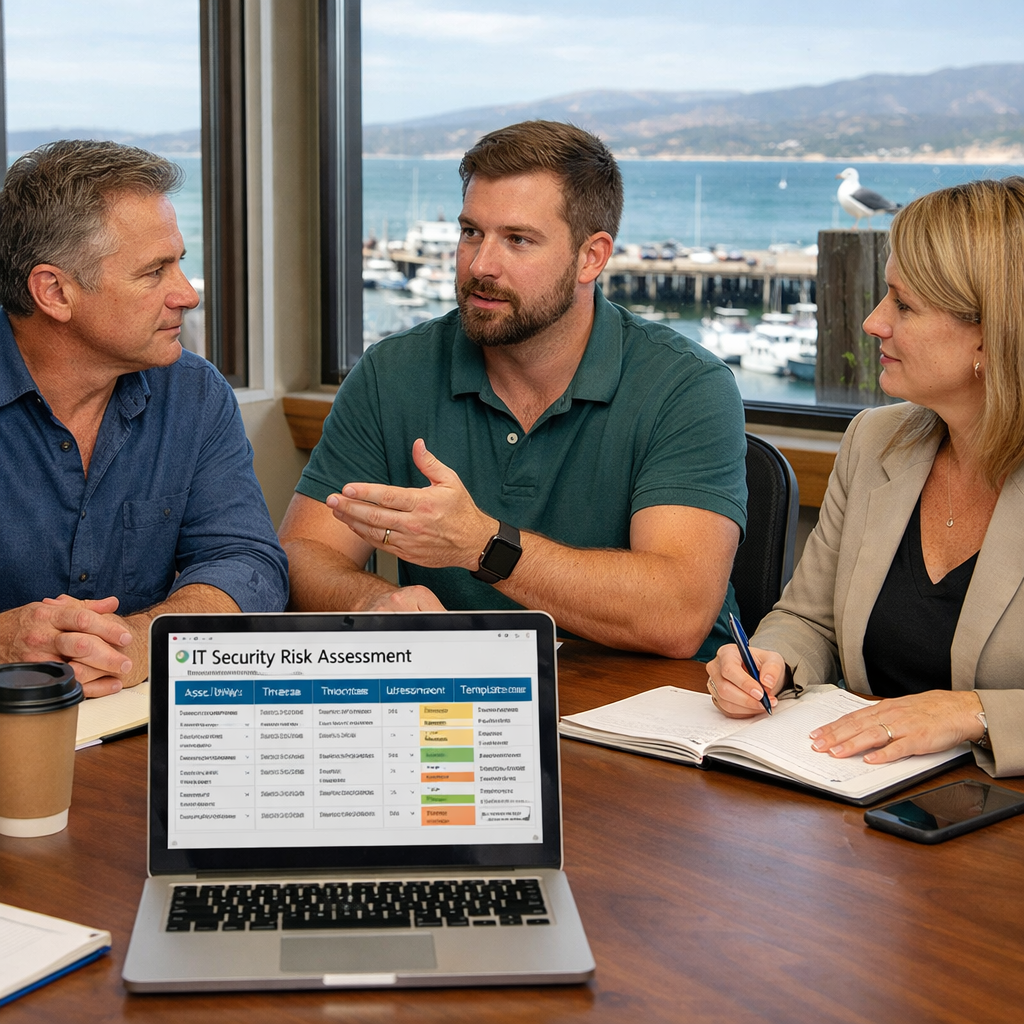
Now that you know what you’ll look at, list every piece of tech that holds value. Think beyond servers. Include laptops, tablets, point‑of‑sale terminals, cloud apps, and even the smart printer in the break room.
For each asset, note who owns it, where it lives, and what data it stores. Use a simple spreadsheet: Asset name, Owner, Location, Data type, Business impact.
Next, rank the data. High‑value data might be patient records, credit‑card info, or proprietary designs. Medium could be marketing lists. Low is anything public.
Here’s a quick way to score impact: Low = little effect on daily ops, Medium = could cause a short outage, High = would shut down the business or break the law.
After you have the list, draw a data‑flow diagram. Show where data moves , from a laptop to a cloud backup, from a POS to a payment gateway. This visual helps you see where a breach could travel.
Don’t forget the people side. Assign an owner for each asset , the person who will be responsible for its security.
Once the inventory is done, you have the raw material for the next steps. It also gives you a clear picture to show to auditors.
For more on why an inventory matters, see Adaptive’s guide to security assessments for Salinas businesses. It explains how a solid inventory cuts down the time spent on later steps.
And if you need a local partner to help you build the list, SRS Networks offers a quick start service that matches the Monterey market.
Bottom line: Identify every device and data set, rank its importance, and assign an owner before you look for threats.
Step 3: Conduct Threat Landscape Analysis
With assets in hand, you now ask: what could go wrong? Threats are anything that might cause harm , a hacker, a natural disaster, even a careless employee.
Start with the obvious. Phishing emails target users who click links. Ransomware looks for weak endpoints. Insider misuse can happen when a staff member copies files to a personal drive.
Use public sources like the CISA alert page to see which attacks are most common in the Monterey area. If a nearby farm suffered a ransomware hit, that’s a clue you should watch for similar vectors.
Next, score each threat on likelihood and impact. A simple 1‑5 scale works: 1 = rare, 5 = almost certain; impact follows the same scale.
- Phishing , Likelihood 4, Impact 3
- Ransomware , Likelihood 3, Impact 5
- Power outage , Likelihood 2, Impact 4
Combine the scores to get a priority number. Focus first on threats that score 8 or higher.
Here’s a short video that shows how a risk matrix drives action.
After you watch, write down the top three threats for your business. That list becomes the basis for the vulnerability check.
Bottom line: Map out the biggest threats, score them, and keep the top ones front‑and‑center.
Step 4: Evaluate Vulnerabilities & Gaps
Now you compare the threats you listed with the actual weaknesses in your environment. This is where you find the gaps that a hacker could use.
Start with a scan. Tools like Microsoft Defender for Endpoint or a free open‑source scanner can spot missing patches, open ports, and weak passwords.
Next, walk through each asset and ask: does it have the control the threat needs to break in? For example, if ransomware is a top threat, does the server have regular backups and MFA?
Record the findings in a table. Here’s a simple format:
| Asset | Threat | Vulnerability | Current Control | Gap? |
|---|---|---|---|---|
| Payroll server | Ransomware | Outdated OS | Monthly patch schedule | Yes |
| POS terminal | Phishing | Weak admin password | None | Yes |
When you see a “Yes” in the Gap column, that’s a fix you need to plan.
Don’t forget people. An employee who shares passwords is a vulnerability even if the tech is solid. Add a row for “Human factor” and note any training gaps.
After you list all gaps, rank them by the same 1‑5 scale you used for threats. High‑risk gaps get fixed first.
“You can’t fix what you don’t see.”
Bottom line: Identify every weakness that matches a top threat, log it, and rank it for action.
Step 5: Prioritize Risks & Impact
Now you have a list of threats, assets, and gaps. It’s time to decide which ones need the most attention.
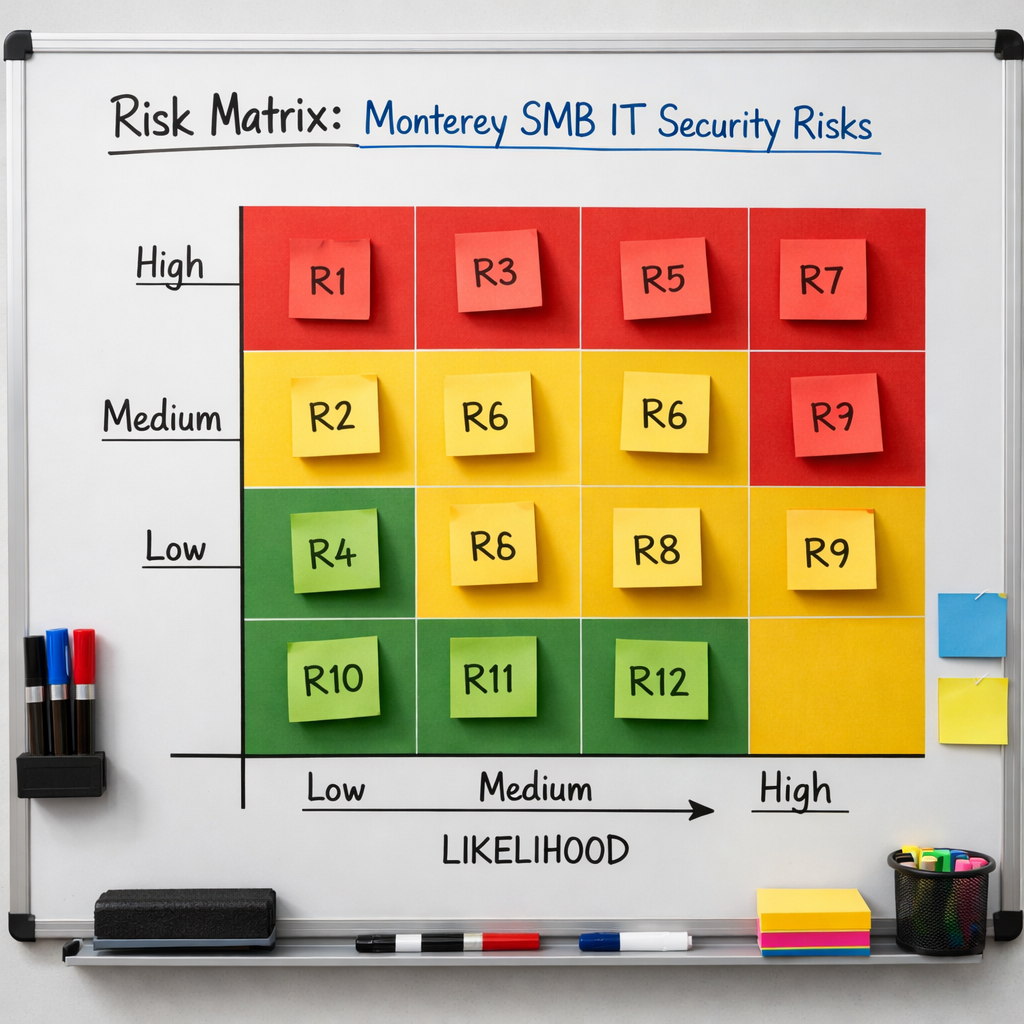
Use a risk matrix that plots Likelihood on the X‑axis and Impact on the Y‑axis. Place each risk in the grid; the top‑right corner holds the biggest problems.
Here’s how to fill it out:
- Take the score you gave each threat (1‑5).
- Take the score you gave each gap (1‑5).
- Multiply the two numbers , the result is the risk score.
Sort the risks from highest score to lowest. The top five become your “quick‑win” list.
When you talk to leadership, use plain language: “If we don’t patch the payroll server, we could lose $50,000 in a day.” Numbers help them see why a fix matters.
Also consider compliance. Some risks hit legal requirements (HIPAA, PCI). Those must move to the top even if their score is lower.
Bottom line: Rank risks by combined likelihood and impact, then focus on the highest‑scoring items first.
Step 6: Develop Mitigation & Controls Plan
With priorities set, you now create a plan that says who does what, by when, and how you’ll check it’s done.
Start with the top risk. Write a short sentence that describes the mitigation. Example: “Install the latest OS patches on the payroll server by Friday.”
Next, assign an owner. The owner is the person who will make sure the task gets finished. It could be the IT manager, a freelance tech, or even a department head.
Set a deadline. Use a sprint model , two weeks for each fix , so you keep momentum.
For each control, note how you’ll verify it. If you add MFA, the verification step could be “Test login on three accounts and record the success rate.”
Don’t forget documentation. A simple Word doc or a ticket in your help‑desk system works. Capture: Risk, Mitigation, Owner, Deadline, Verification.
When you have several mitigations, group them by type , patching, access control, backup, training. That makes budgeting easier.
Remember compliance. If a risk ties to HIPAA, add a note that the control must meet the specific HIPAA rule.
Our experience at SRS Networks shows that a written plan cuts remediation time by about 30% because everyone knows exactly what to do.
Bottom line: Write clear, assigned actions for each high‑risk item and set a short deadline.
Step 7: Implement Continuous Monitoring & Review
Security isn’t a set‑and‑forget job. You need ongoing checks so new threats don’t slip through.
First, set up a monitoring tool. A managed detection service or a lightweight SIEM can pull logs from firewalls, EDR, and cloud apps.
Define alerts that matter. For example, an alert when a file is encrypted on a workstation, or when a user logs in from a new country.
Schedule a monthly review meeting. In that meeting, look at the alerts, check the mitigation checklist, and see if any new risks have appeared.
Update your asset inventory each quarter. New laptops, new SaaS tools, or a moved server all need to be added.
Run a tabletop drill twice a year. Walk through a ransomware scenario, practice the isolation steps, and note any gaps.
If you need a template for the review process, the CISA website offers a simple checklist you can copy.
Bottom line: Make the assessment a living process with tools, alerts, and scheduled reviews.
FAQ
What is the first thing a Monterey SMB should do for an IT security risk assessment?
The first thing is to create a clear inventory of every device, server, and cloud service you use. Mark each item with its data impact level , high, medium, or low , and assign an owner. This inventory gives you a solid base for the rest of the IT security risk assessment Monterey process and helps you focus scans on the most critical assets.
How often should I scan my high‑risk assets?
High‑risk assets like payroll servers or patient‑record databases should be scanned at least once a week. Weekly scans catch new vulnerabilities quickly and let you patch before ransomware can exploit them. Medium‑risk assets can be scanned monthly, and low‑risk devices quarterly.
Do I need a security analyst or can I rely on tools?
You need both. Automated tools find missing patches and open ports fast, but a human analyst adds context, validates alerts, and ranks fixes by business impact. For a small Monterey firm, a mix of a simple scanner and a part‑time analyst works well.
Which controls reduce ransomware risk the most?
Network segmentation, multi‑factor authentication, and immutable backups give the biggest drop in risk. Segmentation stops ransomware from moving laterally, MFA blocks credential‑theft attacks, and backups let you restore without paying a ransom.
How can I tell if my backup plan is ransomware‑ready?
Check that backups are stored off‑site or in a cloud bucket that the internal network cannot reach. Make sure the backup is immutable , it can’t be changed or deleted once written. Test a full restore at least once a month and record how long it takes. If you can recover critical data in under an hour, the backup plan is solid.
What compliance frameworks should I align with?
Start with the NIST Cybersecurity Framework 2.0 because it maps to most regulations. Then add HIPAA if you handle health data, PCI‑DSS for payment info, and California’s CCPA for personal data. Using NIST as a base lets you meet several rules with one set of controls.
Conclusion
Running an IT security risk assessment Monterey doesn’t have to be a massive project. By following the seven steps , define scope, list assets, study threats, find gaps, rank risks, plan fixes, and monitor continuously , you build a practical, living security program.
Each step gives you a clear output you can show to leadership, auditors, or insurance reviewers. And because SRS Networks has been helping Monterey businesses for 28 years, we can walk you through any of these steps and tailor them to your industry, whether you run a dental office, a law firm, or a farm supply shop.
Ready to turn this guide into action? Contact SRS Networks today for a free consultation and start protecting your business right now.