Schools and universities are saving thousands of hours by switching to cloud storage for everything from student records to lesson plans. Most people think this shift is just about making files easier to access online. But today, over 90 percent of educational institutions report that cloud storage has slashed their IT maintenance costs and simplified collaboration more than any previous tech upgrade. The real surprise is not just about space or convenience but about how these cloud-based systems are completely changing the way education happens from the ground up.
Quick Links: Cloud Storage Guide for Educational Institutions
- What Is Cloud Storage For Education? Definition And Purpose
- Why Cloud Storage Matters In Educational Settings?
- Key Concepts Behind Cloud Storage Technology
- Practical Applications Of Cloud Storage In Education
- Real-World Impact Of Cloud Storage For Educational Institutions
Quick Summary
| Takeaway | Explanation |
|---|---|
| Cloud storage enhances collaboration | Cloud storage allows educators and students to easily share resources and collaborate on projects, breaking down barriers of traditional learning environments. |
| Cost savings on infrastructure | Transitioning to cloud storage can significantly reduce hardware costs, maintenance expenses, and allow for predictable technology spending. |
| Scalable storage solutions available | Institutions can quickly adapt storage capacity based on their evolving needs without costly upgrades to physical systems. |
| Improved data security and accessibility | Cloud storage provides secure access to sensitive information while ensuring that authorized users can reach needed data anytime, from anywhere. |
| Facilitates modern educational practices | By utilizing cloud technology, institutions can better support hybrid and remote learning models, making education more accessible and effective. |
What is Cloud Storage for Education? Definition and Purpose
Cloud storage for education represents a transformative digital infrastructure that allows educational institutions to securely store, manage, and access digital resources through internet-connected servers. According to EDUCAUSE research, this technology enables seamless sharing and collaboration of educational materials across diverse learning environments.
Understanding Cloud Storage Fundamentals
At its core, cloud storage functions as a virtual repository where schools, universities, and educational organizations can store digital assets like documents, multimedia content, student records, research files, and administrative data. Unlike traditional local storage systems confined to physical hardware, cloud storage provides flexible and scalable digital space accessible from multiple devices and locations.
The following table summarizes the core features of cloud storage compared to traditional local storage, highlighting key differences relevant to educational institutions.
| Feature | Traditional Local Storage | Cloud Storage |
|---|---|---|
| Storage Capacity | Limited by on-site hardware | Scalable and virtually unlimited |
| Accessibility | On-premises only | Remote, from any internet device |
| Data Protection & Backup | Manual backups, risk of loss | Automated, robust backups |
| Maintenance Requirements | High physical upkeep | Vendor-managed, minimal local work |
| Collaboration | Difficult, limited to local | Seamless, real-time sharing |
| Cost Structure | Major upfront investment | Predictable monthly expense |
Key characteristics of cloud storage for education include:
- Unlimited digital storage capacity
- Remote accessibility from any internet-connected device
- Enhanced data protection and backup mechanisms
- Cost-effective infrastructure management
Strategic Benefits for Educational Institutions
Cloud storage offers profound advantages beyond simple data preservation.
It fundamentally transforms how educational organizations approach information management and technological resources. By centralizing digital assets, institutions can:
- Streamline communication between faculty, students, and administrators
- Reduce physical infrastructure maintenance costs
- Enable collaborative learning experiences
- Support hybrid and remote educational models
Moreover, cloud storage supports advanced educational technologies like learning management systems, digital curriculum platforms, and interactive online resources. This technological foundation allows educational institutions to create more dynamic, responsive, and interconnected learning environments that adapt to evolving educational needs.
Why Cloud Storage Matters in Educational Settings?
Cloud storage has become a critical technological infrastructure for modern educational institutions, transforming how academic resources are managed, shared, and accessed. According to research from the International Journal of Educational Technology in Higher Education, cloud technologies are revolutionizing institutional efficiency and learning experiences.
Addressing Modern Educational Challenges
Traditional data management approaches frequently struggle with escalating digital content volumes, security requirements, and accessibility needs. Cloud storage provides a comprehensive solution that addresses multiple institutional pain points. Educational organizations can now overcome physical storage limitations and create more responsive, flexible technological ecosystems.
This table outlines key challenges faced by educational institutions and demonstrates how cloud storage provides effective solutions to each one.
| Educational Challenge | Cloud Storage Solution |
|---|---|
| Managing growing digital content | Scalable storage for expanding data |
| Ensuring consistent accessibility | Accessible anytime, anywhere over the internet |
| Protecting sensitive information | Encryption, user permissions, and continuous backups |
| Supporting collaborative learning | Real-time resource sharing and project collaboration |
| Reducing infrastructure costs | Predictable expenses and less hardware maintenance |
Key challenges cloud storage resolves include:
- Managing exponentially growing digital content
- Ensuring consistent data accessibility
- Protecting sensitive institutional and student information
- Supporting collaborative learning environments
Financial and Operational Advantages
Beyond technological capabilities, cloud storage delivers substantial financial benefits for educational institutions. By migrating from traditional hardware-based storage systems, schools and universities can significantly reduce infrastructure expenses. Cloud solutions eliminate substantial upfront hardware investments, ongoing maintenance costs, and complex technical support requirements.
Operational advantages encompass:
- Predictable monthly technology expenditures
- Reduced hardware maintenance overhead
- Scalable storage solutions
- Simplified technological upgrades
The strategic implementation of cloud storage enables educational institutions to reallocate financial resources toward core educational objectives, such as curriculum development, student support services, and technological innovation. This approach transforms technology from a cost center to a strategic educational enabler.
Key Concepts Behind Cloud Storage Technology
Cloud storage technology represents a sophisticated digital infrastructure that fundamentally transforms data management and accessibility. According to the National Institute of Standards and Technology, cloud computing encompasses several critical technological principles that define modern data storage approaches.
Fundamental Technological Architecture
The core architecture of cloud storage revolves around distributed computing systems that enable organizations to store, manage, and access digital information across multiple interconnected servers.
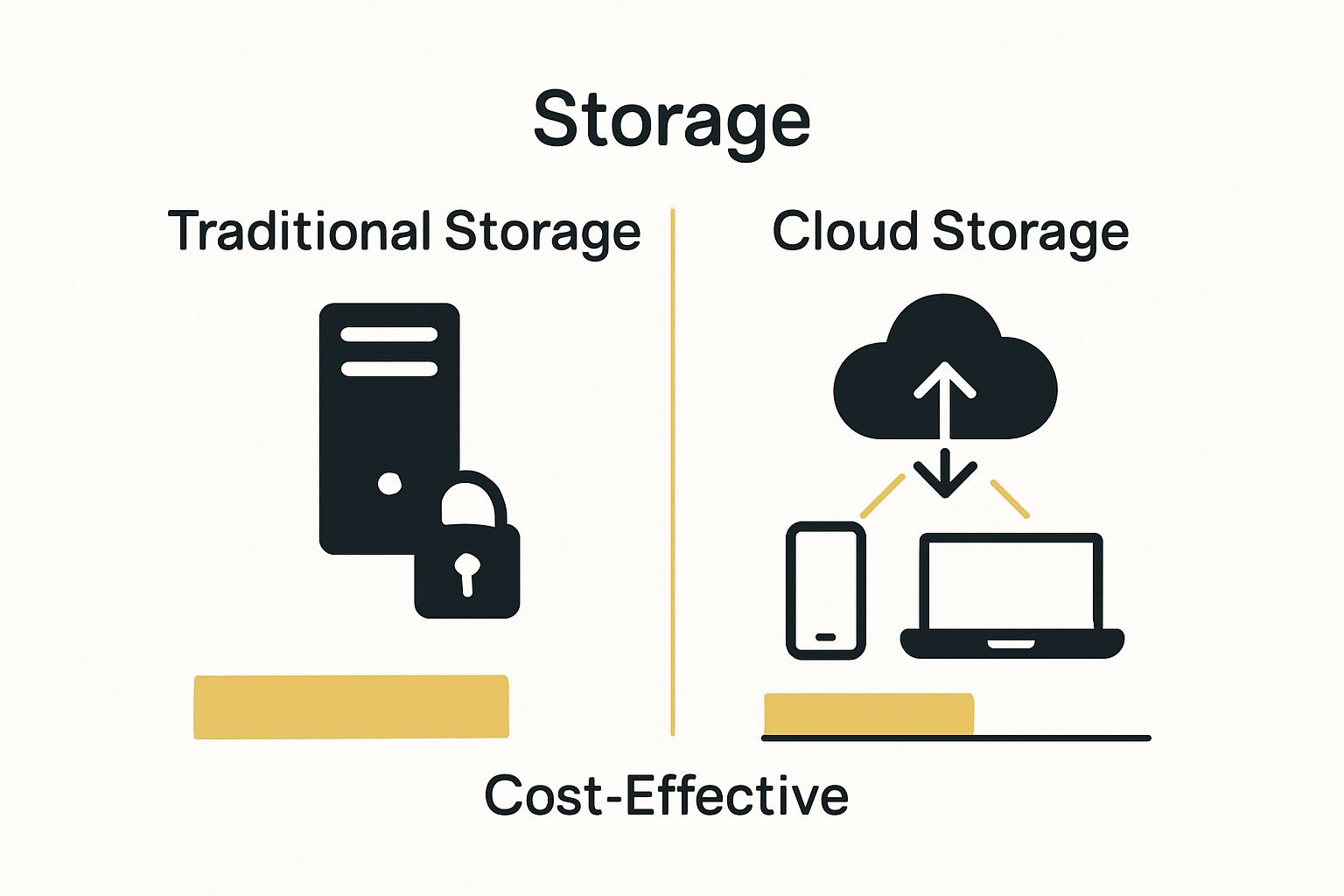 Unlike traditional localized storage methods, cloud technologies provide a dynamic, flexible framework that transcends physical hardware limitations.
Key architectural components include:
- Virtualized server infrastructure
- Redundant data storage mechanisms
- Advanced network connectivity protocols
- Scalable computational resources
Essential Operational Principles
Cloud storage operates through several foundational principles that distinguish it from conventional storage solutions. These principles ensure robust, secure, and efficient data management across diverse technological environments. The system enables seamless data synchronization, real-time accessibility, and comprehensive backup strategies.
Critical operational principles encompass:
- On-demand resource allocation
- Automatic data replication
- Comprehensive security encryption
- Intelligent load balancing
By integrating these sophisticated technological frameworks, cloud storage creates a dynamic ecosystem where data becomes a fluid, accessible resource rather than a static, confined asset. Educational institutions can leverage these principles to create more responsive, adaptive technological infrastructures that support complex learning and administrative requirements.
Practical Applications of Cloud Storage in Education
Cloud storage transforms educational technology by providing versatile digital solutions that support learning, administration, and collaboration. According to educational technology research, these applications extend far beyond simple data preservation.
Learning and Instructional Resource Management
Cloud storage enables seamless distribution and management of educational content, allowing institutions to centralize curriculum materials, research documents, and multimedia resources. Educators can create comprehensive digital libraries accessible to students from any location, supporting both traditional classroom and remote learning environments.
Key instructional applications include:
- Centralized course material repositories
- Interactive digital textbook platforms
- Collaborative research document sharing
- Multimedia content libraries
Administrative and Operational Efficiency
Beyond instructional uses, cloud storage significantly streamlines institutional administrative processes. Academic departments can securely manage student records, financial information, enrollment data, and organizational documentation through integrated cloud platforms. These systems provide robust security protocols while enabling efficient data access and management.
Operational benefits encompass:

- Secure student record management
- Simplified enrollment tracking
- Integrated financial documentation systems
- Comprehensive compliance documentation storage
By implementing cloud storage solutions, educational institutions can create more agile, responsive technological infrastructures that adapt to evolving academic and administrative requirements. The technology supports a holistic approach to digital resource management, transforming how educational organizations store, share, and utilize critical information.
Real-World Impact of Cloud Storage for Educational Institutions
Cloud storage has fundamentally transformed operational dynamics across educational ecosystems, providing innovative solutions to complex technological challenges. According to research from the International Association for K-12 Online Learning, these technological interventions are reshaping institutional capabilities and learning experiences.
Institutional Transformation
Educational organizations are experiencing comprehensive technological metamorphosis through cloud storage implementations. By replacing traditional infrastructure with dynamic, scalable digital platforms, institutions can dramatically enhance their technological responsiveness and operational efficiency. This shift goes beyond mere technological upgrade, representing a strategic reimagining of institutional capabilities.
Significant transformational impacts include:
- Accelerated digital modernization processes
- Enhanced institutional agility
- Reduced technological infrastructure complexity
- Improved resource allocation strategies
Learning Experience Enhancement
Cloud storage directly influences pedagogical approaches by creating more flexible, accessible, and collaborative learning environments. Students and educators can now interact with educational resources seamlessly, transcending traditional geographical and technological limitations. Digital collaboration becomes instantaneous, enabling more dynamic and interactive educational experiences.
Key learning experience improvements encompass:
- Global knowledge sharing capabilities
- Real-time collaborative project development
- Personalized learning pathway support
- Inclusive educational technology access
By embracing cloud storage technologies, educational institutions are not simply adopting new tools but fundamentally reimagining how knowledge is created, shared, and experienced in the digital age.
Transform Your Institution with Secure, Scalable Cloud Storage
You have seen how cloud storage can remove the struggle of limited access, data security, and collaboration challenges in education. SRS Networks helps schools and organizations right here in the Monterey Bay Area move beyond traditional storage barriers. Our customized IT support brings you peace of mind, knowing your student records, curriculum materials, and administrative files are protected and accessible when you need them most.
Do not let outdated technology hold your school or office back. Take the next step toward safer data and simpler sharing with an IT partner who understands the unique challenges of the education sector. Visit SRS Networks to learn how our tailored Cloud Computing Solutions and Data Backup & Business Continuity services can help you build a more connected and resilient learning environment. Contact us today to secure your digital transformation and support your community’s success.
Frequently Asked Questions
What is cloud storage for education?
Cloud storage for education is a digital system that allows educational institutions to store, manage, and access resources online. To implement cloud storage, identify the types of digital assets you need to store and choose a suitable cloud platform to facilitate access and collaboration among students and faculty.
How can cloud storage enhance communication within educational institutions?
Cloud storage improves communication by providing a centralized platform for sharing educational materials among students, faculty, and administrators. Start by creating shared folders for different courses and departments to streamline access and encourage collaboration.
What are the main benefits of using cloud storage for educational files?
The primary benefits of cloud storage for educational files include unlimited storage capacity, remote accessibility, enhanced security, and cost-effective management. Evaluate these benefits by assessing your institution’s current storage needs and calculating potential cost savings over 12 months.
How does cloud storage support remote learning?
Cloud storage facilitates remote learning by allowing students and educators to access instructional resources from any internet-connected device. Ensure that all course materials are uploaded to the cloud to support real-time collaboration and ongoing communication, which can improve learning outcomes.
What steps should institutions take to implement cloud storage solutions?
To implement cloud storage, first assess your current data management practices and then select a cloud storage provider that meets your specific needs. Begin the transition by migrating existing digital assets within 30–60 days and training staff and students on how to access and utilize the new system.
How can cloud storage help manage sensitive student information securely?
Cloud storage can securely manage sensitive student information through robust encryption and access controls. Set up strict user permissions and regularly review who has access to sensitive data to ensure compliance with privacy regulations.