Cloud migration turns the old model of business tech upside down. Companies are switching from local servers to the cloud and can cut operating costs by up to 40 percent according to Gartner. You might expect the biggest win is saving money. Not quite. The real power comes from the way it lets companies move faster and scale with zero hardware headaches. And that surprise advantage is reshaping how every business thinks about technology.
Table of Contents
- What Is Cloud Migration And Its Importance?
- Key Factors Influencing Cloud Migration Decisions
- Understanding The Types Of Cloud Solutions Available
- Assessing Risks And Benefits Of Cloud Migration
- Real-World Examples Of Successful Cloud Migrations
Quick Summary
| Takeaway | Explanation |
|---|---|
| Cloud migration reduces operational costs significantly | Organizations can save up to 40% on operational expenses by adopting cloud technologies, enhancing financial flexibility. |
| Cloud environments offer scalable resources | Businesses can easily adjust computing resources in response to fluctuating demands, improving efficiency and responsiveness. |
| Advanced security measures are provided by cloud providers | Modern cloud solutions often include robust security features and compliance standards that enhance data protection. |
| Conduct thorough assessments before migrating | Evaluate current infrastructure and financial implications to ensure successful transitions to cloud environments. |
| Different cloud models suit varying business needs | Understanding public, private, and hybrid cloud options can help businesses choose the most appropriate solution for their requirements. |
What is Cloud Migration and Its Importance?
Cloud migration represents a strategic technological transformation where businesses transition their digital infrastructure, applications, data, and operational workloads from traditional on premise systems to cloud computing environments. This process enables organizations to leverage advanced computational resources without maintaining extensive physical hardware infrastructure.
Understanding Cloud Migration Fundamentals
At its core, cloud migration involves moving digital assets from local servers or data centers to remote, internet accessible cloud platforms. These platforms, offered by providers like Amazon Web Services, enable businesses to access scalable computing resources on demand.
Key characteristics of cloud migration include:
- Transferring data and applications from local infrastructure to cloud servers
- Redesigning existing systems to optimize cloud performance
- Enabling remote access and enhanced computational flexibility
- Reducing physical hardware maintenance costs
Strategic Business Advantages
Cloud migration delivers profound strategic benefits for organizations. Research from Gartner indicates that businesses adopting cloud technologies can reduce operational expenses by up to 40% while simultaneously improving technological agility.
Cost Efficiency: Cloud platforms eliminate significant upfront hardware investments and ongoing maintenance expenses. Companies can instead pay for computational resources they actually consume, transforming fixed technology costs into flexible operational expenses.
Scalability: Cloud environments allow businesses to rapidly adjust computing resources based on immediate requirements. Whether experiencing sudden traffic increases or seasonal demand fluctuations, organizations can seamlessly scale infrastructure without complex hardware procurement processes.
Security and Compliance: Modern cloud providers invest heavily in advanced security protocols, offering robust protection mechanisms that often exceed traditional on premise security capabilities. This includes automated updates, advanced threat detection, and comprehensive data encryption strategies.
Key Factors Influencing Cloud Migration Decisions
Cloud migration is a complex strategic process that requires careful evaluation of multiple interconnected technological and business considerations. Organizations must conduct comprehensive assessments to determine the viability and potential benefits of transitioning their digital infrastructure to cloud environments.
Technical Infrastructure Assessment
Before initiating cloud migration, businesses must thoroughly examine their existing technological ecosystem. According to the Government Accountability Office, comprehensive infrastructure evaluation involves analyzing current system capabilities, potential integration challenges, and overall technological readiness.
Key technical considerations include:
- Current hardware and software compatibility with cloud platforms
- Network bandwidth and connectivity requirements
- Data transfer and migration complexity
- Potential performance limitations or optimization needs
Financial and Operational Implications
Cloud migration decisions extend beyond pure technological assessments. Financial modeling plays a crucial role in determining the potential return on investment. Companies must analyze:
- Total cost of cloud infrastructure compared to existing on premise systems
- Potential operational efficiency gains
- Long term scalability and flexibility
- Reduced maintenance and hardware replacement expenses
Security and Compliance Considerations
Enterprise organizations must rigorously evaluate cloud migration through a security and regulatory compliance lens. This involves assessing data protection mechanisms, understanding potential vulnerabilities, and ensuring alignment with industry specific regulatory requirements.
Companies should comprehensively review:
- Data encryption and protection protocols
- Compliance with industry regulations like HIPAA or GDPR
- Vendor security certifications and third party audit reports
- Potential risks associated with data storage and transmission
Successful cloud migration demands a holistic approach that balances technological capabilities, financial considerations, and robust security frameworks.
Understanding the Types of Cloud Solutions Available
Cloud computing offers diverse architectural models that cater to different organizational needs, providing flexible infrastructure solutions designed to meet specific business requirements. Understanding these cloud solution types enables companies to select the most appropriate technological framework for their unique operational contexts.
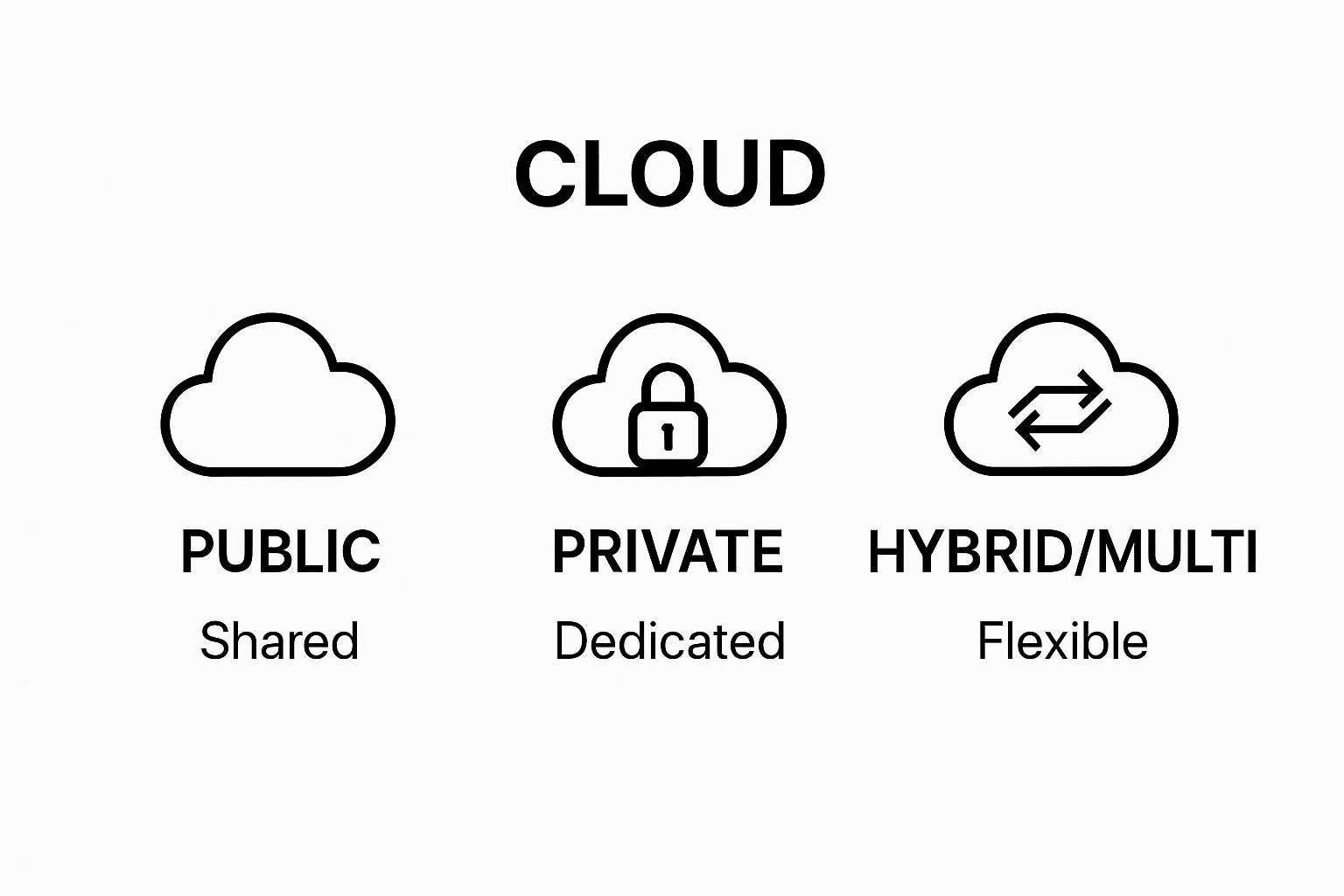
Public Cloud Environments
Public cloud platforms represent shared computing resources accessible via the internet, where cloud service providers manage and maintain the underlying infrastructure. According to the National Institute of Standards and Technology, public clouds offer scalable and cost effective solutions for businesses seeking flexible computational resources.
Key characteristics of public cloud solutions include:
- Shared infrastructure managed by third party providers
- Pay as you go pricing models
- Rapid scalability and resource provisioning
- Minimal upfront hardware investments
Private Cloud Infrastructure
Private cloud solutions provide dedicated computational resources exclusively for a single organization. These environments offer enhanced security and granular control, making them ideal for enterprises with stringent compliance and data protection requirements.
Advantages of private cloud deployments:
- Complete infrastructure control
- Enhanced data security and isolation
- Customizable configuration options
- Direct management of computational resources
Hybrid and Multi Cloud Strategies
Hybrid cloud approaches combine public and private cloud infrastructures, allowing organizations to leverage the strengths of multiple cloud environments. This strategy enables businesses to optimize performance, cost efficiency, and operational flexibility.
Multi cloud strategies involve utilizing services from multiple cloud providers, distributing computational workloads across different platforms to mitigate risks and maximize technological capabilities. This approach provides:
- Increased resilience and redundancy
- Flexibility in selecting best of breed services
- Risk mitigation through provider diversification
- Optimized cost management
Selecting the appropriate cloud solution requires careful evaluation of organizational objectives, technological requirements, security considerations, and budgetary constraints.
Here is a comparison table summarizing the differences between public, private, and hybrid/multi-cloud solutions discussed in the article:
| Cloud Solution Type | Key Characteristics | Typical Use Cases |
|---|---|---|
| Public Cloud | Shared resources, managed by third-party providers, scalable, minimal upfront costs | Web hosting, startups, rapid scaling |
| Private Cloud | Dedicated resources, enhanced security, direct management | Organizations with strict compliance needs |
| Hybrid/Multi-Cloud | Mix of public and private clouds, flexibility, risk mitigation | Businesses needing resilience and agility |
Assessing Risks and Benefits of Cloud Migration
Cloud migration represents a transformative technological strategy that demands comprehensive evaluation of potential advantages and inherent challenges. Organizations must conduct meticulous risk assessments to ensure successful digital infrastructure transitions while maximizing technological potential.

Strategic Business Benefits
Research from the National Institutes of Health highlights the profound operational advantages of cloud migration. Organizational transformation through cloud adoption enables businesses to achieve unprecedented technological flexibility and operational efficiency.
Key strategic benefits include:
- Enhanced computational scalability
- Reduced infrastructure maintenance expenses
- Accelerated technological innovation
- Improved business continuity capabilities
Potential Technological Risks
While cloud migration offers substantial advantages, organizations must carefully navigate potential technological vulnerabilities. Risk mitigation requires proactive identification and strategic management of potential challenges that could impact system performance and data integrity.
Critical risk considerations encompass:
- Data security and privacy vulnerabilities
- Potential service disruption during migration
- Compliance and regulatory alignment challenges
- Integration complexity with existing technological ecosystems
Comprehensive Risk Management Strategies
Successful cloud migration demands a holistic approach that balances technological innovation with robust risk management protocols. Organizations must develop comprehensive strategies that:
- Conduct thorough pre migration assessments
- Implement robust security and encryption mechanisms
- Develop detailed contingency and rollback plans
- Establish continuous monitoring and performance evaluation frameworks
Effective cloud migration transcends technological implementation, requiring strategic alignment between organizational objectives, technological capabilities, and comprehensive risk management approaches.
The following table organizes the strategic business benefits and potential technological risks of cloud migration identified in the article:
| Aspect | Details |
|---|---|
| Strategic Business Benefits | Enhanced scalability, reduced maintenance costs, accelerated innovation, improved business continuity |
| Potential Technological Risks | Data security and privacy concerns, migration disruptions, compliance challenges, complex integrations |
| Businesses must view cloud migration as a nuanced transformation process that demands careful planning, continuous evaluation, and adaptive implementation strategies. |
Real-World Examples of Successful Cloud Migrations
Cloud migration represents a transformative journey for organizations across diverse industries, demonstrating the powerful potential of strategic technological transformation. Examining successful implementation cases provides valuable insights into the practical applications and tangible benefits of cloud adoption strategies.
Enterprise Level Cloud Transformation
According to Harvard Business Review, large scale enterprise migrations showcase the profound operational impact of comprehensive cloud strategies. Technological modernization enables organizations to reimagine their computational infrastructure and unlock unprecedented operational efficiency.
Notable enterprise cloud migration examples include:
- Netflix transitioning entire media streaming infrastructure to cloud platforms
- Coca Cola centralizing global data management through cloud solutions
- Airbnb implementing scalable cloud architectures to support rapid global expansion
- Capital One rebuilding technological infrastructure using cloud native approaches
Small and Medium Business Cloud Adoption
Small and medium enterprises demonstrate remarkable adaptability through strategic cloud migration. These organizations leverage cloud technologies to compete more effectively, reduce technological overhead, and create more agile operational frameworks.
Successful small business cloud migration strategies involve:
- Implementing cost effective cloud productivity tools
- Utilizing cloud based customer relationship management systems
- Developing flexible remote work infrastructures
- Automating routine business processes through cloud platforms
Industry Specific Cloud Implementation
Different industries demonstrate unique approaches to cloud migration, tailoring technological solutions to specific operational requirements. Healthcare, financial services, and manufacturing sectors showcase distinctive cloud adoption strategies that address complex regulatory and performance challenges.
Industry specific cloud migration considerations include:
- Healthcare organizations implementing HIPAA compliant cloud storage
- Financial institutions developing secure cloud based transaction systems
- Manufacturing companies creating interconnected supply chain management platforms
Successful cloud migration transcends technological implementation, representing a strategic reimagining of organizational computational capabilities. Businesses must approach cloud adoption as a comprehensive transformation process that balances technological innovation with operational pragmatism.
Ready for Secure and Smooth Cloud Migration?
Is moving your business to the cloud keeping you up at night? Many local organizations struggle with complex decisions about cloud migration, as highlighted in this article. Challenges such as balancing security, compliance, and cost efficiency can feel overwhelming, especially if you lack in-house IT experts. Working with the right partner takes away the worry and helps you achieve scalability, resilience, and peace of mind. Discover how our expert team at SRS Networks works alongside you to perform thorough readiness assessments, create custom migration roadmaps, and ensure your digital assets stay safe during every step of your cloud journey.
Your business deserves the confidence and freedom that come with smart cloud adoption. Let us handle the complexity so you can focus on growth. Explore our tailored cloud computing solutions or reach out now to schedule a no-pressure consultation. Take a proactive step today before risks grow and opportunities pass you by.
Frequently Asked Questions
What is cloud migration?
Cloud migration is the process of moving digital infrastructure, applications, data, and operational workloads from traditional on-premise systems to cloud computing environments, enabling businesses to access scalable computational resources without extensive hardware maintenance.
What are the benefits of cloud migration for businesses?
Cloud migration offers several benefits, including cost efficiency due to reduced hardware costs, scalability to quickly adjust resources based on demand, enhanced security measures provided by cloud vendors, and improved operational agility.
What factors should businesses consider before migrating to the cloud?
Businesses should evaluate their existing technical infrastructure, including compatibility with cloud platforms, network bandwidth, financial implications of cloud adoption, and security and compliance considerations to ensure a successful migration.
What types of cloud solutions are available for businesses?
There are various cloud solutions, including public clouds, which provide shared resources via the internet; private clouds, which offer dedicated resources for a single organization; and hybrid or multi-cloud strategies that combine different cloud environments for flexibility and resilience.