Networking might sound like a tech buzzword, but it is the invisible force that keeps businesses running smoothly each day. Over 90 percent of companies depend on robust network systems for their daily operations. Most people think high-tech gear is the main ingredient, but the real secret is knowing basic networking terms and how they shape communication. That simple vocabulary might be what stands between smooth collaboration and total confusion.
Table of Contents
- Key Networking Concepts: What Are They?
- The Importance Of Networking Terms In Business Communication
- How Networking Functions: A Look At Data Transmission
- Common Networking Terms: Definitions And Context
- Real-World Applications Of Networking Terms In Various Industries
Navigate Key Networking Terms and Concepts
| Takeaway | Explanation |
|---|---|
| Understand basic networking terms | Familiarity with essential networking vocabulary improves communication and collaboration in business. |
| Master communication protocols | Knowing standard protocols like TCP/IP and HTTP is vital for secure and efficient data transmission. |
| Recognize key network components | Understanding devices such as routers and switches helps design effective network infrastructures. |
| Leverage networking for strategic advantage | Using networking knowledge enables businesses to make informed tech decisions and drive efficiency. |
| Apply networking in industry contexts | Recognizing how networking concepts apply in fields like healthcare and manufacturing optimizes operations. |
Key Networking Concepts: What Are They?
Understanding basic networking terms is crucial for businesses seeking to optimize their technological infrastructure. Networking forms the backbone of modern communication systems, enabling organizations to connect devices, share resources, and maintain seamless digital operations.
Network Architecture Fundamentals
At its core, networking involves creating interconnected systems that allow computers and devices to communicate and exchange information. The fundamental structure of a network depends on several critical components that work together to facilitate data transmission.
Key network architecture elements include:
- Nodes: Any device connected to a network, such as computers, servers, printers, or smartphones
- Connections: Physical or wireless pathways through which data travels
- Protocols: Standardized rules governing how data is transmitted and received
Network design determines how efficiently an organization can share information, collaborate, and maintain secure communication channels. According to Cisco Systems, effective network architecture requires careful planning and understanding of organizational needs.
Communication Protocols and Data Transmission
Networking relies on sophisticated communication protocols that define how data moves between devices. These protocols establish standardized methods for devices to recognize, transmit, and interpret digital information.
The most common networking protocols include:
- TCP/IP: Transmission Control Protocol/Internet Protocol, which manages how data packets are sent and received across networks
- HTTP/HTTPS: Protocols governing web communication and secure web browsing
- DNS: Domain Name System, which translates human-readable website names into numerical IP addresses
Understanding these protocols helps businesses ensure smooth, secure, and efficient digital communication across their technological ecosystem. Proper implementation prevents potential communication breakdowns and supports robust network performance.
The Importance of Networking Terms in Business Communication
In the rapidly evolving digital landscape, understanding basic networking terms has become essential for effective business communication. Networking terminology provides a common language that enables organizations to discuss, design, and implement technological solutions with precision and clarity.
Bridging Technical and Business Communication
Networking terms serve as a critical translation mechanism between technical and non-technical team members. When everyone understands fundamental concepts, communication becomes more efficient, reducing misunderstandings and potential implementation errors.
Key benefits of shared networking vocabulary include:
- Improved Collaboration: Technical and non-technical staff can communicate more effectively
- Faster Problem Resolution: Clear terminology accelerates troubleshooting processes
- Strategic Decision Making: Leadership can make informed technology investments
Arizona State University’s Thunderbird School of Global Management emphasizes that effective communication is foundational to successful business operations, particularly in technology-driven environments.
Strategic Business Advantages
Beyond communication, networking terms provide strategic advantages by enabling businesses to:
- Understand technology infrastructure requirements
- Evaluate potential technology investments
- Develop more robust cybersecurity strategies
- Optimize digital resource allocation
Professional competence in networking terminology demonstrates technical literacy and positions businesses to adapt quickly to technological changes. Companies that invest in understanding these terms can more effectively leverage technology as a competitive advantage, making informed decisions about network design, security, and infrastructure development.
How Networking Functions: A Look at Data Transmission
Data transmission represents the lifeblood of modern network communications, enabling businesses to exchange information rapidly and efficiently across complex technological infrastructures. Understanding how data moves through networks provides critical insights into the mechanics of digital communication.
The Basics of Data Transmission
At its fundamental level, data transmission involves transferring digital information between network devices using standardized communication protocols. This process transforms complex digital signals into coherent, actionable information that organizations can utilize for various operational purposes.
Key components of data transmission include:
- Sender: The device or system initiating the data transfer
- Transmission Medium: Physical or wireless pathways like ethernet cables or wifi signals
- Receiver: The device or system designed to accept and interpret the transmitted data
University of Rhode Island explains that successful data transmission depends on precise conversion and interpretation of digital signals across different technological platforms.
Transmission Methods and Protocols
Networks utilize various transmission methods to ensure data moves accurately and securely. These methods determine how information is packaged, sent, and reassembled during communication processes.
Primary transmission techniques involve:
- Breaking data into smaller packets for efficient transfer
- Implementing error checking mechanisms
- Establishing reliable communication routes
- Maintaining data integrity throughout transmission
Business networks rely on these sophisticated transmission strategies to guarantee information moves quickly, securely, and without corruption. The ability to seamlessly transfer data represents a critical competitive advantage in today’s digital business environment.
Common Networking Terms: Definitions and Context
Networking terminology forms a critical communication framework that enables businesses to understand, design, and implement technological solutions. By mastering these fundamental terms, organizations can effectively navigate the complex landscape of digital infrastructure and communication systems.
Essential Network Infrastructure Terms
Network infrastructure refers to the physical and logical components that support data communication within an organization. Understanding these core terms helps businesses build robust and efficient technological ecosystems.
Key infrastructure terms include:
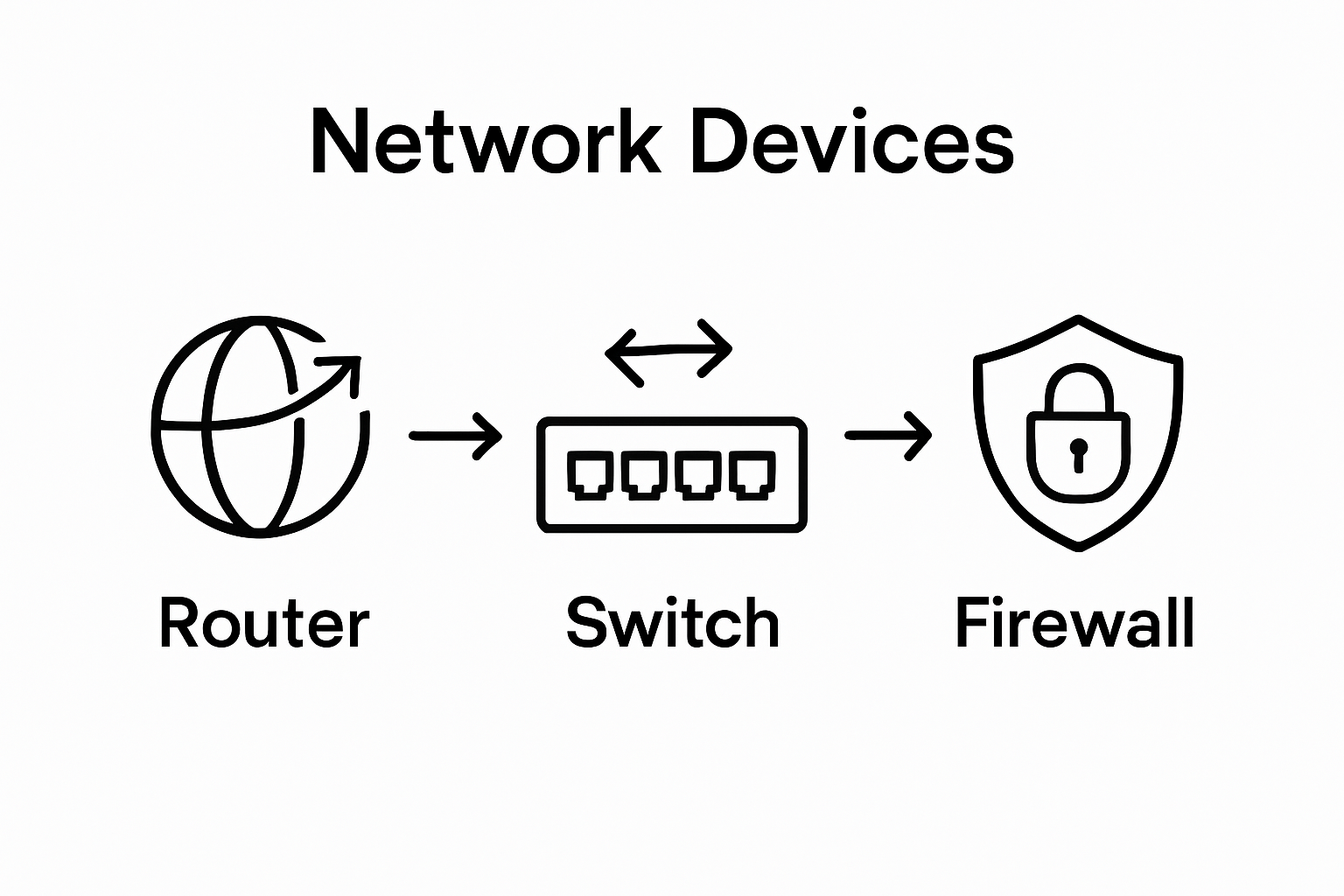
- Router: A device that forwards data packets between computer networks
- Switch: Hardware that connects devices within a local area network (LAN)
- Firewall: Security system monitoring and controlling network traffic
- Server: Powerful computer providing resources and services to other network devices
National Institute of Standards and Technology emphasizes the importance of precise terminology in understanding network design and functionality.
Connection and Communication Terminology
Beyond hardware, networking involves complex communication mechanisms that facilitate data exchange. These terms describe how information moves and is processed across digital networks.
Critical communication terms businesses should understand:
- Bandwidth: Maximum data transfer rate across a network connection
- Latency: Time delay between sending and receiving network data
- Protocol: Set of rules governing network communication
- IP Address: Unique identifier assigned to each network device
Comprehensive understanding of these terms enables businesses to make informed decisions about network design, troubleshoot potential issues, and optimize technological performance. Networking terminology transforms abstract technical concepts into actionable insights for strategic technology management.
Below is a table summarizing essential network infrastructure terms and their definitions to help readers quickly reference and understand the key components discussed in the article.
| Term | Definition |
|---|---|
| Router | Device that forwards data packets between computer networks |
| Switch | Hardware that connects devices within a local area network (LAN) |
| Firewall | Security system monitoring and controlling network traffic |
| Server | Powerful computer providing resources and services to other network devices |
| Bandwidth | Maximum data transfer rate across a network connection |
| Latency | Time delay between sending and receiving network data |
| Protocol | Set of rules governing network communication |
| IP Address | Unique identifier assigned to each network device |
Real-World Applications of Networking Terms in Various Industries
Networking concepts transcend technological boundaries, providing critical infrastructure solutions across diverse industry sectors. Understanding how these terms translate into practical applications helps businesses leverage technology more effectively and strategically.
Healthcare and Medical Technology
In healthcare, networking terms directly impact patient care, research, and administrative processes. Advanced network infrastructures enable seamless data sharing, remote diagnostics, and sophisticated medical research collaborations.
Key networking applications in healthcare include:
- Telemedicine: Utilizing network protocols for remote patient consultations
- Electronic Health Records: Secure data transmission between medical facilities
- Medical Research: Connecting global research databases and sharing complex datasets
- Medical Imaging: Transferring high-resolution diagnostic images across secure networks
National Center for Biotechnology Information highlights how integrated networking technologies transform medical information management and research capabilities.
Manufacturing and Industrial Systems
Manufacturing industries leverage networking terms to create sophisticated, interconnected production environments. Industrial Internet of Things (IoT) technologies rely on advanced networking concepts to optimize operational efficiency.
Networking applications in manufacturing involve:
- Real-time equipment monitoring
- Predictive maintenance systems
- Supply chain tracking
- Automated production line management
- Remote equipment diagnostics
These technological integrations enable businesses to reduce downtime, improve production quality, and make data-driven operational decisions.
 Networking terminology provides the foundational language for designing and implementing these complex technological ecosystems.
Transform Networking Knowledge Into Real Business Results
Understanding basic networking terms is just the beginning. The real challenge comes when trying to apply concepts like protocols, firewalls, or bandwidth to protect your company, support secure collaboration, and prevent costly downtime. If you sometimes feel overwhelmed by tech lingo or worry your network could be holding your business back, you are not alone. That is where the expert team at SRS Networks steps in. We help businesses across the Monterey Bay Area turn technical confusion into clear, practical IT solutions.
Do not let a gap in technology knowledge slow your growth or put data at risk. Take the next step by connecting with our specialists at SRS Networks, where we translate networking terms into tailored strategies that drive productivity and security. Your organization deserves technology that just works and a partner who puts your needs first. Contact us today to schedule your consultation and see the difference a local, dedicated IT partner can make.
Frequently Asked Questions
What are the essential components of network architecture?
Key components of network architecture include nodes (devices connected to the network), connections (physical or wireless pathways), and protocols (standardized rules for data transmission).
How do communication protocols impact data transmission in networking?
Communication protocols establish the methods for how data is transmitted and received. Major protocols like TCP/IP and HTTP/HTTPS ensure efficient and secure data exchange across networks.
Why is understanding networking terminology important for businesses?
Understanding networking terminology aids in effective communication between technical and non-technical team members, facilitates faster problem resolution, and supports informed decision-making regarding technology investments.
What are some common networking terms that businesses should know?
Common networking terms include router, switch, firewall, server, bandwidth, latency, protocol, and IP address, each playing a crucial role in network functionality and performance.