Weak passwords are still the top reason for data breaches, with over 80 percent of hacking-related incidents tied to credential issues. Every organization faces risks when employees use easily guessed combinations or forget to update old logins. Without a strong password policy, even a small oversight can leave sensitive data wide open. This guide breaks down practical steps to assess, strengthen, and enforce password security, helping you protect your business from costly cyber threats.
Table of Contents
- Step 1: Assess Current Password Vulnerabilities
- Step 2: Define Strong Password Requirements
- Step 3: Implement Security Controls And Tools
- Step 4: Enforce Policy Through User Training
- Step 5: Audit And Monitor Policy Compliance
5-Step Guide to SMB Password Policy Implementation
| Key Point | Explanation |
|---|---|
| 1. Conduct a thorough password audit | Systematically identify weak passwords in your organization to enhance security. |
| 2. Define strong password requirements | Establish guidelines mandating long, complex, and unique passwords for all users. |
| 3. Implement effective security tools | Use password managers and multi-factor authentication to strengthen protection. |
| 4. Train employees on password security | Provide engaging training to make staff aware of best practices in password management. |
| 5. Regularly audit and monitor compliance | Continuously review and improve password policy adherence through systematic audits and reporting. |
Step 1: Assess current password vulnerabilities
Password vulnerabilities are the silent gatekeepers that can expose your entire business to potential cybersecurity risks. In this critical first step, we’ll walk through a systematic process to identify and map out potential weaknesses in your current password infrastructure. According to CISA, small to medium-sized businesses are frequent targets for cybercriminals, with weak or stolen passwords serving as common entry points for unauthorized access.
Start your vulnerability assessment by conducting a comprehensive password audit across your organization. Review existing password practices by checking for these common red flags: passwords containing personal information, business names, simple keyboard patterns, or dictionary words. Research from CS Lewis University highlights that unauthorized users can exploit weak passwords by targeting easily guessed combinations like birthdays, company names, or sequential keyboard sequences.
To systematically evaluate your password vulnerabilities, create a detailed checklist that includes reviewing password complexity, checking for password reuse across multiple systems, and identifying any accounts with default or generic passwords. Pay special attention to administrative and privileged accounts, as these represent the most attractive targets for potential attackers.
 Consider using automated password scanning tools that can help detect weak or compromised credentials without manually reviewing each account.
Pro Tip: Document every vulnerability you discover. This inventory will become your roadmap for implementing stronger password policies and training programs.
By meticulously assessing your current password landscape, you’re laying the groundwork for a more robust cybersecurity strategy. Your next step will involve developing a comprehensive password policy that addresses the specific vulnerabilities you’ve uncovered.
Step 2: Define strong password requirements
Defining robust password requirements is your critical defense against unauthorized system access. In this step, you will craft a comprehensive set of password guidelines that transform weak entry points into strong security barriers. According to CISA, strong passwords should be long, random, and uniquely configured to protect against potential breaches.
To establish effective password requirements, focus on creating a multilayered complexity standard. George Mason University IT Security recommends implementing a policy that mandates passwords be at least 10 characters long and include three out of four character types: uppercase letters, lowercase letters, numbers, and special characters. This approach ensures that passwords are not just long but also structurally diverse and difficult to guess.
Implement additional safeguards by prohibiting certain types of passwords. Specifically, block passwords that contain personal information, common dictionary words, sequential keyboard patterns, or easily discoverable personal details. Require employees to create passwords that are completely unique across different systems and mandate regular password rotation to minimize potential security risks.
Pro Tip: Consider using a password strength meter during account creation to provide real-time feedback and guide users toward more secure password choices.
By establishing these comprehensive password requirements, you are creating a robust first line of defense against potential cybersecurity threats.
Your next step will involve developing a clear communication strategy to help employees understand and implement these new password guidelines.
Step 3: Implement security controls and tools
Implementing the right security controls and tools is your strategic approach to transforming password protection from a theoretical concept to a practical defense mechanism. In this critical step, you will select and deploy technological solutions that actively safeguard your organization’s digital access points. According to CISA, password managers and robust security tools are crucial for small to medium sized businesses looking to protect themselves against evolving cyber threats.
Begin by selecting a comprehensive password management solution that supports secure password generation, encrypted storage, and seamless integration across your organization’s systems. Government Technology Handbook recommends using password managers to maintain unique and strong passwords for each account, dramatically reducing the risks associated with password reuse and simplifying overall password management. Look for tools that offer features like multi factor authentication, secure password sharing, and real time breach monitoring to provide multiple layers of protection.
Implement additional security controls such as adaptive authentication systems that analyze login behavior, set up automatic lockouts after multiple failed attempts, and create alerts for suspicious access patterns. Integrate these tools with your existing network infrastructure to ensure comprehensive coverage. Consider implementing endpoint protection software that can monitor and restrict unauthorized password changes or potential compromise attempts.
Pro Tip: Choose security tools that provide detailed logging and reporting capabilities, allowing your IT team to track and analyze potential security incidents in real time.
By carefully selecting and implementing these security controls and tools, you are building a robust technological shield around your organization’s most sensitive digital assets. Your next step will involve training employees on these new security protocols and ensuring widespread adoption across your organization.
Step 4: Enforce policy through user training
Enforcing your password policy requires more than just creating rules. It demands a comprehensive training approach that transforms your employees from potential security vulnerabilities into informed defenders of your organizational digital assets. According to CISA, building a cybersecurity culture involves providing targeted training on password-related scenarios and enabling robust authentication methods.
Develop an engaging, interactive training program that goes beyond traditional lecture formats. Create scenario-based learning experiences that simulate real-world password challenges and demonstrate the direct consequences of weak security practices. CISA recommends setting an example by showcasing how leadership uses long, random, and unique passwords, which encourages employees to adopt similar practices. Include practical demonstrations of password manager usage, multifactor authentication setup, and techniques for creating complex passwords that are both secure and memorable.
Implement a continuous learning approach with periodic refresher training, simulated phishing exercises, and regular security awareness updates. Develop a recognition and accountability system that rewards good security practices while providing clear consequences for repeated policy violations. Create visual reminders like posters, digital dashboards, and quick reference guides that keep password security top of mind for all employees.
Pro Tip: Make training engaging by using gamification elements like security awareness quizzes, leaderboards, and small incentives for demonstrating strong security practices.
By investing in comprehensive user training, you transform password security from a technical requirement into a shared organizational value. Your next step involves establishing ongoing monitoring and continuous improvement mechanisms to keep your password policy dynamic and effective.
Step 5: Audit and monitor policy compliance
Auditing and monitoring your password policy compliance transforms your security strategy from a static set of rules to a dynamic, responsive system that adapts to emerging threats. This crucial step ensures that your carefully crafted password guidelines are not just documents but living protocols actively protecting your organization. According to CISA, effective monitoring includes scheduled password updates for privileged accounts, immediate disabling of default or unused accounts, and comprehensive logging of failed login attempts.
Establish a comprehensive audit framework that combines automated tools and periodic manual reviews. George Mason University IT Security recommends implementing proactive password checker libraries to test password effectiveness and continuously monitor compliance with complexity standards. Develop a systematic approach that includes quarterly comprehensive audits, real time monitoring dashboards, and automated alerts for potential policy violations such as weak password creation, repeated failed login attempts, or suspicious access patterns.
Create a structured reporting mechanism that provides clear visibility into your organization’s password security landscape. Design detailed reports that track key metrics like password complexity scores, account lockout frequencies, and potential security incidents. Implement a tiered response system that defines specific actions for different levels of policy violations ranging from automated password reset requirements to mandatory security retraining for repeated offenders.
Pro Tip: Anonymize and aggregate audit data to identify systemic training needs without singling out individual employees, fostering a collaborative security culture.
By implementing a robust audit and monitoring process, you transform password policy from a theoretical concept into a practical security shield.
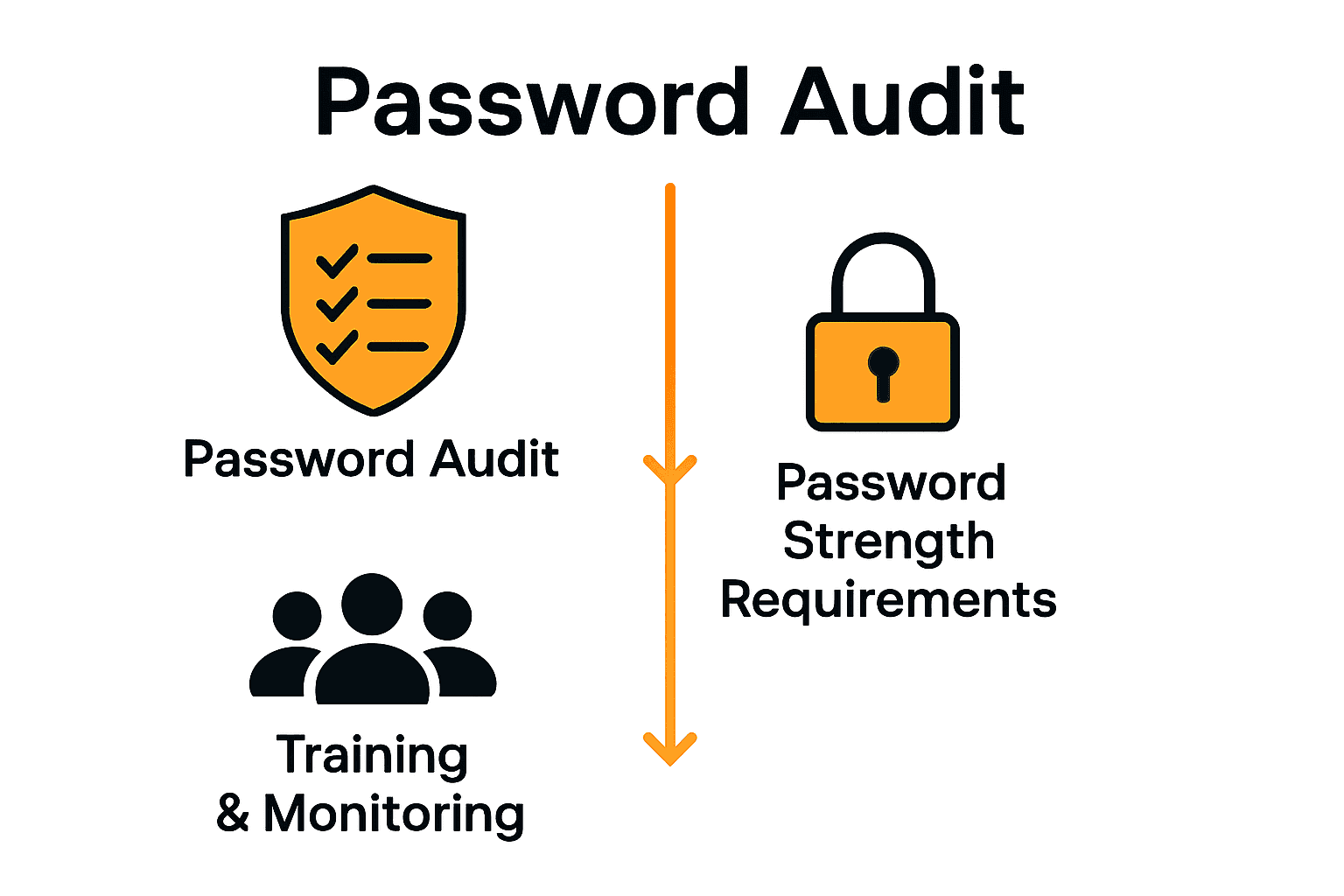 Your next step involves using these insights to continuously refine and improve your organization’s overall password security strategy.
Strengthen Your SMB Password Security with Expert IT Support
Understanding password vulnerabilities and enforcing strong password policies are critical steps to protect your business from costly cyber threats. If your small to medium-sized business faces challenges in assessing password risks or implementing effective security controls and training, you are not alone. Weak passwords and inconsistent policy enforcement leave your systems exposed to attackers attempting to exploit simple mistakes like reusing credentials or ignoring multi factor authentication.
At SRS Networks, we specialize in helping local businesses in the Monterey Bay area build resilient cybersecurity defenses tailored to your needs. From comprehensive cybersecurity solutions including password management tools and endpoint protection to customized managed IT services, we provide the expertise and proactive support that keep your passwords strong and your data secure.
Don’t let password weaknesses be the weak link in your cybersecurity strategy. Partner with SRS Networks now to develop and enforce password policies that protect your business assets. Visit SRS Networks today and take the next step toward safeguarding your digital future.
Frequently Asked Questions
What are the key components of a strong password policy for SMBs?
A strong password policy for SMBs should include clear guidelines on password complexity, length, and uniqueness. Ensure passwords are at least 10 characters long and composed of upper and lower case letters, numbers, and special characters. Implement these rules immediately to establish robust security standards.
How often should password audits be conducted?
Password audits should ideally be conducted quarterly to assess compliance with your password policy. Regular checks facilitate the identification of weak passwords or vulnerabilities, enabling your organization to address potential risks promptly.
What steps can be taken to train employees on password security?
To train employees effectively, develop an engaging, scenario-based training program that highlights the importance of strong passwords. Incorporate regular refresher courses and real-world simulations to reinforce good practices, aiming for ongoing education every few months.
How can multi-factor authentication enhance password security?
Multi-factor authentication (MFA) adds an additional layer of security by requiring users to verify their identity through multiple methods. Implement MFA within 30 days to significantly reduce the likelihood of unauthorized access to your systems.
What actions should be taken to improve password management in an organization?
To improve password management, implement a password manager to generate and securely store unique passwords. Encourage employees to use this tool consistently to reduce password reuse and enhance overall security practices.
How can organizations ensure compliance with password policies?
Organizations can ensure compliance by conducting regular audits and monitoring for policy violations such as weak password creation. Establish a reporting system that tracks compliance metrics and addresses issues immediately to maintain strong password security.