Law firms across the Bay Area are moving their operations to the cloud faster than ever before. And it is not just about convenience anymore. Some legal practices have already cut IT infrastructure costs by up to 40 percent simply by switching to scalable cloud solutions. That might sound like a tech upgrade, but the real story is even bigger. Cloud computing is changing how attorneys work, keep client data safe, and stay ahead in the legal world.
Quick Navigation: Cloud Computing for Bay Area Law Firms
- Top Cloud Computing Benefits For Law Firms
- Addressing Security And Compliance Challenges
- Choosing The Right Cloud Partner In The Bay Area
- Steps To A Successful Cloud Migration For Law Firms
Quick Summary
| Takeaway | Explanation |
|---|---|
| Cloud computing enhances data security. | Law firms benefit from advanced security measures including encryption and continuous monitoring, exceeding traditional systems. |
| Scalable infrastructure reduces IT costs. | Cloud solutions provide flexible resources that adjust to the firm’s needs, reducing overall IT expenditure significantly. |
| Remote collaboration boosts productivity. | Cloud platforms facilitate real-time document sharing and communication, allowing attorneys to work effectively from anywhere. |
| Choose partners with local expertise. | Selecting cloud providers familiar with regional regulations ensures compliance and improves support responsiveness. |
| Implement strategic migration frameworks. | A well-planned migration strategy, including training and change management, is essential for successful cloud adoption. |
Top Cloud Computing Benefits for Law Firms
Cloud computing has revolutionized how law firms manage their digital infrastructure, offering transformative advantages that go far beyond simple data storage. For legal professionals seeking to optimize their practice, understanding these key benefits becomes critical in maintaining competitive edge and operational efficiency.
Enhanced Data Security and Compliance
Law firms handle extraordinarily sensitive information, making data security paramount. Cloud computing provides robust security mechanisms that often surpass traditional on premise systems. Gartner Research reveals that cloud platforms implement multiple layers of security protection, including end to end encryption, multi factor authentication, and continuous monitoring.
Legal practices must navigate complex compliance requirements, and cloud solutions offer built in frameworks that help meet stringent regulatory standards. Advanced cloud platforms provide automatic updates to security protocols, ensuring law firms remain compliant with evolving data protection regulations like GDPR and CCPA.
Scalable and Cost Effective Infrastructure
Traditional IT infrastructure demands significant upfront capital investment and ongoing maintenance expenses. Cloud computing transforms this model by offering flexible, pay as you use resources that adapt precisely to a law firm’s changing needs. Deloitte’s Digital Transformation Report indicates that cloud solutions can reduce IT infrastructure costs by up to 40% for professional service organizations.
Small to medium sized law firms particularly benefit from this approach. Instead of purchasing expensive servers and networking equipment, firms can leverage cloud platforms that scale seamlessly. Whether a practice grows or experiences seasonal fluctuations in workload, cloud infrastructure provides immediate resource allocation without substantial capital expenditure.
Improved Collaboration and Remote Work Capabilities
The legal industry has dramatically transformed its work models, with remote and hybrid arrangements becoming standard. Cloud computing enables seamless collaboration through secure, real time document sharing and communication platforms. Attorneys can access case files, collaborate on documents, and communicate with clients from anywhere with internet connectivity.
Modern cloud solutions integrate powerful tools that support distributed teams. Document version control, secure file sharing, and integrated communication channels ensure that legal professionals can maintain productivity regardless of physical location. This flexibility not only improves operational efficiency but also attracts top talent who value dynamic work environments.
By embracing cloud computing, law firms position themselves at the forefront of technological innovation. The combination of enhanced security, cost effectiveness, and collaborative capabilities makes cloud solutions an indispensable tool for modern legal practices seeking to optimize their technological infrastructure and deliver exceptional client services.
Addressing Security and Compliance Challenges
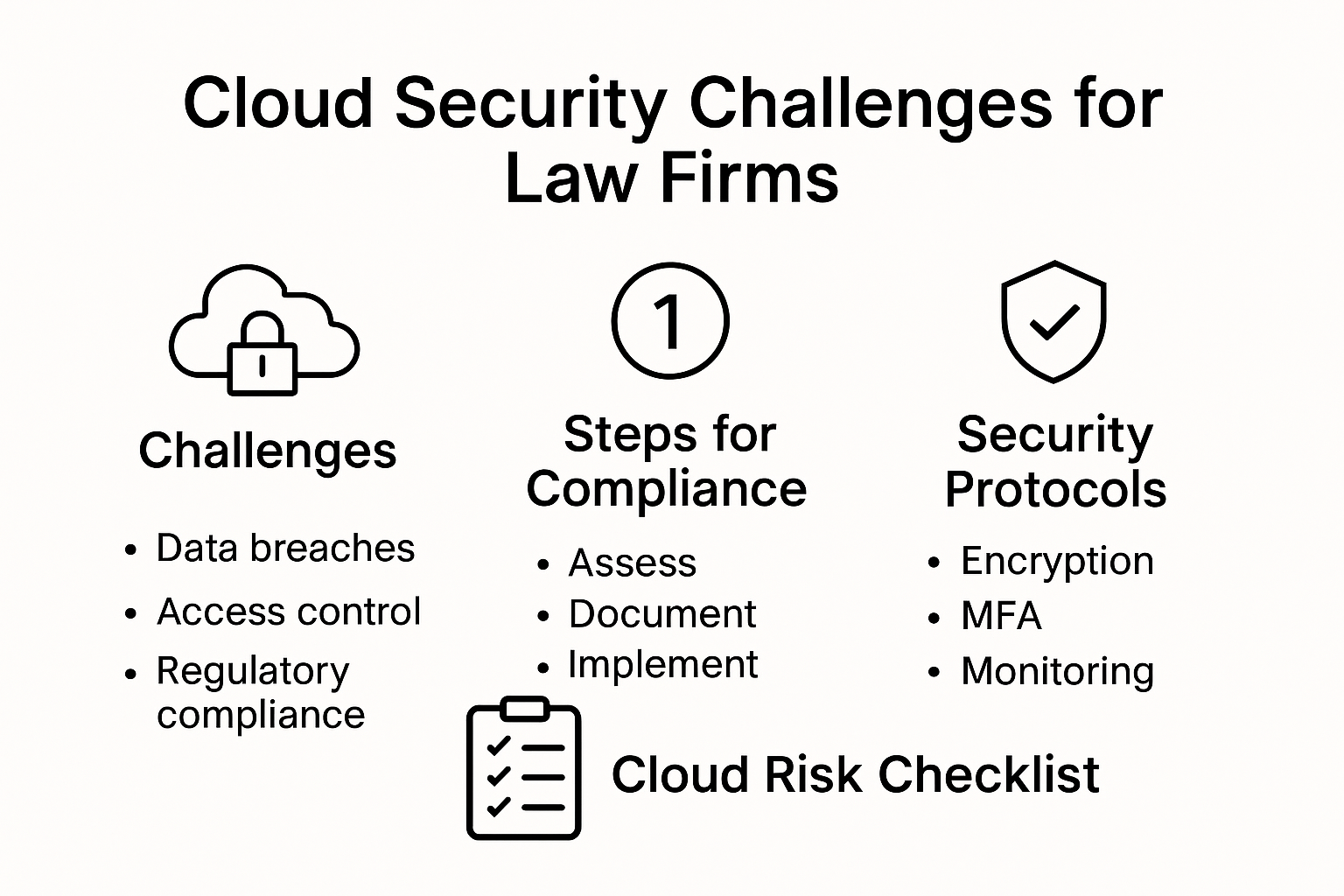
Cloud computing introduces complex security and compliance challenges for law firms that demand strategic and comprehensive approaches. Navigating these intricate landscapes requires understanding nuanced risks, implementing robust protective mechanisms, and maintaining continuous vigilance.
Regulatory Compliance Frameworks
Law firms operate within highly regulated environments that impose stringent data protection requirements. The Law Society emphasizes the critical need for understanding roles and responsibilities between cloud service providers and legal practices. Compliance is not a one time achievement but an ongoing process that requires constant monitoring and adaptation.
Key regulatory considerations include protecting client confidentiality, maintaining data integrity, and ensuring transparent documentation of data handling practices. Different jurisdictions may have varying requirements, making it essential for law firms to work with cloud providers who demonstrate comprehensive compliance capabilities across multiple regulatory frameworks.
Advanced Security Protocols
Mitigating cybersecurity risks demands multi layered security strategies. Journal of Internet Services and Applications highlights the complexity of implementing robust security architectures in cloud environments. Effective security protocols extend beyond basic encryption, incorporating advanced techniques such as:
- Multi Factor Authentication: Requiring multiple verification steps to access sensitive systems
- End to End Encryption: Protecting data during transmission and storage
- Continuous Monitoring: Real time threat detection and immediate response mechanisms
Law firms must prioritize cloud providers who offer granular access controls, allowing precise management of user permissions and maintaining strict information segmentation.
Risk Management and Incident Response
Developing comprehensive risk management strategies is crucial for law firms leveraging cloud computing. This involves creating detailed incident response plans, conducting regular security audits, and maintaining transparent communication channels with cloud service providers.
Proactive risk management includes comprehensive employee training on cybersecurity best practices, implementing robust backup and disaster recovery protocols, and developing clear policies for data handling and access. Law firms should treat cloud security as a dynamic ecosystem that requires continuous assessment and refinement.
By adopting a holistic approach to security and compliance, law firms can transform potential challenges into strategic advantages. The key lies in selecting cloud solutions that not only meet current regulatory requirements but also demonstrate flexibility and commitment to evolving technological landscapes.
Choosing the Right Cloud Partner in the Bay Area
Selecting the ideal cloud computing partner represents a critical strategic decision for law firms in the Bay Area. The technological landscape demands a nuanced approach that goes beyond basic service offerings and prioritizes specialized legal industry expertise.
Comprehensive Security and Compliance Evaluation
Louisiana State Bar Association emphasizes the paramount importance of rigorous due diligence when selecting cloud providers. Law firms must conduct thorough assessments of potential cloud partners, examining their security infrastructure, data protection protocols, and compliance capabilities.
Key evaluation criteria should include robust encryption standards, granular access controls, and transparent data management policies. Law firms need cloud partners who demonstrate not just technical competence but a deep understanding of legal industry specific security requirements. This means verifying the provider’s ability to meet sector specific regulations and maintain the highest standards of client confidentiality.
Local Expertise and Responsiveness
In the Bay Area’s competitive technological ecosystem, proximity and local understanding become significant differentiators. Cloud partners with regional presence offer distinct advantages, including faster response times, better understanding of local regulatory environments, and more personalized support.
Massachusetts Bar Association recommends attorneys exercise ‘reasonable care’ when selecting cloud technologies. This translates to choosing providers who can demonstrate:
- Immediate Technical Support: Local teams capable of rapid onsite intervention
- Regional Compliance Knowledge: Understanding of California specific legal technology regulations
- Scalable Solutions: Flexible infrastructure that grows with your firm’s needs
Technology Integration and Future Readiness
The ideal cloud partner should not merely provide current solutions but demonstrate a commitment to technological innovation. Law firms require partners who can seamlessly integrate emerging technologies, support advanced workflow automation, and provide predictive insights through intelligent data management.
This means evaluating potential cloud providers based on their research and development investments, their track record of technological adaptation, and their ability to offer forward looking solutions. The right partner will help law firms not just manage current technological challenges but anticipate and prepare for future digital transformations.
Ultimately, selecting a cloud computing partner in the Bay Area is about finding a strategic technology ally. It requires a holistic assessment that balances technical capabilities, industry specific expertise, local responsiveness, and a forward thinking approach to legal technology infrastructure.
Steps to a Successful Cloud Migration for Law Firms
Cloud migration represents a transformative journey for law firms, requiring meticulous planning, strategic execution, and comprehensive understanding of technological and operational dynamics. A systematic approach ensures minimal disruption and maximizes the potential of cloud technologies.
Developing a Strategic Cloud Migration Framework
Thomson Reuters emphasizes the critical importance of constructing a comprehensive business cloud strategy before implementation. Successful migration begins with strategic alignment, integrating technological solutions directly with the firm’s long term objectives.
This strategic framework involves conducting a high level operational analysis of existing IT applications, identifying critical systems, and evaluating their compatibility with cloud infrastructure. Engaging practice leaders and soliciting feedback ensures that the migration strategy addresses specific departmental needs and workflow requirements.
Comprehensive Technical Assessment and Preparation
Accountancy Age recommends a thorough technical readiness evaluation before migration. Assessing existing software compatibility becomes paramount in preventing potential integration challenges.
Key technical preparation steps include:
- Infrastructure Audit: Comprehensive review of current IT systems and potential cloud migration challenges
- Compatibility Testing: Evaluating existing software and applications for cloud readiness
- Performance Benchmarking: Establishing baseline performance metrics to measure post migration efficiency
Law firms must also develop a detailed migration roadmap that outlines specific implementation phases, potential risks, and mitigation strategies. This approach allows for incremental migration, minimizing operational disruptions.
Training and Change Management
Successful cloud migration extends beyond technological implementation. It requires a holistic approach that addresses human factors, including staff training, cultural adaptation, and change management.
Implementing comprehensive training programs helps legal professionals understand new cloud based workflows, security protocols, and collaborative tools. This approach reduces resistance to technological change and accelerates user adoption. Firms should design role specific training modules that demonstrate the practical benefits of cloud technologies for different professional roles within the organization.
Additionally, establishing clear communication channels during the migration process helps manage expectations, address concerns, and maintain transparency. Regular updates, feedback mechanisms, and dedicated support resources can significantly smooth the technological transition.
Cloud migration represents more than a technological upgrade it is a strategic transformation of how law firms operate, collaborate, and deliver services. By approaching the process systematically, with careful planning and comprehensive support, law firms can unlock unprecedented efficiency, flexibility, and innovation in their technological infrastructure.

Here is a summary table outlining the key security features described for cloud computing in law firms. This helps clarify which advanced measures go beyond traditional on-premise IT approaches:
| Security Feature | Description | Benefit to Law Firms |
|---|---|---|
| End-to-End Encryption | Protects data during transmission and storage | Maintains confidentiality of sensitive information |
| Multi-Factor Authentication | Requires users to verify identity with multiple steps | Prevents unauthorized access |
| Continuous Monitoring | Monitors for threats and suspicious activity in real-time | Enables immediate response to cyber threats |
| Granular Access Controls | Manages permissions for users to access specific information | Ensures information segmentation |
| Automatic Security Updates | Updates security protocols regularly to stay ahead of threats and regulations | Keeps firm compliant and protected |
Below is a process table summarizing the recommended steps for law firms to successfully migrate to the cloud, as discussed in the article:
| Migration Phase | Key Actions and Considerations |
|---|---|
| Strategic Framework Development | Analyze existing IT systems, align cloud migration with business goals, involve practice leaders |
| Technical Assessment & Preparation | Perform infrastructure audits, test software compatibility, establish performance benchmarks |
| Migration Roadmap & Risk Management | Create phased migration plan, identify risks, develop mitigation strategies |
| Training & Change Management | Provide staff training, develop role-specific modules, address cultural and operational change |
| Communication & Support During Transition | Establish communication channels, offer regular updates, provide support resources |
Frequently Asked Questions
What are the main benefits of cloud computing for law firms?
Cloud computing offers enhanced data security, scalable and cost-effective infrastructure, and improved collaboration and remote work capabilities, making it an essential tool for modern legal practices.
How does cloud computing enhance data security for law firms?
Cloud computing provides advanced security measures such as end-to-end encryption, multi-factor authentication, and continuous monitoring, which help protect sensitive client information more effectively than traditional IT systems.
What should law firms consider when choosing a cloud service provider?
Law firms should evaluate potential cloud partners for their security and compliance standards, local expertise, responsiveness, and their ability to integrate future technologies into their services.
What steps should law firms take for a successful cloud migration?
A successful cloud migration involves developing a strategic migration framework, conducting a comprehensive technical assessment, creating a detailed migration roadmap, and implementing thorough training and change management processes.
Ready to Secure Your Law Firm’s Future with Reliable Cloud Solutions?
Your clients trust you to keep their data safe. Yet, as this article highlights, many law firms in the Bay Area face tough challenges when moving to the cloud. Concerns about protecting sensitive client information, meeting strict compliance rules, and making technology changes without major disruptions can feel overwhelming. That is why hundreds of regional firms trust SRS Networks to turn those fears into strengths. Our team specializes in cloud migration, cybersecurity, and ongoing IT support, with a focus on local law practices just like yours.
Why wait until security risks grow or your technology slows down casework? Let SRS Networks build a next-generation, compliant cloud solution designed just for your firm. Visit SRS Networks today to see how we help Bay Area law firms enjoy secure cloud computing, confident compliance, and reliable local support. Start a conversation with our experts now so you can stay focused on your clients while we take care of your infrastructure.