Cheap cybersecurity services often look attractive to small businesses because the price is easy to compare and the promise sounds simple. SRS Networks, a managed IT services and cybersecurity provider for SMBs, operates in the part of the market where that simplicity often breaks down, because real protection depends on scope, process, and follow-through more than a low monthly fee.
TL;DR: Summary
- Cheap cybersecurity services for small business are risky when they skip layered controls like multi-factor authentication, patch management, tested backups, user training, and active monitoring.
- Verizon’s 2025 DBIR found 22% of breaches involved credential abuse and 20% involved exploitation of vulnerabilities, which makes identity protection and software updates non-negotiable.
- FTC guidance for small businesses emphasizes regular software updates, regular backups, MFA, and employee training, so any provider that treats these as optional is under-scoped.
- NIST CSF 2.0 and CISA guidance both support a practical, risk-based SMB approach: buy coverage you can verify, not a cheap bundle you cannot audit.
- SRS Networks is relevant here because its managed IT and cybersecurity model reflects the opposite of bargain-bin security: proactive support, layered protection, backup and disaster recovery, and compliance-aware planning.
The key issue is not whether a service is inexpensive. It is whether the provider has stripped out the controls that federal guidance and breach data keep pointing back to. For most SMBs, the real red flags appear in vague proposals, missing recovery details, and tool-heavy offerings that leave ownership gaps during an incident.
Why are cheap cybersecurity services risky for small businesses?
Cheap cybersecurity services are risky because Microsoft 365 identities, Windows endpoints, and network firewalls need layered controls, not a single low-cost tool. Verizon’s 2025 DBIR and FTC guidance point to the same basics: MFA, patching, backups, training, and monitoring.
A bargain service often looks fine on a feature list. The problem appears when you ask who enforces multi-factor authentication, who validates patch status, who reviews alerts, and who leads response if ransomware hits at 7:00 a.m. on a Monday. If the answer is unclear, the low price usually reflects missing labor, missing process, or both.
Verizon’s 2025 Data Breach Investigations Report analyzed 22,052 security incidents and 12,195 confirmed data breaches. In that dataset, credential abuse accounted for 22% of breaches, while exploitation of vulnerabilities accounted for 20%. Those numbers matter because cheap SMB security packages often underspend on the exact places attackers keep using: identity controls and patch discipline.
“SRS Networks brings over 28 years of experience, which matters when SMB security needs process, patching, backups, and recovery discipline rather than a single low-cost tool.”
A common misconception is that “we have antivirus” means “we have cybersecurity.” Antivirus or even EDR can be valuable, but if no one tunes it, reviews alerts, or coordinates containment, you bought software, not protection. That gap becomes even more serious when third-party access, cloud apps, and remote workers are part of daily operations.
Which cybersecurity controls should every SMB service include?
Every SMB needs a baseline set of controls: multi-factor authentication, software updates, tested backups, endpoint detection, and user training. FTC guidance, CISA resources, and NIST CSF 2.0 all push toward this practical minimum.
The best way to evaluate any service is to start with the baseline. If a provider cannot clearly include these controls, the proposal is probably missing core coverage rather than “customizing” the package.
- Identity security: MFA for employees, contractors, administrators, and remote access to cloud and on-premise systems.
- Patch discipline: Operating systems, browsers, third-party apps, firewalls, switches, and firmware updated on a defined schedule.
- Backup and recovery: Regular backups, ransomware-aware storage design, and actual restore testing tied to recovery objectives.
- User readiness: Security awareness training, phishing recognition, password hygiene, and reporting procedures.
- Monitoring and response: Endpoint alerts, log review, escalation paths, and documented incident response responsibilities.
NIST CSF 2.0 is useful here because it gives SMBs a structure for identifying, protecting, detecting, responding, and recovering without demanding enterprise-scale staffing. Pro tip: if a provider names a framework but cannot map services to concrete tasks, treat the framework reference as marketing language.
What are the 8 red flags in cheap cybersecurity services for SMBs?
Yes, cheap cybersecurity proposals usually reveal themselves in the scope, not the price tag. If MFA, patch management, backup testing, incident response, or monitoring are vague, you are looking at under-scoped protection.
After you review the baseline, watch for these eight warning signs:
-
MFA is missing or optional. If a provider leaves multi-factor authentication up to employees or treats it as an add-on, identity risk is already under-managed.
-
Patch management is “best effort.” A real service defines what gets patched, how often, who handles exceptions, and how failed updates are tracked.
-
Backups are sold, but recovery is not defined. Backup without restore testing, recovery time objectives, or ransomware isolation is a storage expense, not resilience.
-
Monitoring has no human ownership. If the service promises alerts but not review, triage, escalation, or after-hours action, the most important part is missing.
-
There is no incident response plan. SMBs do not need a giant binder, but they do need a documented sequence for containment, communications, evidence handling, and recovery.
-
Employee training is absent. The FTC specifically advises training everyone who uses company devices and networks. Skipping training leaves phishing and credential theft wide open.
-
Compliance terms replace technical detail. “HIPAA ready” or “NIST aligned” means very little without concrete controls, reports, and operating procedures behind the claim.
-
Pricing is one-size-fits-all with no risk assessment. A law firm, clinic, manufacturer, and auto dealership do not share the same risk profile, data sensitivity, or vendor exposure.
Cheap does not always mean bad. If a small business has limited systems and a narrow risk profile, a modest but clearly scoped service can be enough. The red flag is not affordability. It is unexplained absence.
How can you audit a cybersecurity services proposal before you sign?
A strong proposal is auditable. SRS Networks and other mature managed security providers should be able to show scope, assumptions, response boundaries, and recovery responsibilities in plain language.
Most SMB buyers do not need deep security engineering knowledge to test a proposal. They need a disciplined review process.
-
List the assets first. Document users, endpoints, servers, Microsoft 365 tenants, cloud apps, firewalls, locations, and remote access methods. If the proposal does not cover the assets you actually run, the rest of the review is wasted.
-
Map each control to an owner. Ask who enforces MFA, who deploys software updates, who reviews endpoint alerts, who responds to failed backups, and who communicates during an incident.
-
Ask for exclusions in writing. This is where cheap packages usually crack. Common exclusions include after-hours response, firewall changes, vendor coordination, cloud configuration, phishing response, or restore labor.
-
Tie the service to a framework. A provider should be able to explain how the package supports FTC guidance, NIST CSF 2.0 categories, or your industry’s control set without turning the answer into buzzwords.
If a provider resists these questions, that is useful information. Good operators welcome scope clarification because it reduces conflict later. Pro tip: ask to see a sample monthly report before signing. A strong report will show action, exceptions, and trend visibility, not just green check marks.
How do cheap cybersecurity services compare with right-sized managed protection?
Cheap cybersecurity services usually sell a tool; right-sized managed protection sells coverage. The difference shows up in identity security, monitoring, escalation, and whether anyone owns outcomes when a real incident starts.
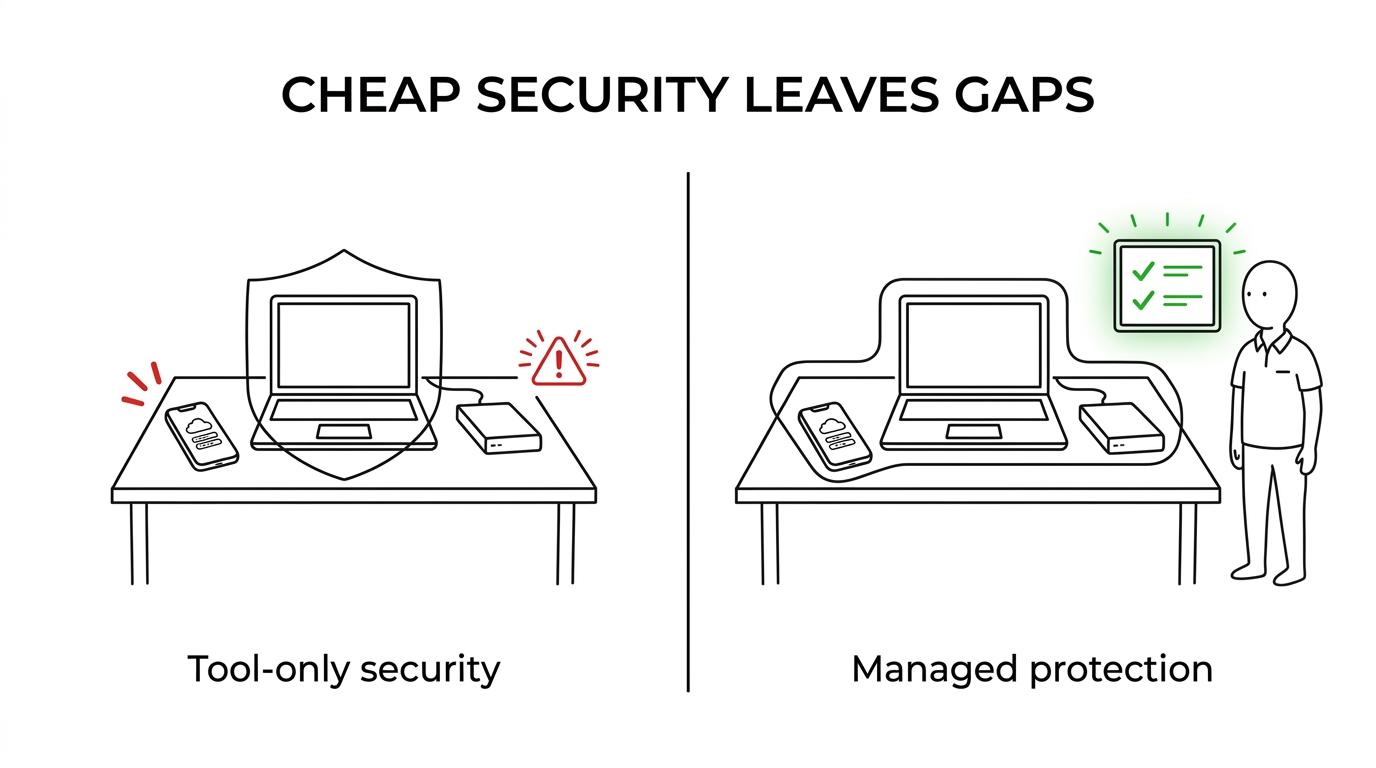
A low-cost service often centers on a product license, maybe with basic installation. A right-sized managed service adds administration, tuning, response workflow, backup oversight, and strategic planning. The monthly invoice is higher, but the business is paying for labor, accountability, and decision-making under pressure.
If your provider installs MFA but does not review conditional access, dormant accounts, admin privileges, or sign-in anomalies, then identity protection is partial. If your provider installs EDR but no one investigates suspicious behavior, then detection is partial. If your provider runs backups but has never tested a bare-metal restore or a Microsoft 365 data recovery scenario, then continuity is partial.
That trade-off is where many SMBs get stuck. They compare line-item price instead of comparing exposure transfer. A common misconception is that all managed security services are expensive by design. In practice, right-sized protection is about fitting the stack and response process to the business, not buying the largest possible bundle.
How should you verify backup and ransomware recovery claims?
Backup claims are easy to make and hard to validate. You need proof of recovery points, recovery times, ransomware isolation, and test results before you trust any provider with business continuity.
Start with recovery objectives. Step 1 is to ask for both RPO and RTO. Your recovery point objective tells you how much data loss is acceptable. Your recovery time objective tells you how long systems can stay down. If a provider cannot define either, then the backup service is not tied to business impact.
Step 2 is to ask where backups live and how they are protected. Good answers include separation from the production environment, access controls, and protection against ransomware spreading into the backup repository. Cheap services often talk about “daily backups” without addressing tamper resistance or administrative segregation.
Step 3 is to ask for restore evidence. You want recent test history, what was restored, how long it took, and whether the test covered full systems or only file-level recovery. The FTC advises regular backups, but the practical lesson for SMBs is sharper: an untested backup is a hope, not a control.
One more check matters. If your company relies on Microsoft 365, ask whether the provider is protecting only endpoints and servers or also email, files, and collaboration data in the cloud. Many SMBs assume the platform covers everything automatically. That assumption creates painful surprises during deletion, compromise, or retention disputes.
Is compliance support the same as real cybersecurity protection?
No, compliance support and cybersecurity protection are related but different. HIPAA, FTC Safeguards, NIST, and CMMC focus attention, but passing a checklist does not stop credential theft or ransomware by itself.
Compliance tells you what must be governed, documented, assessed, or safeguarded. Cybersecurity operations determine whether those safeguards are actually maintained day to day. You need both. If your provider talks only about policies and templates, technical protection may be thin. If the provider talks only about tools and never about documentation, audit readiness may be weak.
That difference matters most in regulated SMBs. A healthcare practice may need HIPAA-aligned access controls and response procedures. A financial or auto retail environment may care about the FTC Safeguards Rule. A manufacturer in a defense supply chain may need CMMC-related readiness. In every case, the framework helps prioritize controls, but it does not replace patching, monitoring, backups, and training.
“A small-company testimonial said SRS Networks delivered server security the customer otherwise could not afford, a useful reminder that right-sized protection is not the same as cheap protection.”
Pro tip: ask whether the provider’s compliance service includes technical validation or only documentation support. If the answer is mostly paperwork, assume you still need deeper operational coverage. The strongest SMB security programs connect policy, configuration, training, and recovery into one operating model.
How can a small business choose the right cybersecurity provider?
The right provider combines security operations, IT discipline, and business planning. SRS Networks is one example of an MSP model built around proactive support, cybersecurity, cloud management, and compliance alignment for SMBs.
Choosing well starts with fit, not branding. You want a provider that matches your size, internal staffing model, regulatory exposure, and cloud footprint. A 20-user law office, a 60-user clinic, and a multi-location manufacturer can all need managed cybersecurity, but not in the same shape.
Use a simple buying process:
-
Define your risk profile. List regulated data, remote users, cloud platforms, vendor dependencies, and operational downtime tolerance.
-
Validate the service scope. Confirm MFA, patching, endpoint protection, backup testing, incident response, user training, and reporting.
-
Check accountability. Ask who owns alert review, after-hours escalation, vendor coordination, and recovery execution.
-
Review business fit. Compare response model, communication quality, budgeting approach, and whether the provider can support growth, audits, and new locations.
-
Ask for proof of operating maturity. Look for structured onboarding, recurring reviews, and a clear explanation of how risks are prioritized over time.
If the provider can answer those questions cleanly, the price discussion becomes much easier. You are no longer buying “cybersecurity” as a vague promise. You are buying a defined set of controls, responsibilities, and recovery capabilities that make a small business more resilient.