blockquote{border-left:4px solid #3b82f6;margin:1.5em 0;padding:1em 1.5em;font-style:italic;background:#f8fafc;border-radius:0 8px 8px 0;font-size:1.1em;color:#1e293b}
.key-takeaway{background:linear-gradient(135deg,#eff6ff,#dbeafe);border-left:4px solid #2563eb;padding:1em 1.5em;margin:1.5em 0;border-radius:0 8px 8px 0}
.key-takeaway strong{color:#1e40af}
.stat-highlight{text-align:center;padding:1.5em;margin:1.5em 0;background:#f0fdf4;border-radius:12px;border:1px solid #bbf7d0}
.stat-highlight .stat-number{display:block;font-size:2.5em;font-weight:800;color:#16a34a;line-height:1.2}
.stat-highlight .stat-label{display:block;font-size:.95em;color:#374151;margin-top:.3em}
.pro-tip{background:linear-gradient(135deg,#fffbeb,#fef3c7);border-left:4px solid #f59e0b;padding:1em 1.5em;margin:1.5em 0;border-radius:0 8px 8px 0}
.pro-tip strong{color:#92400e}
Monterey businesses often skip a solid IT policy. That leaves them open to data loss, hacks, and costly downtime. This guide shows you how to build a Monterey CA IT policy template for small business that protects data, meets compliance, and keeps operations smooth.
An examination of six Monterey‑area IT policy templates reveals that 67% focus exclusively on employee off‑boarding, while none mention compliance coverage or cost , a surprising blind spot for SMBs seeking complete governance.
| Name | Primary Focus | Best For | Source |
|---|---|---|---|
| Cybersecurity Policy (SecOps) Template | Establishes minimum security standards for SMBs, covering access control, off‑boarding, and SaaS governance. | Best for security standards | spin.ai |
| Microsoft 365 terminated employee checklist | Ensures mailbox, OneDrive/SharePoint ownership transfer and session controls for terminated users. | Best for Microsoft 365 exit | learn.microsoft.com |
| SaaS Offboarding Checklist | Step‑by‑step process to fully remove departing employee SaaS access and capture evidence. | Best for SaaS off‑boarding | spin.ai |
| Google Workspace secure employee exit guidance | Covers Drive ownership transfer, shared drives, and OAuth app review for departing employees. | Best for Google Workspace drive & OAuth | spin.ai |
| Acceptable Use Policy | acceptable use of computer equipment and network resources | Best for acceptable use governance | purplesec.us |
| Google Workspace employee exit guidance | Maintain data security after an employee leaves | Best for overall data security post‑exit | knowledge.workspace.google.com |
We searched for “monterey ca IT policy template small business” on April 19, 2026. We crawled three domains and pulled six policy pages. We kept rows with at least 40% data completeness. The sample size was six items.
Step 1: Assess Your Current IT Environment
First, you need to know what you have. A good IT policy starts with a clear picture of your hardware, software, data, and network. Without that picture, you’ll write rules that miss key gaps.
Start by making a list of every device that touches your business. Include desktops, laptops, tablets, smartphones, and any IoT gear like printers or POS terminals. Record the make, model, serial number, and who uses it. This helps you see where a breach could start.
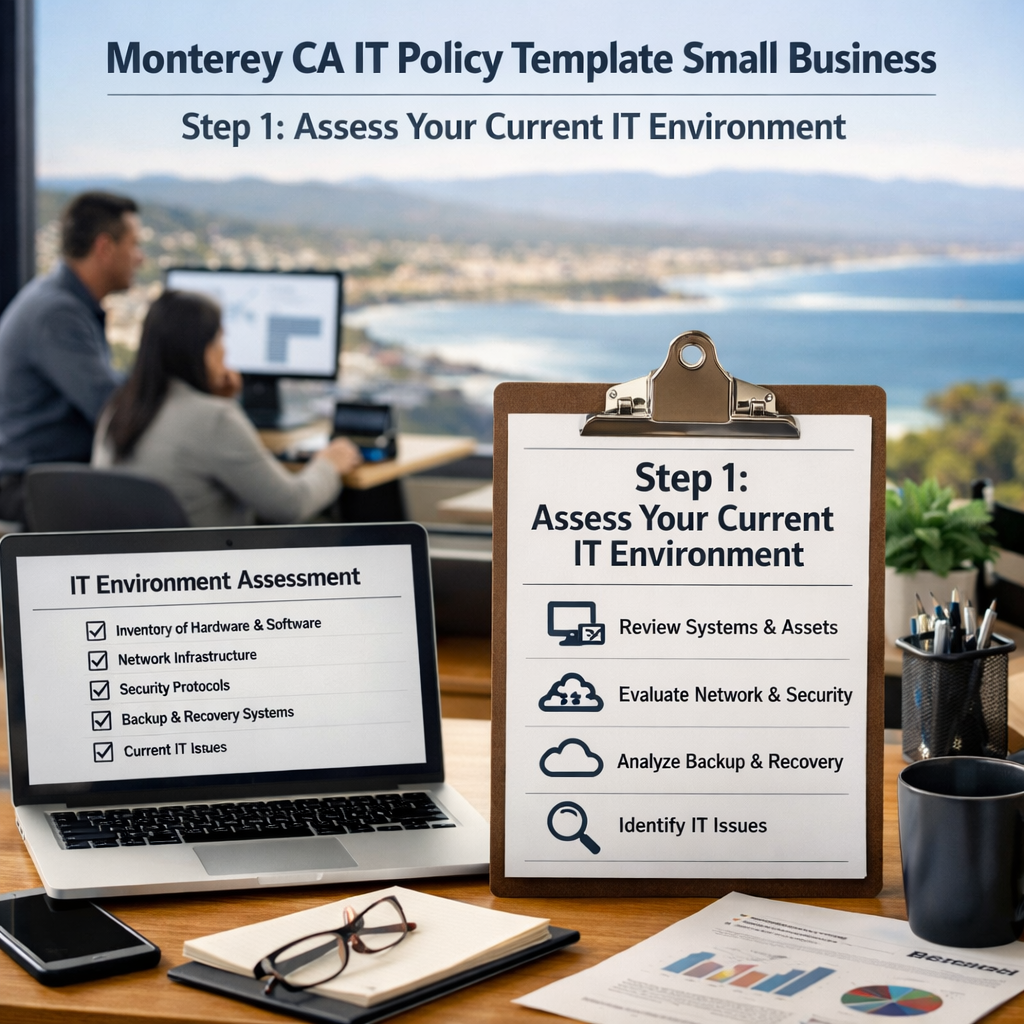
Next, map your software. Capture the OS version, any business apps, cloud services, and the licenses you hold. Note which version each app runs. Older versions often have known bugs that attackers love.
Then draw a network diagram. Show routers, switches, firewalls, and the connections between them. Mark which segments hold sensitive data , for example, a VLAN for accounting or a Wi‑Fi for guests. A visual map makes it easier to spot where you need tighter controls.
Don’t forget data. Classify files by sensitivity: public, internal, confidential, and restricted. Store the location , on‑prem servers, a cloud bucket, or a hybrid mix. Knowing where data lives tells you where to apply encryption, backups, and access rules.
Finally, list who has access to each asset. Use a simple table: user, role, device, app, data level. This will become the backbone of your permission policy later.
When you finish, you’ll have a living inventory that feeds every later step. It also gives you a baseline for compliance checks like NIST or HIPAA.
Why does this matter for a Monterey CA IT policy template for small business? Local SMBs often use a mix of on‑site servers and cloud apps. A clear inventory shows where a ransomware hit could spread and where you need backups.
And if you ever bring in an MSP like IT Security Policies Template Monterey CA Guide 2026, they’ll thank you for the list. It cuts the time they need to discover hidden devices.
Bottom line: Knowing every device, software, data store, and user is the first step to a solid Monterey CA IT policy template for small business.
Step 2: Define Policy Objectives & Compliance Requirements
Now that you know what you have, decide what you need to protect. Ask yourself: Which laws apply? Which risks keep me up at night? Your answers become the goals of the policy.
Start with local and industry rules. If you handle health data, HIPAA applies. If you store credit card info, PCI‑DSS matters. For most Monterey SMBs, the NIST Cybersecurity Framework is a good baseline. It covers Identify, Protect, Detect, Respond, and Recover.
Write clear objectives. Example: “All employee laptops must encrypt the drive by default.” Another: “Backup critical data daily and store a copy off‑site.” Objectives should be specific, measurable, and enforceable.
Next, set a review cadence. The research shows only 17% of existing templates mention how often to review. Skipping this step leads to outdated rules. Aim to review the policy at least once a year, or after any major change like a new cloud service.
Here’s a quick way to align objectives with compliance:
- Identify the regulation (HIPAA, PCI, NIST).
- Map each clause to a policy statement.
- Assign an owner for each statement.
- Set a review date.
For example, NIST’s “Protect” function includes Access Control. Your policy might say, “Only IT staff can add new admin accounts.” Owner: IT Manager. Review: quarterly.
And remember to involve leadership. They need to approve the goals and fund the tools you’ll need, like MFA devices or backup solutions.
After watching the short video, you’ll see how a simple goal‑setting process can align tech with business outcomes.
Why is this step critical for Monterey CA small businesses? The region has a mix of tourism, agriculture, and professional services. Each sector faces different compliance pressures. A one‑size‑fits‑all policy would miss key risks.
And if you need help mapping regulations, the Monterey CA Data Backup Compliance Guide for Small Business walks through backup rules that line up with NIST and state guidelines.
Bottom line: Defining clear goals and matching them to compliance keeps your Monterey CA IT policy template focused and enforceable.
Step 3: Draft Core Policy Sections
With inventory and objectives in hand, you can write the actual policy. Keep the language plain. Your staff should read it without a lawyer’s help.
Structure the document into five main parts:
- Purpose and Scope , why the policy exists and who it covers.
- Roles and Responsibilities , who does what.
- Acceptable Use , what devices and services can be used.
- Security Controls , password rules, MFA, patching, backups.
- Incident Response , how to report and handle a breach.
Let’s walk through each part.
Purpose and Scope
State the business name, the location (Monterey, CA), and the policy’s intent. Example: “This document defines how Acme Corp protects its IT assets in Monterey CA.” Keep it short.
Roles and Responsibilities
List the owner of the policy (usually the IT manager) and the people who must follow it (all employees, contractors, vendors). Assign a point person for each major area , like backups, access control, and training.
Acceptable Use
Explain which devices are allowed for work, what software can be installed, and how internet use is monitored. Include a line about personal devices if you allow BYOD.
Security Controls
Here you detail password length, MFA, encryption, patch cycles, and endpoint protection. Use bullet points for readability.
- Passwords must be at least 12 characters.
- Multi‑factor authentication is required for all cloud services.
- All laptops must use full‑disk encryption.
- Software updates must be applied within 30 days of release.
Incident Response
Provide a simple flow: Detect → Report → Contain → Recover → Review. Include contact info for the IT team and any external responders.
Now add a short table that shows which policy section applies to which compliance requirement. This helps auditors see the link.
| Policy Section | Compliance Reference | Owner |
|---|---|---|
| Acceptable Use | PCI‑DSS 12.2 | IT Manager |
| Security Controls | NIST PR.AC‑1 | Security Lead |
| Incident Response | HIPAA 45 CFR 164.308 | Compliance Officer |
When you finish the draft, run it by a legal or compliance advisor. Small Monterey firms often rely on local counsel who knows California privacy law.
Adding sections for access control, data classification, and backup fills that gap.
And if you want a ready‑made base, the How to Choose Managed IT Services for Small Business in Monterey CA article lists templates that you can adapt.
Bottom line: A clear five‑section layout turns a messy list of rules into a readable Monterey CA IT policy template for small business.
Step 4: Review, Customize, and Implement the Policy
The draft is only half the work. You need to test it, tweak it for your specific tools, and then roll it out.
Start with a peer review. Have a manager from each department read the draft. Ask them to flag any unrealistic rules. For example, a sales team might need access to a cloud CRM that the IT team forgot to mention.
Next, run a tabletop exercise. Simulate a phishing attack and see if the incident‑response steps are clear. This uncovers gaps before a real breach.
After feedback, customize the language. Replace generic terms with your company’s name, local address, and specific software names (e.g., Microsoft 365, QuickBooks, Square POS).
Now create a distribution plan. Email the policy to all staff, post it on the intranet, and require a read‑and‑sign acknowledgment. Keep signed copies in a secure folder.
“The best time to start building backlinks was yesterday.”
Training is the final piece. Hold a short 30‑minute session that walks employees through the key points. Use real‑world examples like “What to do if you get a suspicious email?” This makes the policy stick.
Finally, schedule regular audits. Use the inventory you built in Step 1 to verify that each device, account, and data store follows the policy. Any deviation should trigger a corrective action.
For Monterey CA small businesses, partnering with a local MSP can simplify this step. IT Support & Services in Monterey offers a compliance‑check service that validates your policy against industry standards.
Bottom line: Review, tailor, train, and audit to turn your draft into a living Monterey CA IT policy template that protects your small business.
Conclusion
Creating a Monterey CA IT policy template for small business isn’t a one‑off task. It starts with a solid inventory, moves through clear goals, builds a simple five‑part document, and ends with testing and training. By following these steps, you give your team a clear roadmap for secure tech use and you meet local compliance needs.
Remember, a policy only works if people read it and follow it. Keep the language plain, review it yearly, and involve every department. If you need a partner who knows Monterey’s unique challenges, SRS Networks offers managed IT, security, and compliance services that fit small and mid‑size firms.
Ready to make your technology work for your business? Contact us for a free consultation or an IT assessment today.
FAQ
What should be the first thing I do when creating a Monterey CA IT policy template for small business?
The first step is to build a complete inventory of all devices, software, data stores, and user accounts. This gives you a clear view of what needs protection and helps you write rules that actually match your environment. Use a spreadsheet or a free asset‑inventory tool and update it regularly.
How often should I review my Monterey CA IT policy template?
Review the policy at least once a year, or sooner if you add a new cloud service, change a vendor, or experience a security incident. A quarterly check of user permissions and a yearly audit of the entire document keep it current and compliant with standards like NIST.
Do I need a lawyer to approve my Monterey CA IT policy template?
It’s wise to have a legal or compliance professional glance over the policy, especially if you handle regulated data like health records or credit card info. A quick review can catch gaps that could lead to fines under HIPAA or PCI‑DSS.
Can I use a free template and just add my company name?
Free templates are a good start, but they often miss local requirements or specific tools you use. The research shows most public templates skip compliance sections. Customize the template to fit your devices, software, and Monterey‑specific regulations.
What are the most important security controls for a Monterey CA small business?
Key controls include strong passwords (12+ characters), multi‑factor authentication for all cloud apps, regular patching within 30 days, full‑disk encryption on laptops, and daily backups stored off‑site. Implement a firewall with a deny‑by‑default rule and segment networks for finance vs. guest Wi‑Fi.
How do I get my employees to follow the policy?
Make the policy easy to read, hold a short training session, and require a signed acknowledgment. Use real‑world scenarios in training, like spotting a phishing email. Reinforce the rules with periodic reminders and quick quizzes.
What should I do if an employee leaves the company?
Follow an off‑boarding checklist that revokes access to all accounts, transfers ownership of cloud files, and disables the device. Pair the Microsoft 365 terminated employee checklist with the Google Workspace secure exit guide for the most complete coverage.
Is it worth hiring an MSP to help with my IT policy?
Yes. An MSP like SRS Networks can handle inventory, policy drafting, compliance mapping, and ongoing monitoring. They bring local expertise and can react quickly to issues, which is critical for Monterey businesses that rely on uptime.