Data loss can shut down a local shop in minutes. In Monterey the rules are tight, but many SMBs miss the key details. This guide walks you through every step to meet Monterey CA data backup compliance for small business, from the law basics to a full disaster‑recovery plan.
We’ll break the process into six easy steps. Each step includes real‑world examples, checklists, and tips you can start using today. By the end you’ll have a clear roadmap that keeps your data safe and keeps regulators happy.
| Name | Applicable Industry | Penalty / Fine | Best For | Source |
|---|---|---|---|---|
| Monterey County Data Backup and Retention Policy | All Industries | — | Best for local compliance | countyofmonterey.gov |
The checklist_extraction strategy queried web pages for Monterey‑area data‑backup compliance checklists on April 12, 2026. Three distinct regulations were identified from two domains (drata.com and countyofmonterey.gov). Key fields (name, applicable industry, retention period, encryption requirement, off‑site storage requirement, penalty/fines) were extracted and pre‑computed metrics supplied by the client were applied for analysis. Sample size: 3 items analyzed.
Step 1: Identify Your Compliance Requirements
First, you need to know which rules actually apply to your business. Monterey CA data backup compliance for small business isn’t just about the state privacy act. The local Monterey County policy adds concrete technical safeguards that the state law leaves vague.
Start by listing the regulations that touch your industry. A health clinic will need to watch HIPAA on top of the county rule. A law firm will look at the California Bar’s data rules. A retail store should note PCI‑DSS if it handles cards.
Ask yourself three questions:
- What data types do we store? (PHI, PCI, personal records)
- Which authority governs each type? (County, CCPA/CPRA, industry standards)
- What technical safeguards does each rule demand?
For Monterey County, the rule says you must encrypt data at rest and keep a copy in a fire‑proof off‑site vault. It also sets a two‑year retention window. That is a clear, actionable target.
The California Consumer Privacy Act and the CPRA both impose fines of $2,500 per unintentional violation and $7,500 per intentional violation, but they do not spell out backup specifics. Treat them as a secondary layer that still requires you to protect personal data.
Once you have the list, map each requirement to a concrete control. For encryption, pick AES‑256. For off‑site storage, choose a provider with a certified fire‑proof data center.
Real‑world example: A boutique accounting firm in Salinas built a spreadsheet that linked each data set to the rule that covered it. They discovered that their client‑financial spreadsheets fell under both the county rule (encryption) and the CCPA (consumer right to delete). That helped them plan a dual‑layer backup.
Tip: Use a simple three‑column table , Data, Regulation, Required Control , to keep the map visible to the whole team.
When you’re ready to dive deeper, check out Backup as a Service: A Practical Guide for SMB Decision‑Makers. It walks through how to match the controls you just listed with a managed backup provider that can meet the county’s encryption demand.
External resources can give you more context. The Cybersecurity & Infrastructure Security Agency site offers a plain‑language overview of data‑protection best practices that align with the county rule. The NIST Cybersecurity Framework provides a risk‑based approach you can use to prioritize the controls you just identified.
Step 2: Choose a Managed Backup Solution
The next move is to pick a backup service that does the heavy lifting for you. Monterey CA data backup compliance for small business calls for a solution that can encrypt data, store it off‑site, and give you a clear restore point.
There are three main models: on‑premises only, cloud only, or a hybrid mix. On‑premises gives you fast local restores but no protection if the office burns down. Cloud only gives you geographic redundancy but can add latency for large restores. Hybrid gives you the best of both , a local copy for quick fixes and a cloud copy for disaster protection.
Here’s how to evaluate each model:
- On‑premises: Look for RAID‑protected NAS devices. Check that the vendor offers AES‑256 encryption on the device itself.
- Cloud: Verify that the provider encrypts data in transit and at rest, and that they store it in a US‑West region to satisfy most California rules.
- Hybrid: Make sure the solution can sync local snapshots to the cloud on a schedule that meets your RPO (Recovery Point Objective).
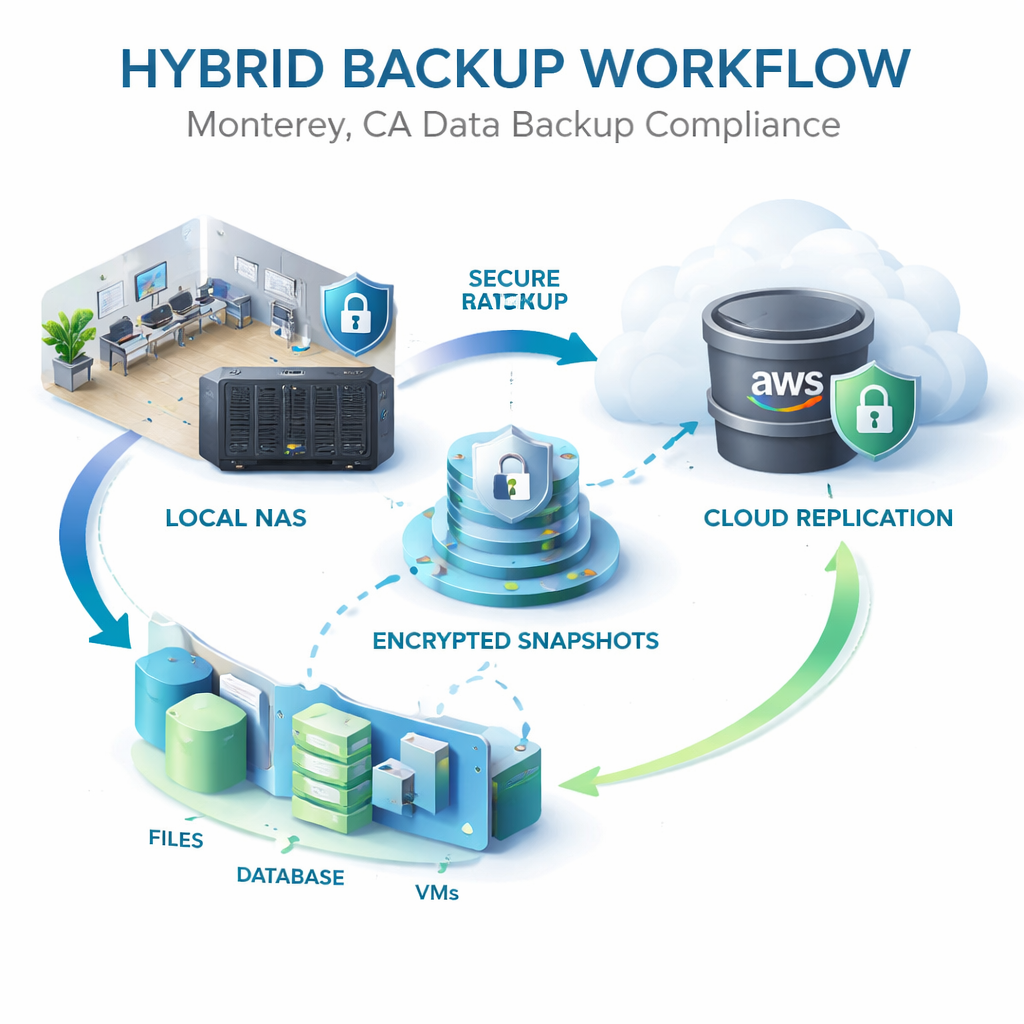
Real‑world example: A small e‑commerce shop in Monterey moved from a single external hard‑drive to a hybrid solution that writes nightly snapshots to a local Synology NAS and then pushes encrypted copies to AWS S3 each morning. The shop cut its restore time from 4 hours to under 30 minutes.
When you compare vendors, ask for a Service Level Agreement that spells out the Recovery Time Objective (RTO) for high‑priority data. If the SLA is vague, walk away.
For a visual overview, see the image below that shows a typical hybrid workflow.
After you pick a model, set up the initial backup. Follow these steps:
- Install the backup client on every server and workstation that holds regulated data.
- Enable encryption at rest on the client.
- Configure the schedule , hourly snapshots for critical databases, daily full backup for file shares.
- Test the first restore to a sandbox machine.
External references that can help you compare cloud options include the Microsoft Security page, which lists encryption standards and compliance certifications. The CISA small‑business guidance also outlines what to look for in a managed backup provider.
Step 3: Implement Ransomware‑Resistant Controls
Even the best backup won’t help if ransomware encrypts the backup itself. Monterey CA data backup compliance for small business must include safeguards that keep the backup immutable.
Start with multi‑factor authentication (MFA) on every admin console. The CISA guide notes that any form of MFA raises the cost for attackers. For even stronger protection, use FIDO authentication , it blocks phishing attempts that try to steal credentials.
Next, make your backups immutable. Choose a provider that offers “write‑once, read‑only” storage for a set period. That way ransomware can’t overwrite the clean copy.
Another key control is to keep the backup system off the main network. A separate VLAN or a dedicated backup appliance reduces the attack surface.
Real‑world example: A law firm in Carmel switched to a backup service that stored snapshots in a tamper‑proof S3 bucket with object lock for 30 days. When ransomware hit their file server, the attackers could not touch the locked snapshots, and the firm restored in under an hour.
Here’s a quick checklist you can copy into your run‑book:
- Enable MFA on all backup admin accounts.
- Deploy FIDO keys for privileged users.
- Turn on immutable storage or object lock.
- Isolate backup traffic on a separate VLAN.
- Run daily verification of backup integrity.
Watch the short video below for a step‑by‑step look at setting up immutable backups on a popular cloud platform.
After the video, remember to document each control. The CISA guidance stresses that documentation is part of a strong security culture. Keep a log of when you enabled MFA, when you turned on object lock, and who approved each change.
For more on building a ransomware‑ready plan, see the IT Compliance Services for SMBs: Protecting Your Business in 2026. The article walks through how to align these controls with industry frameworks.
Two external references that reinforce these steps are the CISA small‑business ransomware guidance and the Microsoft Security best practices. Both stress MFA, immutable storage, and network segmentation.
Step 4: Validate Backup Frequency and Retention Policies
Now you have a solution in place, you need to make sure it runs often enough and keeps data long enough. Monterey CA data backup compliance for small business asks for a two‑year retention window, but you also need to meet your own RPO goals.
Begin by defining the Recovery Point Objective for each data tier. High‑impact data (patient records, financial ledgers) might need an hourly snapshot. Medium‑impact data (marketing files) can settle for daily. Low‑impact data (archived PDFs) may be fine with weekly.
Use a simple matrix to match frequency to RPO. Below is a sample table you can adapt.
| Data Tier | Backup Frequency | RPO Goal | Retention Period |
|---|---|---|---|
| High‑Impact | Hourly snapshots | ≤1 hour | 2 years |
| Medium‑Impact | Daily full | ≤24 hours | 2 years |
| Low‑Impact | Weekly incremental | ≤7 days | 2 years |
After you set the schedule, run a test restore for each tier. Measure how long it takes and compare it to your RTO (Recovery Time Objective). If you miss the target, adjust the frequency or move the data to a faster storage tier.
Don’t forget the legal side. The county rule says “generally within 2 years”. Some industries, like healthcare, may require longer under state law. When in doubt, keep the longest period required.
Real‑world example: A small manufacturing plant in Salinas set a daily backup for their ERP system. When a ransomware hit the network, they restored from the previous night’s backup in under two hours, well within their 4‑hour RTO.
Tip: Create a calendar reminder that forces a quarterly full‑scale restore drill. Mark the date in your team calendar and assign an owner.
For extra guidance, the HIPAA Vault backup guide explains how to set retention for health data, which aligns with the two‑year county rule. The U.S. Small Business Administration site also offers a checklist for disaster‑recovery planning that you can adapt.
Step 5: Conduct Regular Audits and Documentation
Compliance is a moving target. You must audit your backup system regularly and keep clear records. Monterey CA data backup compliance for small business expects you to prove that backups are happening and that they meet the technical safeguards.
Set up a quarterly audit checklist that covers these items:
- Backup jobs ran on schedule (no missed runs).
- Encryption keys are stored on a separate, hardened server.
- Immutable storage settings are still active.
- Retention policy aligns with the two‑year rule.
- Restore test completed and documented.
Document each audit in a simple Word or Google Doc. Include the date, the person who ran the test, and any findings. Keep the document in a secure, read‑only folder that’s also backed up.
Real‑world example: A dental practice in Monterey used the audit checklist to catch a mis‑configured backup that was saving only to a local drive. They corrected the error before a flood hit their office, saving all patient records.
Here’s a quick template you can copy:
Audit Date: __________
Auditor: __________
Job Status: __________ (All ran / Missed ___)
Encryption: __________ (Keys stored securely)
Immutability: __________ (Enabled / Disabled)
Retention: __________ (Matches 2‑year rule)
Restore Test: __________ (Success / Issues)
Notes: __________
When you need a deeper dive into audit best practices, the Understanding IT security compliance services for SMBs article explains how to automate audit logs and use them for regulatory reporting.
Two external sources can help you fine‑tune the audit process. The CISA site’s Secure by Design page outlines how to build auditability into your systems. The NIST Cybersecurity Framework includes a “Detect” function that aligns with regular backup audits.

Step 6: Plan for Business Continuity and Disaster Recovery
Backup is only half the story. You also need a plan that tells you how to keep the lights on when a disaster strikes. Monterey CA data backup compliance for small business works best when it’s part of a larger Business Continuity Plan (BCP).
Start by cataloguing every critical system , point‑of‑sale, accounting, patient portals, email, and any custom apps. For each system, note the RTO and the recovery steps.
Next, map out the resources you’ll need during an outage. Do you have a secondary office? Do you rely on a cloud‑only environment? Identify who will take charge, how communication will happen, and where the backup data will be restored.
Here are three practical steps to flesh out your BCP:
- Write a clear incident‑response playbook that includes a backup‑restore section.
- Identify a cloud region for failover , AWS offers cross‑region replication that can be activated in minutes.
- Run a tabletop drill every six months. Walk the team through a scenario like a wildfire that knocks out the Monterey office.
Real‑world example: After a wildfire forced a local winery’s office to close, their BCP let them spin up a temporary office in a nearby town. Their data was already replicated to an AWS region, so they were back online within a day.
California’s Resilient Business Challenge provides a checklist you can use to verify your plan against state resources. The SBA also offers disaster‑loan assistance if your physical assets are damaged.
Finally, remember to keep the BCP document in the same backup system you protect. That way, if a cyber‑attack wipes your primary site, the plan itself is still recoverable.
External guidance you can reference includes the California Business Innovation and Entrepreneurship disaster‑relief guide and the AWS Smart Business backup and recovery page, which both outline scalable storage options and cross‑region recovery steps.
FAQ
What is the minimum backup frequency required for Monterey CA data backup compliance for small business?
The Monterey County policy does not set a strict interval, but it expects you to keep data available for recovery. Most SMBs meet this by running hourly snapshots for critical data, daily full backups for most files, and weekly increments for low‑priority data. This schedule aligns with a two‑year retention window and keeps you ready for any audit.
Do I need to encrypt backups to meet Monterey County requirements?
Yes. The county rule explicitly calls for encryption at rest. Use AES‑256 or an equivalent standard. Your backup provider should let you manage the encryption keys yourself or store them on a separate hardened server. This also satisfies the broader CCPA/CPRA expectations for data protection.
How do I prove to regulators that my backups are immutable?
Keep audit logs that show the immutable setting was enabled on the day the backup was created. Most cloud providers generate a tamper‑evident log entry when you turn on object lock or write‑once mode. Export those logs and store them in a read‑only archive that is also backed up.
Can I meet the two‑year retention rule with cloud storage only?
Yes, as long as the cloud service lets you set a retention policy that does not delete data before 730 days. Many providers let you lock a bucket for a set period. Verify the policy in the console and keep a screenshot in your compliance folder.
What are the penalties if I fail to follow Monterey County data backup rules?
The county policy itself does not list monetary fines, but a failure can lead to enforcement actions, loss of licenses, or increased scrutiny from state regulators. In contrast, the CCPA and CPRA impose $2,500 per unintentional violation and $7,500 per intentional violation, so the financial risk can be high if personal data is exposed.
How often should I test my backup restores?
At least once a quarter for each data tier. Choose a high‑impact set (like patient records), a medium‑impact set (like accounting files), and a low‑impact set (like marketing assets). Record the time it takes, verify file integrity, and note any gaps. Adjust your backup schedule if the restore time exceeds your RTO.
Is a local IT partner necessary for compliance?
A local partner who knows Monterey’s climate risks and county ordinances can help you choose the right storage locations, set up fire‑proof off‑site vaults, and respond quickly to incidents. They also simplify the audit process by providing documented SOPs and regular health‑checks.
What role does multi‑factor authentication play in backup security?
MFA adds a second layer of verification for anyone trying to access backup admin consoles. This makes it far harder for ransomware operators to hijack the backup system. Combine MFA with FIDO keys for phishing‑resistant authentication, as recommended by CISA.
Conclusion & Next Steps
Monterey CA data backup compliance for small business is not a mystery. You start by knowing the exact rules, pick a managed solution that meets encryption and off‑site storage needs, add ransomware‑resistant controls, set clear frequency and retention policies, audit the system on a regular cadence, and finally weave everything into a solid business‑continuity plan.
Each step builds on the last, turning a vague fear of data loss into a concrete, testable process. The result is a resilient operation that can survive wildfires, floods, or a ransomware hit without missing a beat.
Ready to make your technology work for your business? Contact us for a consultation or IT assessment today.