Nearly 60 percent of small and medium businesses say keeping up with technology is one of their top challenges. As digital tools become more essential, many companies find it tough to manage IT needs while growing their core business. Managed IT support services step in to simplify complex tech demands, offering reliable solutions that help organizations stay secure, productive, and focused on what matters most.
Table of Contents
- Defining Managed IT Support Services
- Main Types of Managed IT Solutions
- How Managed IT Support Works In Practice
- Key Benefits For Small Businesses
- Typical Costs And Pricing Models
- Choosing The Right Managed IT Partner
Key Takeaways
| Point | Details |
|---|---|
| Strategic Outsourcing | Managed IT support services allow businesses to focus on core objectives by outsourcing technology management to specialized providers. |
| Proactive Management | These services emphasize continuous monitoring and preemptive problem-solving to minimize disruptions and ensure efficient IT operations. |
| Cost Efficiency | Small to medium-sized organizations benefit from predictable expenses and reduced need for internal IT staff, enabling access to advanced technologies. |
| Partner Selection | Choosing the right managed IT partner is crucial, requiring evaluation of technical expertise, service responsiveness, and alignment with business needs. |
Defining Managed IT Support Services
Managed IT support services represent a strategic approach for businesses to outsource their technology infrastructure management to specialized third-party providers. According to SIG, these services involve comprehensive technology management that enables organizations to focus on their core business objectives while ensuring robust, secure, and efficient IT systems.
At its core, managed IT support is about transferring the complex responsibilities of technology maintenance, monitoring, and troubleshooting to expert professionals. This service model covers a wide range of critical technology functions, including:
- Network monitoring and maintenance
- Proactive cybersecurity protection
- Data backup and recovery strategies
- Help desk and technical support
- Cloud infrastructure management
- Hardware and software updates
By partnering with a managed IT support provider, businesses gain access to enterprise-level technological expertise without the substantial overhead of maintaining an internal IT department. Small to medium-sized organizations particularly benefit from this model, as it allows them to leverage advanced technological capabilities that would otherwise be cost-prohibitive. Professional IT management ensures that technology becomes an enabler of business growth rather than a potential bottleneck or source of operational disruption.

The real power of managed IT support lies in its proactive approach. Instead of waiting for systems to fail, these services use advanced monitoring tools and strategic interventions to prevent potential issues before they can impact business operations. This approach not only minimizes downtime but also provides businesses with predictable technology expenses and strategic IT planning that aligns with their long-term organizational goals.
Main Types of Managed IT Solutions
Managed IT solutions offer businesses a flexible approach to technology infrastructure, with multiple service models designed to meet diverse organizational needs. According to Texas DIR, these solutions span a comprehensive range of services including hardware management, software solutions, and cloud-based services that enable companies to streamline their technological capabilities.
The primary types of managed IT solutions can be categorized into several key areas:
Here’s a summary of the main types of managed IT solutions:
| Category | Key Services | Typical Benefits |
|---|---|---|
| Hardware Management | Device installation Equipment maintenance Inventory tracking |
Reliable devices Extended hardware life |
| Software Solutions | Software deployment Platform management License compliance |
Up-to-date software Legal compliance |
| Cloud Service Models | SaaS PaaS IaaS |
Scalability Reduced capital expense |
-
Hardware Management Services
- Device installation and configuration
- Equipment maintenance and replacement
- Inventory tracking and lifecycle management
-
Software Solutions
- Instructional software deployment
- Adaptive learning platform management
- Software licensing and compliance
-
Cloud Service Models
- Software-as-a-Service (SaaS)
- Platform-as-a-Service (PaaS)
- Infrastructure-as-a-Service (IaaS)
As noted by GSA, cloud service models represent a nuanced approach to managed IT solutions. SaaS typically offers minimal customization with reduced maintenance requirements, while PaaS provides greater application control, demanding organizations actively manage code functionality and security compliance. This spectrum of options allows businesses to select precisely the level of technological support that matches their operational complexity and strategic objectives.
The evolution of managed IT solutions reflects the growing complexity of modern technological ecosystems. By offering scalable, flexible resources, these services enable organizations to access enterprise-grade technology capabilities without massive internal infrastructure investments. Whether a small startup or a medium-sized enterprise, businesses can now leverage professional IT management that adapts dynamically to their changing technological requirements, transforming IT from a potential cost center into a strategic business enabler.
How Managed IT Support Works in Practice
Managed IT support operates through a strategic partnership between businesses and technology experts, transforming complex IT management into a streamlined, proactive process. According to Texas DIR, this approach encompasses a comprehensive range of technology services that go far beyond traditional break-fix IT support, including hardware and software solutions, installation, maintenance, and ongoing training.
The practical implementation of managed IT support typically follows a structured workflow:
- Initial Technology Assessment
- Comprehensive evaluation of existing IT infrastructure
- Identification of potential vulnerabilities and inefficiencies
- Mapping current technology ecosystem
- Custom Solution Design
- Developing tailored IT strategies
- Selecting appropriate technology tools
- Creating scalable support frameworks
- Continuous Monitoring and Management
- 24/7 network surveillance
- Proactive threat detection
- Real-time system performance tracking
- Immediate incident response
Most managed IT support providers utilize advanced remote monitoring technologies that allow them to diagnose and resolve potential issues before they escalate into significant problems.
This preemptive approach means businesses experience minimal disruption, with many technical challenges addressed invisibly in the background, often before end-users even recognize a potential system limitation.
The real magic of managed IT support lies in its transformative potential. By outsourcing technological management to specialized professionals, organizations can redirect their internal resources toward core business objectives. Instead of maintaining an expensive in-house IT department, companies gain access to enterprise-grade technological expertise, cutting-edge security protocols, and flexible support models that adapt precisely to their evolving operational needs. This approach turns technology from a potential operational burden into a strategic enabler of business growth and innovation.
Key Benefits for Small Businesses
Small businesses face unique technological challenges that can significantly impact their growth and operational efficiency. According to SIG, managed IT support provides a transformative solution by offering specialized expertise and resources that would typically be unaffordable for smaller organizations. This approach enables businesses to access enterprise-level technological capabilities without the substantial overhead of maintaining a full internal IT department.
The key benefits for small businesses include:
-
Cost-Effective Technology Management
- Predictable monthly technology expenses
- Elimination of expensive emergency IT repairs
- Reduced need for full-time IT staff
-
Enhanced Cybersecurity Protection
- Advanced threat monitoring
- Proactive security vulnerability assessments
- Rapid incident response capabilities
-
Scalable Technology Solutions
- Flexible IT infrastructure support
- Easy technology upgrades
- Customized service packages
By leveraging managed IT support, small businesses can redirect their limited resources toward core business activities instead of getting bogged down in complex technological maintenance. The ability to access professional IT expertise without significant capital investment means companies can compete more effectively, regardless of their size. This approach transforms technology from a potential operational burden into a strategic advantage, allowing smaller organizations to operate with the same technological sophistication as larger enterprises.
Perhaps the most critical benefit is the peace of mind that comes with knowing technological challenges are being managed by experts. Small business owners can focus on growth, innovation, and customer relationships, confident that their IT infrastructure is being monitored, maintained, and secured by professionals. Managed IT support essentially becomes an extension of the business, providing ongoing technological guidance and support that adapts to changing business needs and emerging technological trends.
Typical Costs and Pricing Models
Managed IT support pricing has evolved to provide businesses with flexible and predictable technology investment strategies. According to Texas DIR, these service contracts are designed to help organizations control and anticipate their technological expenditures by offering standardized pricing models that account for various organizational needs and complexity levels.
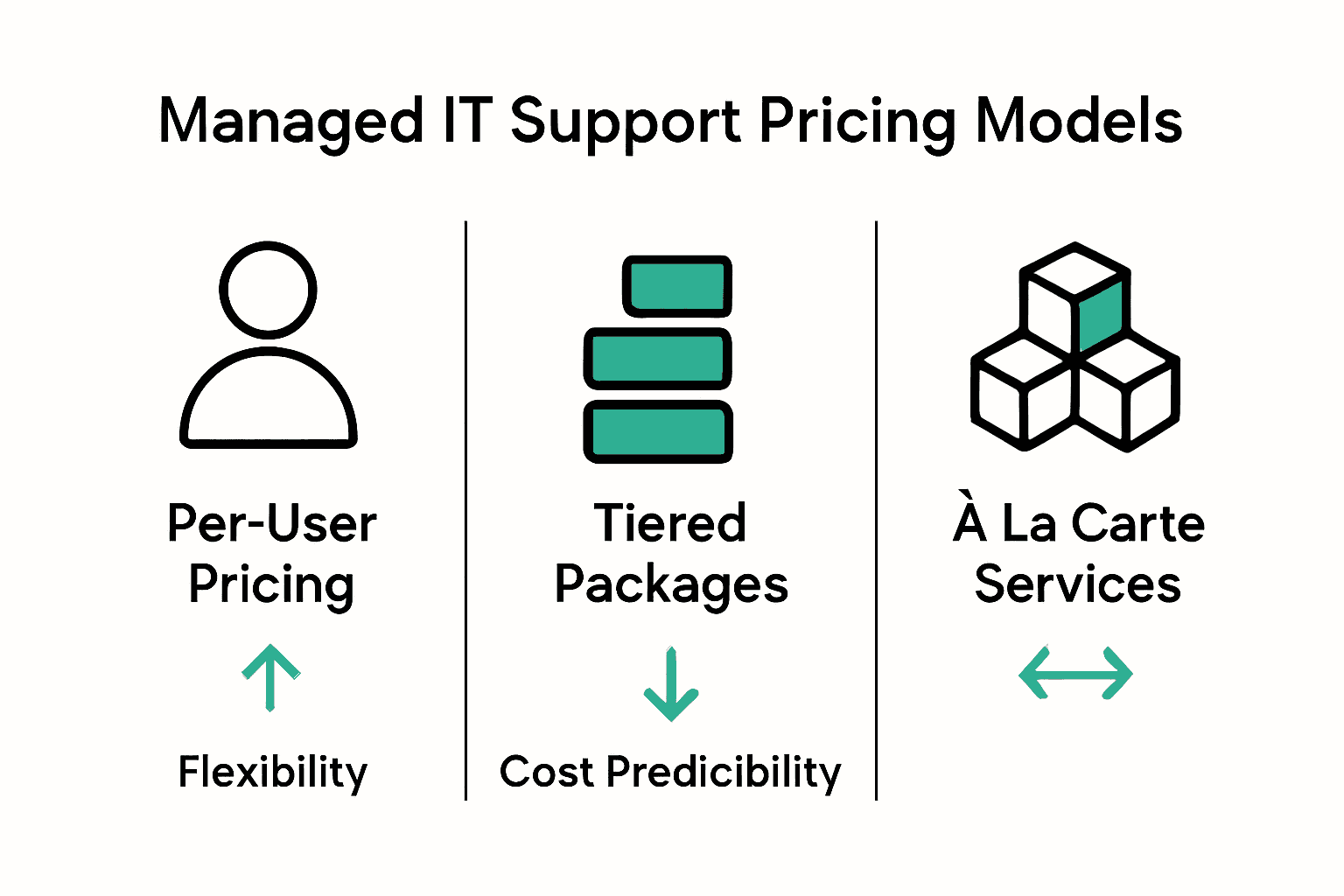
Typical managed IT support pricing models include:
- Per-User Pricing
- Fixed monthly cost per employee
- Scalable as organization grows
- Includes comprehensive support for individual technological needs
- Tiered Service Packages
- Basic, intermediate, and advanced support levels
- Increasing complexity and coverage with each tier
- Allows businesses to select precisely matching service intensity
- À La Carte Services
- Pay only for specific technological interventions
- Customizable support selections
- Ideal for businesses with unique or intermittent requirements
As noted by GSA, the cost of managed IT services can vary significantly depending on the service model chosen. Software-as-a-Service (SaaS) solutions typically offer lower maintenance expenses due to minimal customization, while Platform-as-a-Service (PaaS) solutions may involve higher costs because of more complex application management and security compliance requirements.
Small to medium-sized businesses can expect monthly managed IT support costs to range from $100 to $250 per user, depending on service complexity, industry-specific requirements, and the depth of technological support needed. The true value lies not just in the price, but in the comprehensive protection, strategic guidance, and operational efficiency these services provide. By transforming technology expenses from unpredictable emergency costs to a structured, predictable investment, managed IT support offers businesses a financially intelligent approach to maintaining robust, secure technological infrastructure.
Choosing the Right Managed IT Partner
Selecting the ideal managed IT support partner represents a critical strategic decision for businesses seeking technological reliability and growth. According to SIG, choosing the right Managed Services Provider (MSP) involves carefully evaluating multiple factors that extend far beyond simple technical capabilities, focusing on the provider’s expertise, service range, and genuine alignment with an organization’s unique operational needs.
Key criteria for selecting a managed IT partner include:
- Technical Expertise and Credentials
- Industry-specific certifications
- Proven track record in your business sector
- Advanced technological knowledge
- Regular training and skill updates
- Service Responsiveness
- 24/7 support availability
- Guaranteed response times
- Multiple communication channels
- Proactive problem-solving approach
- Scalability and Flexibility
- Adaptable service packages
- Ability to grow with your business
- Customizable technological solutions
- Transparent upgrade paths
Businesses should conduct thorough due diligence by requesting comprehensive references, examining case studies, and understanding the potential partner’s technological ecosystem. A reliable MSP should demonstrate not just technical proficiency, but a genuine commitment to understanding your specific business challenges and strategic objectives.
Ultimately, the right managed IT partner becomes more than a service provider – they transform into a strategic technology ally. Look for professionals who communicate clearly, show genuine interest in your business goals, and can articulate complex technological concepts in straightforward, understandable language. The most effective partnerships are built on trust, transparency, and a shared vision of leveraging technology to drive meaningful business growth and operational efficiency.
Empower Your Business with Trusted Managed IT Support from SRS Networks
Managing complex IT systems while focusing on your business growth can feel overwhelming. As the article highlights, proactive managed IT support is essential for preventing downtime, securing your data, and streamlining your technology infrastructure. Whether it is network monitoring, cybersecurity, or cloud management, addressing these needs with expert guidance frees you from unpredictable IT challenges and costly emergencies.
At SRS Networks, we understand these pain points and deliver customized, flat-rate managed IT services that help businesses in the Monterey Bay Area thrive. Our local, hands-on approach ensures you get fast response times, personalized solutions, and scalable technology strategies that grow with your company. Visit About Us – SRS Networks to see how our dedicated team brings industry expertise to your doorstep. Learn more about our Managed IT Services and how our Cybersecurity Solutions protect your digital assets with proactive monitoring and rapid incident response.
Ready to eliminate IT headaches and empower your business with technology that works as hard as you do?
Explore how SRS Networks combines local commitment with enterprise-grade IT support to protect your operations and accelerate growth. Don’t wait for your systems to fail. Partner with us today by visiting SRS Networks and take the first step toward IT peace of mind.
Frequently Asked Questions
What are managed IT support services?
Managed IT support services involve outsourcing technology management to specialized providers, allowing businesses to focus on their core objectives while ensuring efficient and secure IT systems.
How does managed IT support work in practice?
Managed IT support operates through a partnership between businesses and IT experts, involving assessments, custom solution designs, and continuous monitoring to manage IT infrastructure proactively.
What are the key benefits of managed IT support for small businesses?
Managed IT support offers small businesses cost-effective technology management, enhanced cybersecurity, and scalable solutions, enabling them to compete effectively without a large internal IT team.
What are the typical costs associated with managed IT support?
Managed IT support costs typically range from $100 to $250 per user per month, depending on the chosen service model and the complexity of the technology support required.