Choosing a managed service provider can make or break your company’s tech future. Over 60 percent of organizations that switch MSPs cite poor alignment with business goals as the main frustration. Most assume picking the right IT partner is all about fancy software or the lowest price. That thinking leaves out the real secret: your MSP shapes your long-term growth and innovation far beyond just tech support.
Table of Contents
- Step 1: Analyze Your Business Needs And Goals
- Step 2: Research Potential Msp’s In Your Area
- Step 3: Evaluate Msp Service Offerings And Solutions
- Step 4: Assess Msp Experience And Expertise
- Step 5: Compare Costs And Contract Terms
- Step 6: Conduct Final Discussions And Make Your Selection
Step-by-Step Guide to Selecting Your Ideal MSP
| Key Point | Explanation |
|---|---|
| 1. Conduct a thorough internal audit | Assess your current technological infrastructure to identify strengths and gaps. This inventory will guide your MSP needs. |
| 2. Engage key stakeholders in assessment | Involve various department leaders to gather insights on technological needs. Their input creates a balanced view of requirements. |
| 3. Research potential MSPs through multiple channels | Utilize local networks and professional forums to find reputable providers. Personal recommendations offer valuable insights not found in brochures. |
| 4. Evaluate MSP offerings systematically | Create a scoring matrix to compare service offerings, flexibility, and response times. This objective assessment aids in narrowing down options. |
| 5. Analyze cost and contract terms comprehensively | Look beyond base prices to assess hidden fees and contract flexibility. Ensure terms align with your business strategy and operational needs. |
Step 1: Analyze Your Business Needs and Goals
Selecting the right Managed Service Provider (MSP) begins with a comprehensive assessment of your organization’s technological requirements and strategic objectives. This critical first step establishes the foundation for finding an IT partner who can truly align with your business vision.
Start by conducting a thorough internal audit of your current technological infrastructure, examining both your existing systems and the gaps that potentially exist. Document every technological touchpoint within your organization, from network infrastructure and security protocols to communication platforms and data management systems. This inventory will serve as a blueprint for understanding exactly what capabilities you need from an MSP.
Consider your organization’s specific performance goals and growth projections. A manufacturing firm will have dramatically different technological needs compared to a healthcare provider or a professional services company. Your MSP selection must account for industry-specific compliance requirements, scalability expectations, and potential technological transformations on your strategic roadmap.
According to CompTIA’s Managed Services Guide, organizations should prioritize creating a detailed list of functional requirements that encompass both immediate needs and future technological aspirations. This approach ensures you’re not just solving current challenges but positioning your technology infrastructure for long-term success.
Engaging key stakeholders across different departments becomes crucial during this assessment. Your IT team, operations managers, finance leaders, and department heads can provide nuanced insights into technological pain points and operational requirements. Their collective input will help create a comprehensive picture of what your ideal MSP must deliver.
Below is a checklist table to help ensure you have thoroughly analyzed your business needs before moving forward with MSP selection.
| Requirement | Description | Verified (Yes/No) |
|---|---|---|
| Current Tech Audit | Review and document all existing IT infrastructure | |
| Stakeholder Input | Gather feedback from all key department heads | |
| Business Goals Identified | Define performance goals and growth projections | |
| Compliance Needs Checked | Confirm all industry compliance requirements | |
| Essential Functions Listed | Differentiate non-negotiable needs | |
| Desired Enhancements Listed | Identify aspirational improvements | |
| Future Capabilities Planned | Consider upcoming technological transformations |
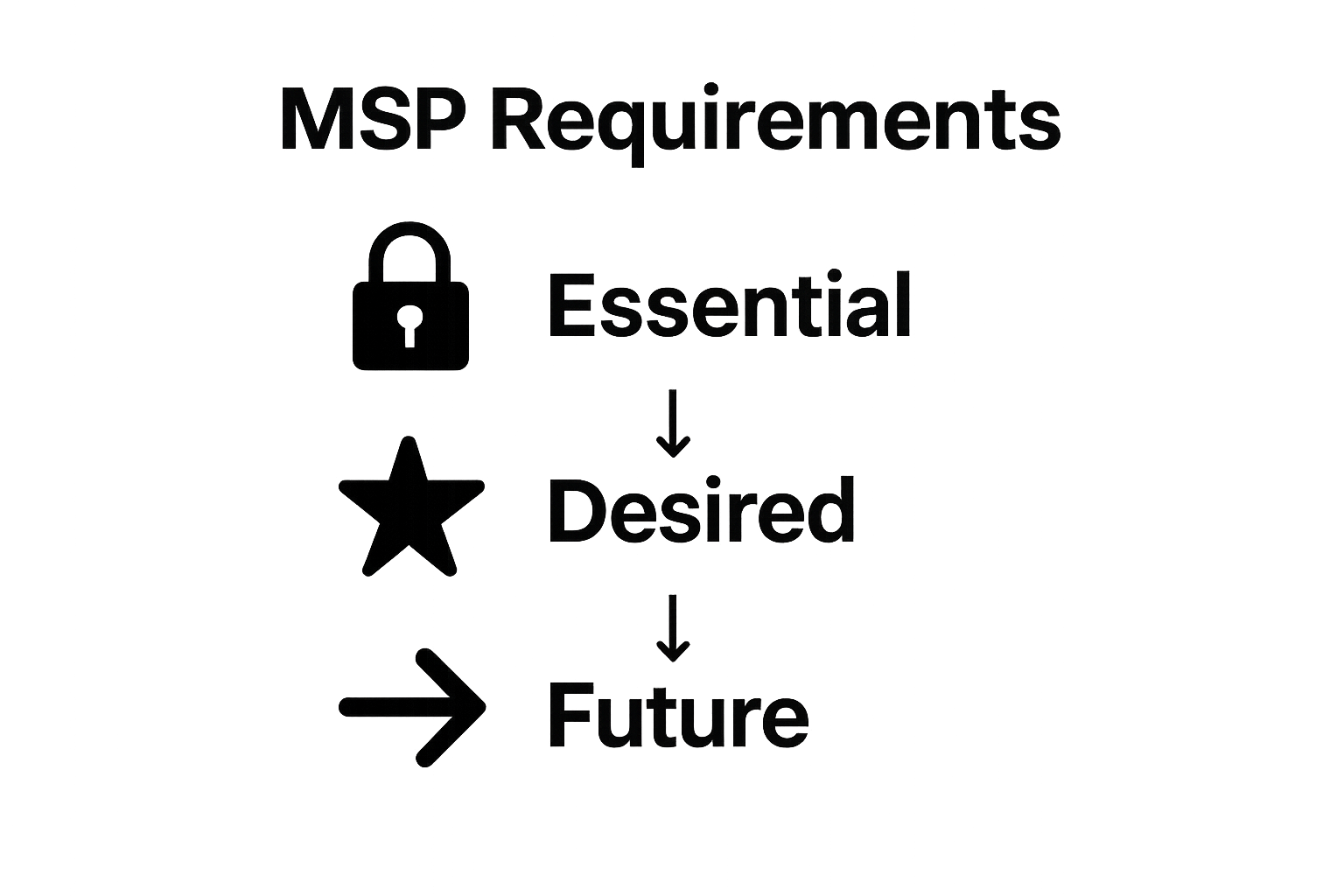
As you develop your requirements, categorize them into three primary areas: essential functions, desired enhancements, and future capabilities. This stratification allows you to distinguish between non-negotiable technological needs and aspirational improvements, giving potential MSP partners a clear understanding of your expectations.
By meticulously analyzing your business needs and goals, you transform the MSP selection process from a generic procurement exercise into a strategic alignment of technological partnership. The more precise and comprehensive your initial assessment, the more effectively you can identify an MSP that doesn’t just provide services, but becomes a true technological catalyst for your organization’s growth.
Step 2: Research Potential MSPs in Your Area
With your business needs clearly defined, the next critical phase involves conducting targeted research to identify managed service providers who can effectively meet your technological requirements. This step transforms your preliminary assessment into actionable insights about potential IT partners within your local and regional ecosystem.
Begin by leveraging multiple research channels to compile a comprehensive list of potential MSPs. Local business networks, professional associations, and industry-specific recommendations provide invaluable initial leads. Platforms like LinkedIn, regional chamber of commerce directories, and professional technology forums can help you discover reputable providers with proven track records in your specific business sector.
Expand your research beyond simple online searches by engaging your professional network. Reach out to colleagues, industry peers, and business associates who have recently undergone similar technological transitions. Their firsthand experiences can reveal nuanced insights about MSP performance, reliability, and responsiveness that might not be apparent through traditional marketing materials.
According to CompTIA’s Managed Services Buying Guide, organizations should evaluate potential MSPs across multiple critical dimensions. Look for providers who demonstrate specialized expertise in your industry, maintain robust cybersecurity credentials, and offer transparent service level agreements. Pay close attention to their technological certifications, years of operational experience, and the depth of their support infrastructure.
Develop a systematic approach to evaluating potential MSPs by creating a structured comparison matrix. This tool should capture essential evaluation criteria such as service offerings, pricing models, response times, technological specializations, and client testimonials. Prioritize providers who show a demonstrated ability to adapt to evolving technological landscapes and provide proactive, strategic technological guidance.
During your research phase, request preliminary consultations or informational meetings with shortlisted MSPs. These interactions provide opportunities to assess their communication style, technical expertise, and cultural alignment with your organization. Prepare a consistent set of questions that probe their understanding of your specific business challenges and their proposed technological solutions.
Verify each potential MSP’s credentials by examining their client portfolios, requesting references, and investigating their reputation through independent review platforms. Look for consistent patterns of positive client feedback, demonstrated industry expertise, and a track record of successful technological implementations. Your goal is to identify not just a service provider, but a strategic technological partner who can support your organization’s long-term growth and innovation objectives.
Step 3: Evaluate MSP Service Offerings and Solutions
With your initial research complete, the next crucial phase involves a meticulous evaluation of potential managed service providers’ comprehensive service offerings and technological solutions. This step demands a strategic and thorough approach to ensuring the MSP can not only meet your current technological requirements but also anticipate and support your future business evolution.
Conduct a comprehensive comparison of service packages by requesting detailed proposals from each shortlisted provider. These proposals should offer transparent insights into their core service offerings, including network management, cybersecurity protocols, cloud infrastructure support, data backup strategies, and technical support mechanisms. Pay close attention to the depth and breadth of their service spectrum, looking for providers who offer integrated solutions rather than fragmented technological interventions.
Examine each MSP’s technological capabilities through the lens of your specific business needs. Look for providers who demonstrate flexibility and customization potential, rather than those offering rigid, one-size-fits-all solutions. A robust MSP should be able to articulate how their technological framework can be tailored to address your unique operational challenges and support your strategic objectives.
According to CompTIA’s Managed Services Buying Guide, organizations should evaluate potential providers across multiple critical dimensions. Scrutinize their service level agreements (SLAs) with particular attention to response times, problem resolution protocols, and guaranteed uptime percentages. These documents reveal the provider’s commitment to operational excellence and their ability to maintain consistent technological performance.
Develop a systematic scoring mechanism to objectively assess each MSP’s service offerings. Create a detailed evaluation matrix that captures key criteria such as technological expertise, industry-specific experience, cybersecurity capabilities, scalability of solutions, pricing structures, and potential integration capabilities with your existing technological ecosystem. This methodical approach transforms subjective assessments into data-driven decision-making.
Beyond technical specifications, evaluate the human element of potential MSP partnerships. Schedule in-depth consultations that allow you to assess their communication style, responsiveness, and cultural alignment with your organization. A technically proficient MSP that struggles with communication or fails to understand your business context can become more of a hindrance than a help.
Finalize your evaluation by requesting comprehensive references and case studies from providers who demonstrate strong alignment with your requirements. Speak directly with their existing clients to gain unfiltered insights into the provider’s actual performance, reliability, and ability to deliver on their promised technological solutions. Your goal is to select an MSP that becomes a strategic technological partner, not merely a service vendor.

Step 4: Assess MSP Experience and Expertise
Assessing an MSP’s experience and expertise represents a critical juncture in your selection process, where you move beyond surface-level marketing materials to understand the true depth of their technological capabilities and industry knowledge. This step demands a comprehensive investigation that goes far beyond simple credential checking.
Begin by examining the provider’s track record of technological implementations within your specific industry vertical. Look for evidence of sustained success, not just isolated project achievements. Request detailed case studies that demonstrate their ability to solve complex technological challenges similar to those your organization might encounter. Pay particular attention to how they have helped businesses navigate technological transformations, manage risk, and drive operational efficiency.
Dive deep into the professional backgrounds of the MSP’s key technical leadership and support teams. Verify their industry certifications, professional training, and ongoing technological education. Reputable MSPs invest consistently in their team’s skill development, ensuring they remain at the forefront of technological innovation. Request information about their staff’s technical qualifications, including vendor-specific certifications from major technology providers like Microsoft, Cisco, or cloud platforms such as AWS and Azure.
According to CISA’s Managed Service Provider Risk Considerations, organizations should conduct thorough due diligence on potential providers’ security practices and incident response capabilities. Investigate their historical performance in managing technological challenges, particularly around cybersecurity, data protection, and business continuity. Request detailed information about their approach to security incidents, including response times, mitigation strategies, and long-term prevention protocols.
Establish a comprehensive evaluation framework that goes beyond technical competence. Look for providers who demonstrate strategic thinking and a forward-looking approach to technological management. The ideal MSP should not just respond to your current needs but anticipate future technological trends and help you proactively adapt your infrastructure.
Seek out direct conversations with the MSP’s existing clients, particularly those in similar industries or with comparable technological complexity. These references will provide unfiltered insights into the provider’s actual performance, reliability, and ability to deliver on their promised technological solutions. Ask specific questions about their responsiveness, problem-solving capabilities, and capacity to support business growth.
Ultimately, your goal is to identify an MSP that brings not just technical skills, but genuine technological partnership. Look for providers who demonstrate a holistic understanding of how technology can drive business strategy, transforming your IT infrastructure from a cost center into a strategic competitive advantage.
Step 5: Compare Costs and Contract Terms
Navigating the financial landscape of managed service provider agreements requires a strategic and nuanced approach that goes far beyond simple price comparisons. This step involves a comprehensive analysis of pricing structures, contract terms, and the long-term financial implications of your technological partnership.
Develop a detailed cost comparison matrix that breaks down each potential MSP’s pricing model with surgical precision. Look beyond the headline numbers to understand the underlying cost components, including base service fees, per-user charges, additional service rates, and potential scalability expenses. Some providers offer flat-rate packages, while others utilize more complex tiered pricing structures that can significantly impact your total cost of ownership.
The following table provides an overview of common MSP pricing models and their key characteristics to help you compare providers more effectively.
| Pricing Model | Main Features | Pros | Cons |
|---|---|---|---|
| Flat-rate | Single consistent fee for all services | Simple, predictable costs | May pay for unused items |
| Tiered | Different service levels at escalating cost | Scalable to business size | May require upgrades |
| Per-user | Fee based on number of users supported | Flexible with staff changes | Can rise with growth |
| À la carte | Pay only for selected services | Customizable, cost control | May miss key bundled items |
Examine the contract terms with meticulous attention to detail. Pay particular focus to service level agreements (SLAs), termination clauses, and performance guarantees. These contractual elements reveal more about the provider’s confidence and commitment than their marketing materials ever could. Look for transparent provisions that clearly outline response times, problem resolution protocols, and specific performance metrics that protect your organizational interests.
According to CompTIA’s Managed Services Buying Guide, organizations should carefully evaluate how managed services transform technological expenses from capital expenditures to operational expenses. Consider the total cost of ownership beyond the monthly or annual subscription rates. Factor in potential savings from reduced downtime, improved operational efficiency, and the opportunity costs associated with maintaining an in-house IT infrastructure.
Interrogate each provider’s pricing model for hidden costs and potential scalability challenges. Some MSPs offer seemingly attractive initial rates that balloon with additional service requirements or unexpected technological complexity. Request comprehensive proposals that include detailed breakdowns of potential additional expenses, implementation costs, and future upgrade pricing.
Negotiate contract terms that provide flexibility and protect your organizational interests. This might include provisions for periodic service reviews, clear performance benchmarks, and straightforward mechanisms for contract modification or termination. The most effective MSP partnerships are built on mutual understanding and transparent financial expectations.
Consider the long-term financial implications of your MSP selection. A slightly higher monthly rate might represent significant value if the provider offers superior technological support, proactive problem solving, and strategic technological guidance. Your goal is not to find the cheapest solution, but the most cost-effective technological partnership that aligns with your business objectives and supports your growth trajectory.
Step 6: Conduct Final Discussions and Make Your Selection
The final stage of selecting a managed service provider represents a critical moment where comprehensive research converges with strategic decision-making. This step transforms your meticulous evaluation into a tangible technological partnership that will shape your organization’s future technological trajectory.
Schedule comprehensive final discussions with your top two or three potential MSP candidates, creating structured interaction opportunities that go beyond standard presentations. These meetings should be treated as strategic conversations where you probe deeply into the provider’s operational capabilities, cultural alignment, and long-term vision. Prepare a detailed list of scenario-based questions that challenge the MSP to demonstrate their problem-solving approach, technological adaptability, and commitment to your specific business needs.
During these final discussions, request live demonstrations of their technological capabilities and support infrastructure. Ask to meet the actual team members who would be managing your account, understanding their expertise, communication style, and approach to technological challenges. These interactions provide invaluable insights into the human element of the potential partnership that cannot be gleaned from written proposals or marketing materials.
According to FDIC guidelines for service provider selection, organizations should engage in detailed negotiations that establish clear mutual understanding of roles, responsibilities, and expectations. Develop a comprehensive evaluation scorecard that objectively rates each potential provider across multiple dimensions, including technical expertise, cultural fit, responsiveness, cost-effectiveness, and strategic alignment with your business objectives.
Pay particular attention to the potential MSP’s communication protocols and escalation processes. Understand exactly how they will handle critical technological challenges, including their incident response times, communication channels, and long-term problem-resolution strategies. The most effective technological partnerships are built on transparent, proactive communication frameworks that provide clarity and confidence.
Before making your final selection, conduct a comprehensive risk assessment that examines potential vulnerabilities in the proposed technological partnership. This involves evaluating the MSP’s cybersecurity practices, data protection protocols, compliance capabilities, and ability to adapt to your evolving technological requirements. Your goal is to select a provider that not only meets your current needs but can strategically support your future technological evolution.
Finalize your selection by creating a detailed transition plan that outlines the implementation process, key milestones, and initial performance benchmarks. Negotiate a trial period or initial short-term contract that allows both parties to validate the partnership’s effectiveness, ensuring you have flexibility to adjust or change course if the relationship does not meet expectations.
Ready to Find the MSP That Truly Gets Your Business?
Selecting the right managed service provider is about more than comparing features—it is about finding a technology partner who understands your unique business needs, industry challenges, and vision for growth. If the process of assessing goals, evaluating solutions, and sorting through complex contract terms in your MSP search feels overwhelming, you are not alone. Many local businesses struggle to translate their big-picture objectives into practical IT strategies that drive real results.
At SRS Networks, we turn confusion into clarity. Our team listens first, then designs managed IT services, cybersecurity solutions, and network support that match what your company actually needs today and tomorrow. We know your business deserves a provider who is both responsive and invested in your success. Curious how easy it can be to secure flat-rate, reliable IT support from a dedicated partner who understands your market? Visit our Managed IT Services page to discover why so many local organizations choose SRS Networks. Do not wait until your next IT headache—reach out now and let us show you a smarter, simpler way to choose and work with a trusted MSP.
Frequently Asked Questions
What should I consider when analyzing my business needs before choosing an MSP?
Start by conducting a thorough internal audit of your current technological infrastructure, identifying existing systems and potential gaps. Document technological touchpoints, evaluate specific performance goals, and engage key stakeholders for insights.
How do I research potential managed service providers effectively?
Leverage local business networks, professional associations, and online platforms such as LinkedIn to compile a list of potential MSPs. Engage your professional network for recommendations and conduct preliminary consultations to assess their capabilities.
What key criteria should I use to evaluate an MSP’s service offerings?
Create a systematic scoring mechanism that captures criteria such as service offerings, pricing models, response times, technological specializations, and service level agreements. Look for flexibility in their solutions and their ability to meet both current and future technological needs.
How can I assess an MSP’s experience and expertise in my industry?
Examine the MSP’s track record of successful implementations within your industry, verify the qualifications of their technical team, and investigate their past performance in managing technological challenges, particularly regarding cybersecurity and business continuity.