Disaster recovery testing sounds technical and tedious, but missing this process leaves most companies shockingly exposed. Over 40 percent of businesses never reopen after a major disaster. People expect the tech to be the weak link, and yet communication breakdowns and unclear priorities usually cause the biggest failures in real incidents. Learn how each step in this recovery process actually decides whether a business bounces back or closes its doors forever.
Disaster Recovery Testing: Step-by-Step Guide
- Step 1: Identify Critical Business Functions
- Step 2: Develop A Comprehensive Recovery Plan
- Step 3: Conduct Realistic Testing Scenarios
- Step 4: Evaluate Test Results And Identify Gaps
- Step 5: Update Recovery Strategies And Documentation
Quick Summary
| Key Point | Explanation |
|---|---|
| 1. Identify Critical Functions First | Begin by determining essential business functions to prioritize during disasters. |
| 2. Utilize Business Impact Analysis | Use BIA to assess revenue loss, compliance risks, and reputation factors related to failures. |
| 3. Develop a Detailed Recovery Plan | Create a structured plan that translates analyses into actionable recovery protocols. |
| 4. Conduct Realistic Testing Scenarios | Test recovery plans through practical simulations to identify vulnerabilities in a controlled environment. |
| 5. Systematically Evaluate Test Results | Analyze testing outcomes to pinpoint performance gaps and inform strategy improvements. |
Step 1: Identify Critical Business Functions
Disaster recovery testing begins with a critical foundational task: identifying the most essential functions that keep your business operational. This initial step determines which systems, processes, and resources are non-negotiable during potential disruptions.
Starting the identification process requires a comprehensive organizational assessment. Business leaders must gather key stakeholders from each department to map out functions that cannot experience prolonged interruption. These typically include financial systems, customer communication platforms, core production processes, and data management infrastructures.
Conducting a Business Impact Analysis
A Business Impact Analysis (BIA) becomes your primary diagnostic tool for this stage. During the BIA, your team will systematically evaluate each operational component by examining potential revenue loss, regulatory compliance risks, and reputational damage that could occur from system failures. According to University of Tennessee Health Science Center, critical functions encompass more than just technical systems—they include safeguarding personnel, maintaining academic or research programs, and supporting administrative capabilities.
The analysis should incorporate detailed conversations with department heads to understand nuanced operational dependencies. What might seem peripheral could actually be a linchpin in your organization’s functionality. For instance, a seemingly minor customer service database might be crucial for maintaining client relationships and processing urgent transactions.
Key verification criteria for successful critical function identification include:
- Quantifiable financial impact assessment for each function
- Clear documentation of interdepartmental process dependencies
- Ranked prioritization of recovery sequence
- Comprehensive understanding of potential disruption consequences
Successful completion of this step means you have a clear, documented inventory of functions that represent your organization’s operational backbone.
Below is a checklist table summarizing key verification criteria for identifying critical business functions during disaster recovery planning.
| Verification Criteria | Purpose |
|---|---|
| Quantifiable financial impact assessment | Determines potential revenue loss from disrupted function |
| Clear documentation of process dependencies | Maps how functions rely on each other |
| Ranked prioritization of recovery sequence | Sets order for restoring functions in an emergency |
| Comprehensive understanding of disruption consequences | Ensures all potential impacts are evaluated |
| Department head input and review | Captures operational nuances and hidden dependencies |
The table below provides an overview of the main steps in disaster recovery testing, summarizing each stage and the primary outcome to expect.
| Step | Key Activity | Primary Outcome |
|---|---|---|
| 1. Identify Critical Business Functions | Assess and list essential processes and systems | Inventory of critical operations |
| 2. Develop Recovery Plan | Create structured, actionable recovery protocols | Comprehensive, documented recovery strategy |
| 3. Conduct Realistic Testing Scenarios | Simulate disaster events to test plans | Identified vulnerabilities and response gaps |
| 4. Evaluate Test Results and Identify Gaps | Analyze testing data for weaknesses and inefficiencies | List of performance gaps for remediation |
| 5. Update Recovery Strategies and Documentation | Refine plans and procedures based on findings | Up-to-date and robust disaster recovery plan |
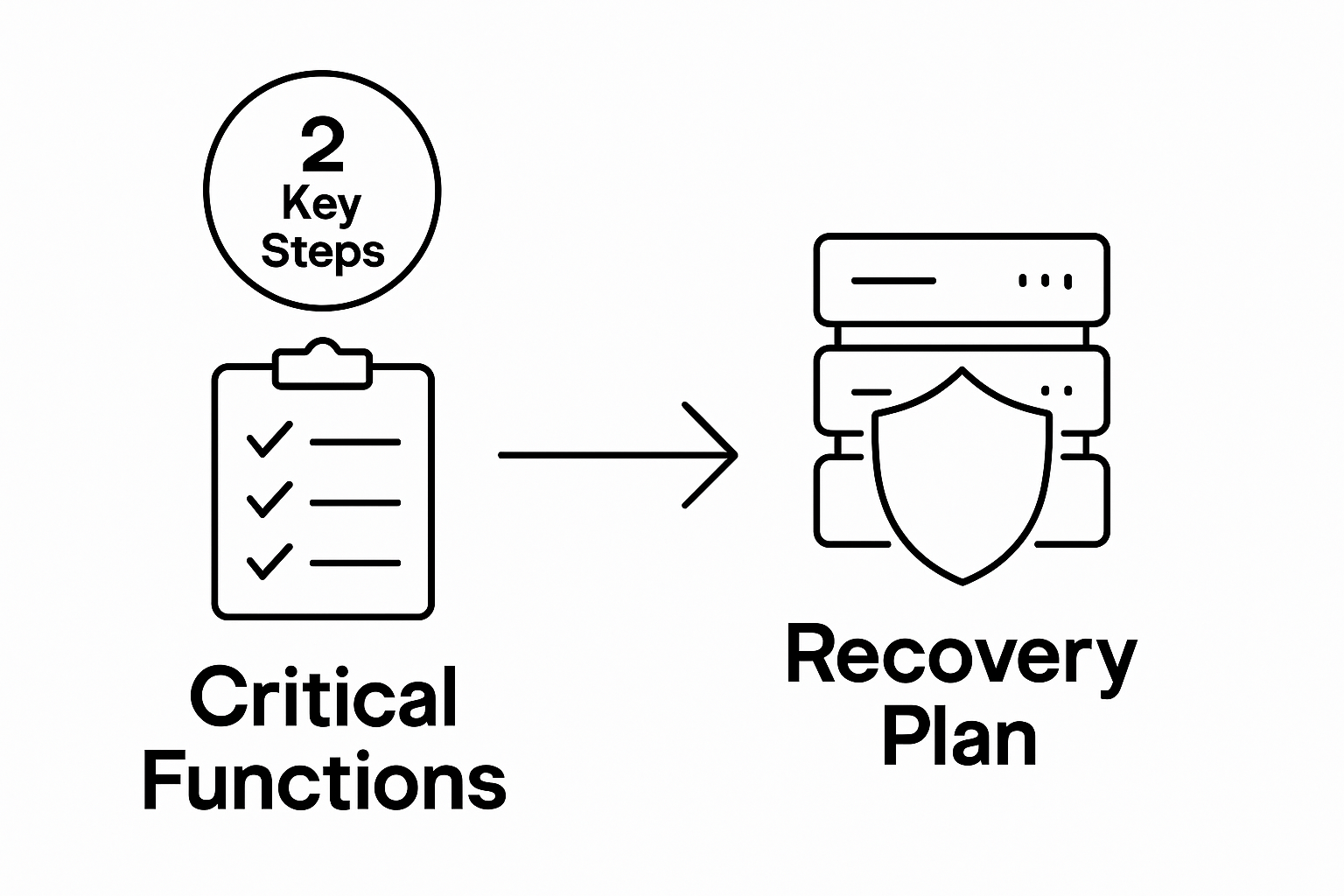
Step 2: Develop a Comprehensive Recovery Plan
With critical business functions identified, the next crucial phase is crafting a robust disaster recovery plan that transforms your organizational vulnerability into strategic resilience. This comprehensive document serves as your technical roadmap for navigating potential system disruptions with precision and confidence.
Developing an effective recovery plan requires meticulous collaboration between IT specialists, departmental leaders, and senior management. The plan must translate your business impact analysis into actionable recovery strategies that address technological, operational, and human elements of potential disasters.
Structuring Your Recovery Blueprint
Your disaster recovery plan should function as a living document that provides crystal-clear guidance during high-pressure scenarios. According to Ready.gov, the most effective plans align IT recovery priorities directly with core business functions, establishing precise recovery time objectives for each critical system.
The plan must include detailed recovery protocols for different potential scenarios, ranging from minor system interruptions to complete infrastructure failures. This means creating specific workflows that outline exact steps for data restoration, system failover, communication protocols, and personnel responsibilities. Each recovery pathway should include primary and backup strategies, ensuring multiple contingencies are available if initial recovery attempts prove unsuccessful.
Key components your comprehensive recovery plan must encompass include:
-
Detailed inventory of critical IT systems and their interdependencies
-
Specific recovery time objectives for each system
-
Clear communication protocols for incident response
-
Designated roles and responsibilities during recovery operations
-
Comprehensive contact information for recovery team members
Successful plan development requires ongoing refinement. Schedule regular reviews and updates to ensure the document remains current with your evolving technological infrastructure and organizational needs. Your disaster recovery plan is not a static document but a dynamic strategy that adapts alongside your business, providing a reliable safety net against potential technological disruptions.
Step 3: Conduct Realistic Testing Scenarios
After developing a comprehensive recovery plan, the next critical phase is transforming theoretical strategies into practical, actionable scenarios through rigorous disaster recovery testing. This step bridges the gap between documented procedures and real-world performance, revealing potential vulnerabilities before an actual crisis emerges.
Realistic testing requires creating scenarios that mirror genuine potential disruptions your organization might face. These simulations should challenge your recovery plan comprehensively, pushing your systems and team to demonstrate their true resilience under simulated stress conditions.
Designing Comprehensive Test Scenarios
Effective disaster recovery testing demands a multi-layered approach that progressively increases in complexity. Begin with tabletop exercises where team members walk through recovery procedures verbally, discussing potential challenges and response strategies. These initial discussions help identify communication gaps and procedural weaknesses without risking actual system interruption.
As your team becomes more comfortable, escalate to technical simulation scenarios that directly test your recovery infrastructure. These might include controlled system shutdowns, network isolation tests, and data restoration drills. According to EDUCAUSE, comprehensive testing helps verify plan effectiveness, ensure regulatory compliance, and provide critical assurance to stakeholders.
Key testing scenario considerations include:
- Varying levels of simulated disruption complexity
- Scenarios targeting different critical business functions
- Unexpected variables that challenge standard recovery protocols
- Time-sensitive recovery performance metrics
During testing, document every observation meticulously. Note communication breakdowns, technical limitations, and time required for system restoration. These insights become your roadmap for continuous improvement, allowing you to refine recovery strategies and close potential operational gaps. Successful testing is not about achieving perfection but demonstrating adaptability and continuous learning in the face of potential technological challenges.
Step 4: Evaluate Test Results and Identify Gaps
After executing your disaster recovery testing scenarios, the critical next phase involves a systematic and thorough evaluation of the results. This step transforms raw testing data into actionable insights that will strengthen your organization’s technological resilience and preparedness.
Careful analysis requires a comprehensive and objective approach that goes beyond surface-level observations. Your evaluation must dissect every aspect of the testing performance, examining not just technical outcomes but also human response, communication effectiveness, and systemic interdependencies.
Conducting a Detailed Performance Review
Begin by organizing your testing documentation into clear, quantifiable metrics. Performance gaps become most apparent when you compare actual recovery times against predefined recovery time objectives. Look for discrepancies in system restoration, data integrity, and team response protocols. According to EDUCAUSE, regular testing and exercises are crucial for maintaining an effective business continuity and disaster recovery plan.
The evaluation process should involve a cross-functional team representing IT, operations, and senior management. This diverse perspective ensures a holistic understanding of potential vulnerabilities. Discuss not just technical shortcomings but also communication breakdowns, decision-making challenges, and resource allocation inefficiencies that emerged during testing.
Key evaluation criteria to examine include:
- Recovery time performance against established objectives
- Data integrity and completeness after system restoration
- Team communication and coordination effectiveness
- Identification of unexpected technical or procedural limitations
Successful gap identification is more than a technical exercise—it’s a strategic opportunity for organizational improvement. Each identified weakness represents a chance to refine your disaster recovery approach. Prioritize gaps based on potential business impact, creating a structured remediation plan that addresses the most critical vulnerabilities first. Remember that disaster recovery testing is an iterative process, with each evaluation cycle bringing your organization closer to a truly robust and resilient technological infrastructure.
Step 5: Update Recovery Strategies and Documentation
The final stage of disaster recovery testing transforms insights gained from previous steps into actionable improvements. This crucial phase ensures your recovery strategies remain dynamic, responsive, and aligned with your organization’s evolving technological landscape.
Updating your disaster recovery documentation is not a one-time administrative task but a continuous process of refinement. The gaps and performance insights uncovered during testing become the foundation for strategic enhancements that strengthen your organization’s technological resilience.
Implementing Comprehensive Strategy Refinements
Begin by scheduling a comprehensive review meeting with key stakeholders from IT, operations, and leadership. During this session, systematically walk through the testing results, presenting detailed performance metrics and identified vulnerabilities. Each identified gap should be accompanied by specific recommendations for improvement, creating a clear roadmap for strategy enhancement.
According to Ready.gov, recovery plans must reflect the most current understanding of your organization’s technological infrastructure and operational requirements. This means updating not just procedural documentation, but also revising technical configurations, communication protocols, and recovery time objectives based on real-world testing performance.
Key documentation update considerations include:
- Revising recovery time objectives for critical systems
- Updating contact information for recovery team members
- Documenting lessons learned from recent testing scenarios
- Modifying technical recovery procedures based on identified gaps
Successful documentation updates require more than simply editing text. Implement a version control system that tracks changes, ensuring all team members have access to the most current recovery strategies. Schedule mandatory training sessions to familiarize key personnel with updated procedures, transforming documentation revisions into practical organizational knowledge. Remember that a truly effective disaster recovery plan is a living document, continuously evolving to meet the dynamic challenges of your technological ecosystem.

Protect Your Business from Downtime with SRS Networks
When preparing for disaster recovery, many businesses discover just how exposed they are to technical failures and operational disruptions. This article highlighted the challenges of identifying critical business functions, developing detailed recovery plans, and ensuring realistic testing scenarios. Yet, even with documentation, it is easy for gaps to remain and for teams to miss vital steps that keep your operations safe, compliant, and running. If you have concerns about untested processes or worry that your current business continuity plan leaves you open to costly downtime, you are not alone.
Are you ready to eliminate uncertainty and gain real confidence in your disaster recovery testing? See how SRS Networks turns industry best practices into action with managed IT services, business continuity expertise, and proactive support tailored to organizations across Central California. With strong local partnerships and customized solutions, your business can recover quickly and efficiently from any disruption. Explore our approach to business continuity and see why companies trust us to bridge the gaps between theory and reality in IT resilience.

Act now to turn your disaster recovery plan into a proven safety net. Visit SRS Networks and connect with experts who will help you update, test, and maintain your plan so you can focus on growth, not risk. Reach out today and discover how easy technology resilience can be when you have the right partner by your side.
Frequently Asked Questions
What are the critical steps in disaster recovery testing?
The critical steps in disaster recovery testing include identifying essential business functions, developing a comprehensive recovery plan, conducting realistic testing scenarios, evaluating test results and identifying gaps, and updating recovery strategies and documentation.
How does a Business Impact Analysis (BIA) help in disaster recovery planning?
A Business Impact Analysis helps identify the most critical business functions and assess potential risks, such as revenue loss and compliance issues, allowing organizations to prioritize recovery efforts effectively.
What components should be included in a disaster recovery plan?
A disaster recovery plan should include an inventory of critical IT systems, recovery time objectives, recovery protocols for various scenarios, communication procedures during incidents, and designated roles and responsibilities for the recovery team.
How often should organizations conduct disaster recovery testing?
Organizations should regularly conduct disaster recovery testing to ensure their plans remain effective and current. It’s recommended to schedule reviews and testing at least annually or whenever there is a significant change in the business environment or technology landscape.