Disasters can knock out a business in less than a day and most never see it coming. Take this in. Over 40 percent of businesses without a disaster recovery plan shut down for good after a major incident. Everyone seems to worry about flashy cyber attacks or natural disasters but the real danger is having no plan at all. That hidden weakness could hurt you long before any storm or data breach does.
Quick Navigation: Key Disaster Recovery Topics
- Why Disaster Recovery Matters For Every Business
- Key Steps To Build A Strong Disaster Recovery Plan
- Tailoring Disaster Recovery By Industry And Location
- Best Practices For Testing And Updating Your Plan
Quick Summary
| Takeaway | Explanation |
|---|---|
| Disaster recovery planning is essential. | It protects businesses from severe financial losses and operational disruptions. |
| Conduct a comprehensive risk assessment. | Identify and map critical systems, vulnerabilities, and interdependencies for effective planning. |
| Develop and regularly test recovery strategies. | Establish clear protocols and conduct simulations to ensure preparedness for potential disasters. |
| Tailor plans to industry and location. | Consider specific risks and regulatory requirements unique to your sector and region. |
| Embrace a culture of continuous improvement. | Regularly update and refine your disaster recovery strategies based on testing and changing circumstances. |
Why Disaster Recovery Matters for Every Business
Businesses today operate in an increasingly complex and unpredictable environment where a single unexpected event can potentially derail operations and threaten organizational survival. Disaster recovery is not just a technical contingency plan but a critical strategic imperative that protects an organization’s most valuable assets: its data, reputation, and continuity.
The Financial Impact of Operational Disruptions
The potential economic consequences of unaddressed business disruptions are staggering. The U.S. Small Business Administration reveals that businesses without a comprehensive disaster recovery plan face a significantly higher risk of permanent closure after experiencing a major incident. This stark reality underscores the necessity of proactive planning.
Consider the direct financial implications. A single day of operational downtime can cost small to medium-sized businesses thousands of dollars in lost revenue, productivity, and potential contractual penalties. Cyber incidents, natural disasters, infrastructure failures, or critical system breakdowns can rapidly escalate from minor inconveniences to existential threats.
Protecting Organizational Resilience
The U.S. Department of Homeland Security emphasizes that effective disaster recovery planning goes beyond immediate crisis management. It involves systematically identifying potential operational and financial vulnerabilities, developing robust restoration strategies, and maintaining customer trust during challenging periods.
A well-constructed disaster recovery plan enables businesses to:
- Minimize Downtime: Quickly restore critical systems and operations
- Protect Sensitive Data: Ensure data integrity and prevent permanent loss
- Maintain Customer Confidence: Demonstrate organizational preparedness and reliability
- Comply with Regulatory Requirements: Meet industry-specific disaster preparedness standards
Building a Culture of Preparedness
Disaster recovery is not a one-time task but an ongoing commitment to organizational resilience. It requires continuous assessment, updating of protocols, and comprehensive employee training. Businesses must view disaster recovery as a strategic investment rather than an optional expense.
Moreover, modern businesses face multifaceted risks beyond traditional physical disasters. Cybersecurity threats, data breaches, ransomware attacks, and technological infrastructure failures demand sophisticated, adaptive recovery strategies. Learn more about our comprehensive disaster recovery solutions that can help safeguard your business against potential disruptions.
Ultimately, disaster recovery represents an organization’s commitment to sustainability, professionalism, and long-term strategic planning. By prioritizing comprehensive recovery strategies, businesses transform potential vulnerabilities into opportunities for demonstrating resilience and operational excellence.
Key Steps to Build a Strong Disaster Recovery Plan
Developing a robust disaster recovery plan requires strategic thinking, comprehensive assessment, and meticulous preparation. Businesses must approach this critical process with precision and foresight to ensure organizational resilience in the face of potential disruptions.
Comprehensive Risk Assessment and System Mapping
Ready.gov emphasizes the critical first step of identifying and mapping all critical IT systems and applications. This process involves conducting a thorough inventory of technological infrastructure, understanding interdependencies between different systems, and evaluating potential vulnerabilities.
Businesses should create a detailed inventory that includes:
- Hardware Inventory: Servers, workstations, network equipment
- Software Applications: Critical business software and their dependencies
- Data Storage Systems: Databases, cloud storage, physical servers
- Communication Infrastructure: Network configurations, communication tools
The goal is to create a comprehensive understanding of your technological ecosystem, allowing for targeted and effective recovery strategies.

Developing Recovery Strategies and Protocols
The Federal Emergency Management Agency recommends establishing clear recovery time objectives and developing specific strategies for each critical business function. This involves creating detailed protocols that outline exact steps for system restoration, data recovery, and operational continuity.
Key components of an effective recovery strategy include:
- Establishing precise recovery time objectives (RTO)
- Creating step-by-step restoration procedures
- Defining roles and responsibilities for recovery team members
- Developing communication protocols during emergencies
- Implementing redundant systems and backup mechanisms
Continuous Testing and Improvement
A disaster recovery plan is not a static document but a dynamic strategy that requires ongoing refinement. Regular testing, training, and simulation exercises are crucial to ensuring the plan’s effectiveness. This involves conducting periodic drills that simulate various disaster scenarios, identifying potential weaknesses, and continuously updating the plan based on lessons learned.
Businesses should implement a cycle of:
- Quarterly plan reviews
- Annual comprehensive disaster recovery simulations
- Continuous staff training and awareness programs
- Regular updates to reflect technological and organizational changes
Explore our comprehensive approach to disaster recovery planning to understand how professional guidance can transform your organizational resilience.
Ultimately, a strong disaster recovery plan is more than a technical document. It represents an organization’s commitment to preparedness, strategic thinking, and the ability to protect its most valuable assets during unexpected challenges. By approaching disaster recovery as a comprehensive, dynamic process, businesses can transform potential vulnerabilities into opportunities for demonstrating operational excellence and resilience.
Tailoring Disaster Recovery by Industry and Location
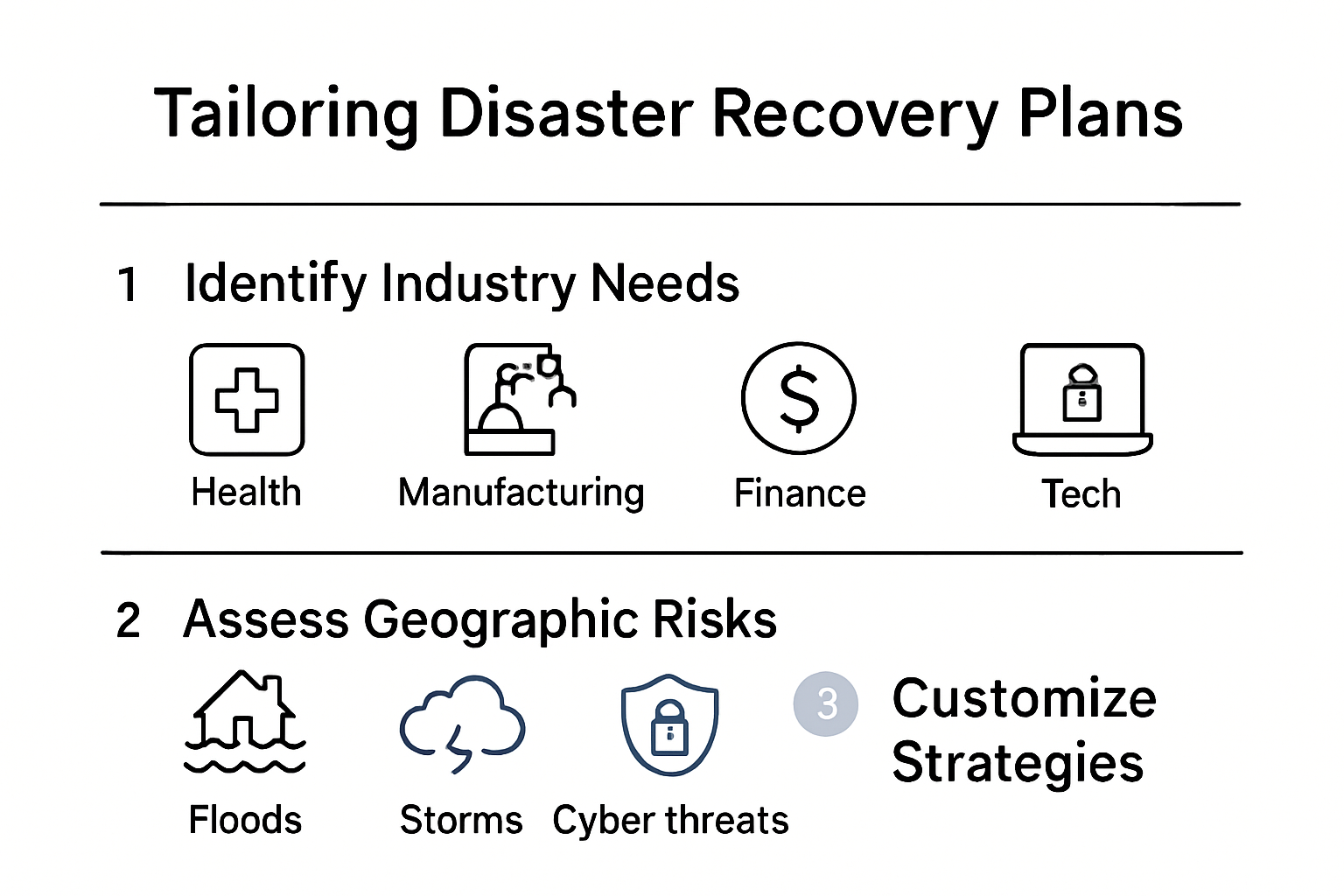
Disaster recovery is not a one-size-fits-all strategy. Each industry and geographic location presents unique challenges and risks that demand specialized, nuanced approaches to resilience and continuity planning.
Industry-Specific Recovery Considerations
The U.S. Economic Development Administration highlights the critical importance of developing industry-specific disaster recovery strategies. Different sectors face distinct technological, operational, and regulatory challenges that require tailored approaches.
For instance:
- Healthcare: Requires robust data protection protocols, patient record preservation, and compliance with HIPAA regulations
- Manufacturing: Needs strategies for equipment recovery, supply chain continuity, and production line restoration
- Financial Services: Demands immediate data recovery, transaction integrity, and secure communication channels
- Technology Companies: Requires rapid system restoration, data redundancy, and minimal service interruption
Each industry must develop recovery plans that address its specific operational dependencies, technological infrastructure, and regulatory requirements.
To help readers easily compare how disaster recovery considerations vary by industry, the table below summarizes specific requirements and risks for different sectors mentioned in the article.
| Industry | Key Recovery Considerations |
|---|---|
| Healthcare | Data protection protocols, patient record preservation, HIPAA compliance |
| Manufacturing | Equipment recovery, supply chain continuity, production line restoration |
| Financial Services | Immediate data recovery, transaction integrity, secure communications |
| Technology | Rapid system restoration, data redundancy, minimal service interruption |
Geographic and Environmental Risk Mapping
FEMA’s National Disaster Recovery Framework emphasizes the importance of understanding local environmental and geographic risks. Different regions face varied potential disasters such as earthquakes, floods, wildfires, hurricanes, or technological disruptions.
Businesses must conduct comprehensive risk assessments that consider:
- Local climate and environmental conditions
- Frequency of natural disaster events
- Infrastructure vulnerabilities
- Regional technological ecosystem
- Specific community and business interdependencies
Adaptive and Flexible Recovery Strategies
Ready.gov recommends developing adaptive recovery strategies that can flex and respond to evolving technological and environmental challenges. This requires a dynamic approach that goes beyond static documentation.
Key elements of adaptive recovery planning include:
- Regular risk assessment updates
- Continuous technology infrastructure evaluation
- Scenario-based training and simulation
- Flexible communication and response protocols
- Ongoing staff education and awareness programs
Explore our localized disaster recovery solutions designed to address the unique challenges of businesses in our region.
Ultimately, effective disaster recovery is about understanding and anticipating unique organizational and environmental contexts. By developing nuanced, industry-specific, and location-aware strategies, businesses can transform potential vulnerabilities into opportunities for demonstrating resilience, preparedness, and strategic thinking.
Best Practices for Testing and Updating Your Plan
A disaster recovery plan is only as effective as its most recent test and update. Businesses must approach plan maintenance with the same rigor and commitment they apply to initial plan development, recognizing that technological landscapes, organizational structures, and potential risks continuously evolve.
Comprehensive Testing Methodologies
The National Institute of Standards and Technology recommends a multi-tiered approach to disaster recovery plan testing that goes beyond theoretical documentation. Effective testing involves a strategic combination of different exercise types that simulate various potential scenarios and challenge the organization’s recovery capabilities.
Key testing methodologies include:
- Tabletop Exercises: Scenario-based discussions where team members walk through potential disaster scenarios
- Simulation Drills: Partial system tests that mimic specific disaster recovery procedures
- Full-Scale Simulations: Comprehensive tests that involve entire organizational systems and multiple departments
- Technological Recovery Tests: Specific assessments of data restoration and system failover capabilities
Each testing method serves a unique purpose in validating and refining the disaster recovery strategy, allowing organizations to identify potential weaknesses before an actual emergency occurs.
The following table organizes the main disaster recovery testing methodologies mentioned in the article and provides a brief description of each, making it easier for readers to understand and compare their purposes.
| Testing Method | Description |
|---|---|
| Tabletop Exercises | Scenario-based team discussions to walk through potential disasters |
| Simulation Drills | Partial system tests mimicking specific recovery procedures |
| Full-Scale Simulations | Comprehensive tests involving whole systems and multiple departments |
| Technological Recovery Tests | Specific assessments of data restoration and system failover |
Systematic Plan Review and Update Protocols
Regular and structured plan reviews are crucial for maintaining the relevance and effectiveness of disaster recovery strategies. Organizations should establish a systematic approach to reviewing and updating their plans, driven by both scheduled assessments and triggered by specific organizational changes.
Consider implementing:
- Quarterly comprehensive plan reviews
- Annual full-scale testing and evaluation
- Immediate updates following significant technological infrastructure changes
- Review triggered by organizational restructuring
- Assessments after any actual disaster or near-miss event
Documentation of each review, including identified gaps and implemented improvements, creates a transparent evolution of the disaster recovery strategy.
Continuous Learning and Improvement
Disaster recovery planning is not a static process but a dynamic, continuous journey of improvement. Organizations must cultivate a culture of preparedness that views testing and updating as opportunities for organizational learning and resilience enhancement.
Effective continuous improvement involves:
- Collecting and analyzing feedback from all testing exercises
- Developing actionable insights from simulation results
- Investing in ongoing staff training and awareness programs
- Creating mechanisms for cross-departmental knowledge sharing
- Staying informed about emerging technological and industry-specific risks
Discover our comprehensive disaster recovery testing approaches that can help transform your organization’s preparedness strategy.
Ultimately, the goal of testing and updating is not perfection but progressive improvement. By treating disaster recovery as a living, breathing strategic asset, businesses can develop increasingly sophisticated and responsive approaches to potential disruptions, turning potential vulnerabilities into opportunities for demonstrating organizational agility and resilience.
Frequently Asked Questions
What is a disaster recovery plan and why is it important for businesses?
A disaster recovery plan outlines the processes and strategies a business implements to recover its critical functions and IT systems after a disruptive event, such as natural disasters or cyber attacks. It’s crucial for minimizing downtime, protecting sensitive data, and ensuring the long-term survival of the business.
How can businesses conduct a comprehensive risk assessment for disaster recovery?
Businesses can conduct a risk assessment by inventorying their critical IT systems, mapping interdependencies, evaluating vulnerabilities, and identifying potential threats. This helps in developing effective recovery strategies tailored to the specific needs of the organization.
What are the best practices for testing a disaster recovery plan?
Best practices include implementing a variety of testing methodologies such as tabletop exercises, simulation drills, and full-scale simulations. Regular training for staff and consistent updates based on test outcomes are also essential to maintain an effective recovery strategy.
How often should a disaster recovery plan be updated?
A disaster recovery plan should be reviewed and updated at least quarterly, with immediate revisions made following significant technological changes or after any actual disaster events. This ensures the plan remains relevant and effective in an evolving business environment.
Secure Your Business Future with Disaster Recovery That Works
Reading about disaster recovery planning in this guide probably made one thing clear. A single unexpected incident—whether it is a cyber threat or a power outage—can put your entire business at risk. If you are like many leaders in Salinas, Monterey, or across Central California, you worry about how a disaster might expose gaps in your current technology setup. You want certainty. You want continuity. Most of all, you want peace of mind knowing your critical data is protected and your team can bounce back fast.
At SRS Networks, we specialize in turning these worries into a strong foundation for real business resilience. Our local technicians provide the managed IT support and disaster recovery planning discussed in the article, combining proactive IT monitoring, secure data backup, and compliance-focused strategies all built with your specific industry needs in mind. Our clients trust us because we do more than just safeguard your data—we help you develop recovery protocols, train your staff, and regularly test your plan so you can keep your promise to your customers, no matter what the future brings.
Is your business ready to pass the ultimate test of operational continuity? Do not wait to find out during a crisis. Partner with SRS Networks to access enterprise-level protection with the local expertise you deserve. Discover the difference and start your custom disaster recovery roadmap today by visiting our main website or learning more about our business continuity and backup solutions. Your future starts with a conversation. Take action now and make your resilience your competitive edge.