Bay Area businesses run on speed, innovation, and seamless tech, yet one silent threat hovers over them all. A single minute of IT downtime can cost up to $7,900. It sounds like something only giant corporations should worry about, but the real shock is this hits small and midsize companies the hardest, often turning a minor tech hiccup into a make-or-break situation for the entire organization.
In This Article: IT Downtime Costs, Impacts & Mitigation Strategies
- What Is IT Downtime And Why It Matters
- Major Financial And Operational Impacts Of Downtime
- Industry-Specific Risks And Real-Life Examples
- Effective Ways To Reduce IT Downtime Costs
Quick Summary
| Takeaway | Explanation |
|---|---|
| IT downtime can cost $7,900 per minute. | Small to medium-sized businesses face severe financial risks due to significant downtime costs accumulating rapidly. |
| Proactive monitoring prevents unexpected IT failures. | Implementing advanced monitoring systems allows organizations to identify vulnerabilities before they escalate into major disruptions. |
| Robust disaster recovery plans are essential. | Comprehensive strategies ensure quick data restoration and minimize service interruption during technological failures. |
| Training staff enhances IT problem-solving capabilities. | Continuous professional development equips staff with skills to quickly diagnose and resolve system issues, reducing downtime impact. |
| View IT infrastructure as a strategic asset. | Positioning IT as a critical strategic component helps organizations prioritize investments for operational resilience and innovation. |
What Is IT Downtime and Why It Matters
In the digital ecosystem of Bay Area organizations, IT downtime represents a critical vulnerability that can dramatically disrupt business operations and financial stability. Disaster recovery strategies become essential when understanding the profound implications of technological interruptions.
Defining IT Downtime
IT downtime occurs when computer systems, networks, or critical technological infrastructure become unavailable or non-functional. According to the U.S. Government Accountability Office, this interruption can range from brief moments to extended periods where digital services remain inaccessible. For Bay Area organizations operating in high-stakes industries like technology, healthcare, and finance, even minutes of downtime can translate into significant financial and operational consequences.
The complexity of modern technological ecosystems means downtime can emerge from multiple sources. Hardware failures, software glitches, cybersecurity incidents, network complications, and human errors can all precipitate unexpected service disruptions. Each scenario presents unique challenges that demand proactive management and strategic prevention.
The Multifaceted Impact of Technological Interruptions
Beyond immediate financial losses, IT downtime carries profound ripple effects across organizational infrastructure. Productivity grinds to a halt when employees cannot access critical systems. Customer trust erodes when services become unreliable. Compliance requirements in sensitive sectors like healthcare and finance can be compromised, potentially triggering regulatory penalties.
Small to medium-sized businesses in the Monterey Bay region are particularly vulnerable. Without robust IT infrastructure and comprehensive disaster recovery plans, these organizations risk substantial economic setbacks. A single hour of downtime can cost thousands of dollars in lost revenue, reduced employee productivity, and potential long-term reputational damage.
Moreover, the interconnected nature of modern business means that IT disruptions do not occur in isolation. A network failure can cascade through supply chains, communication platforms, and customer relationship management systems. The potential for widespread disruption underscores the critical importance of understanding and mitigating IT downtime risks.
By recognizing IT downtime as more than a technical inconvenience but as a strategic business challenge, Bay Area organizations can develop comprehensive approaches to technological resilience. Proactive monitoring, robust backup systems, and strategic disaster recovery planning become not just recommended practices but essential survival strategies in an increasingly digital business landscape.
Major Financial and Operational Impacts of Downtime
In the dynamic business environment of the Bay Area, IT downtime represents far more than a temporary technical inconvenience. It is a significant financial and operational threat that can undermine an organization’s entire strategic framework. Strategic IT management becomes critical in mitigating these potentially devastating consequences.
Direct Financial Losses
The economic impact of IT downtime extends far beyond simple service interruption. According to research from the National Institutes of Health, organizations can face staggering costs approaching $7,900 per minute of system unavailability. For small to medium-sized businesses in the Monterey Bay region, such financial strain could represent an existential threat.
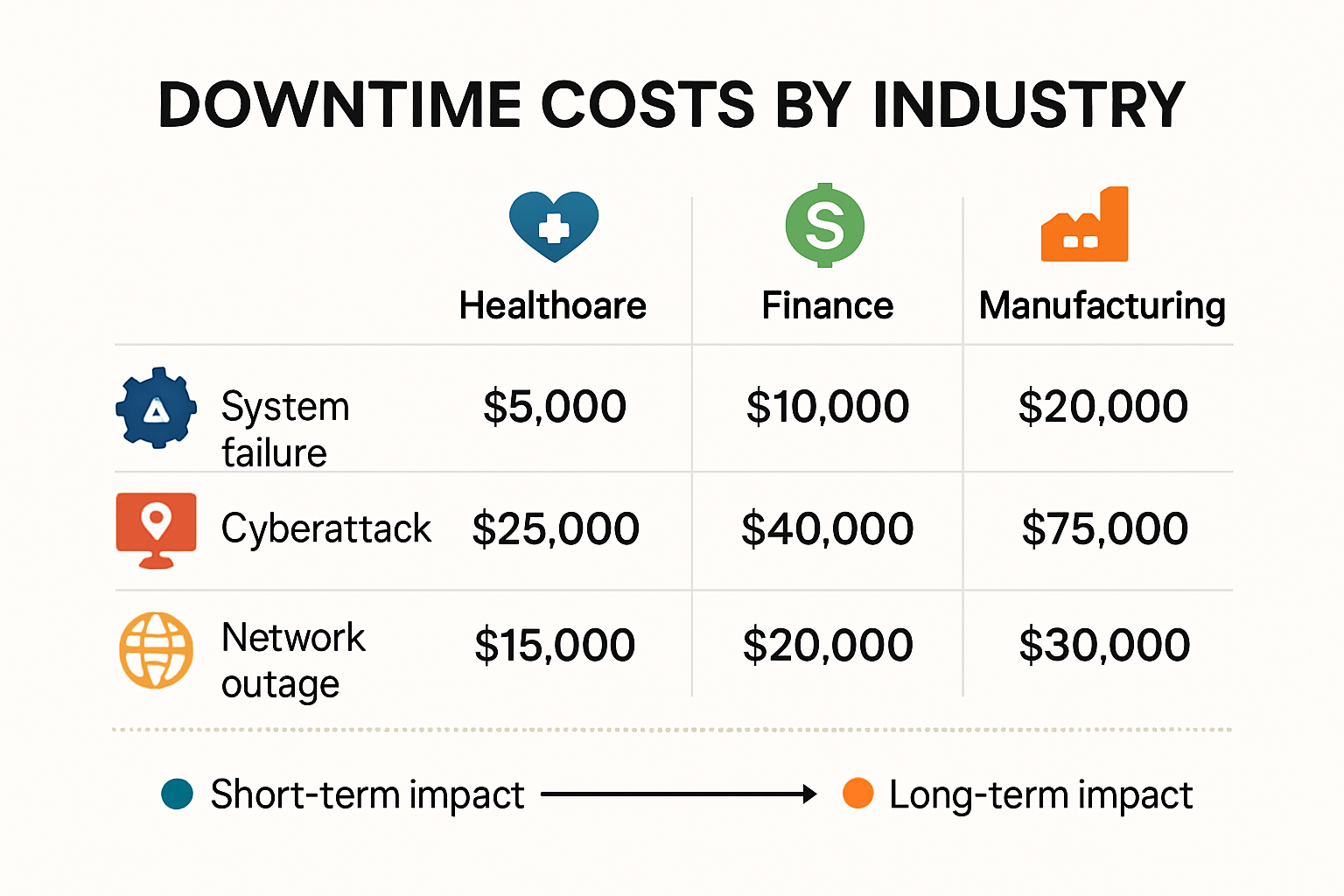
These direct financial losses manifest through multiple channels. Revenue streams halt when digital services become inaccessible. Transaction processing stops. Sales platforms go offline. Customer engagement platforms become non-functional. Each minute of downtime translates directly into measurable economic damage that compounds rapidly.
Here is a summary of the main types of financial and operational losses Bay Area organizations may experience during IT downtime, based strictly on the article’s content.
| Impact Type | Description |
|---|---|
| Direct Financial Loss | Revenue loss due to halted services, unprocessed transactions, and inactive sales platforms. |
| Productivity Loss | Employee downtime, communication breakdowns, and missed deadlines. |
| Reputational Damage | Loss of customer trust, negative perception, and reduced stakeholder confidence. |
| Regulatory Penalties | Potential compliance violations leading to fines, especially in healthcare and finance. |
| Recovery Costs | Expenses related to restoring services, incident response, and administrative overhead. |
Operational Disruption and Productivity Erosion
Beyond immediate monetary losses, IT downtime triggers cascading operational challenges. The National Institute of Standards and Technology highlights that system failures create extensive productivity interruptions across organizational structures. Employees become unable to access critical work resources. Communication platforms malfunction. Collaborative tools cease functioning. Project timelines extend. Deadlines become compromised.
In technology-driven sectors like Silicon Valley and the broader Bay Area, where competitive advantage relies on rapid innovation and seamless digital collaboration, even brief technological interruptions can represent significant strategic setbacks. Manufacturing workflows stall. Healthcare providers experience patient care disruptions. Financial service providers cannot process critical transactions.
Reputational and Long-Term Strategic Consequences
Perhaps most critically, persistent or repeated IT downtime erodes organizational credibility. According to US Government Accountability Office analysis, repeated technological failures can trigger substantial reputational damage that extends far beyond immediate financial losses. Customer trust diminishes. Potential clients become hesitant to engage. Investors may question organizational reliability.
For Bay Area businesses competing in highly sophisticated technological ecosystems, maintaining an impeccable technological reputation is paramount. A single significant downtime incident can undermine years of carefully constructed organizational credibility. The potential for lost business opportunities, reduced market positioning, and diminished stakeholder confidence represents a complex, multi-dimensional risk that transcends simple monetary calculation.
Understanding these profound implications requires Bay Area organizations to view IT infrastructure not as a peripheral support system, but as a critical strategic asset. Proactive investment in robust technological resilience, comprehensive disaster recovery planning, and advanced monitoring systems becomes not just recommended practice, but an essential survival strategy in an increasingly digital business landscape.
Industry-Specific Risks and Real-Life Examples
The impact of IT downtime varies dramatically across different industries, with each sector facing unique technological vulnerabilities and potential economic consequences. Comprehensive IT risk management becomes crucial in understanding and mitigating these sector-specific challenges.
Healthcare and Medical Services
In the healthcare sector, IT downtime represents more than a financial risk it directly threatens patient safety and care delivery. According to Lawrence Berkeley National Laboratory research, power and system interruptions can create catastrophic consequences. Electronic health record systems going offline can delay critical treatments, compromise medication administration, and disrupt surgical scheduling. For medical practices in the Monterey Bay region, a single system failure could mean missed diagnoses, delayed patient care, and potential legal complications.
Real-world examples underscore these risks. Hospital networks experiencing electronic medical record system failures have reported significant patient treatment delays, with some facilities forced to revert to manual paper-based processes. These interruptions not only compromise patient care but also create substantial administrative burdens and potential compliance violations.
Technology and Financial Services
Technology and financial sectors face particularly acute risks from IT downtime. Research from the Foundation for Defense of Democracies suggests that coordinated ransomware attacks could potentially cause economic losses approaching $80 billion, affecting hundreds of small and medium-sized businesses. Stock trading platforms, payment processing systems, and cloud-based financial services become critically vulnerable during technological interruptions.
Consider the example of a major financial institution experiencing a network outage during peak trading hours. Transaction processing halts. Customer accounts become temporarily inaccessible. Trading algorithms stop functioning. The ripple effects can extend far beyond immediate operational disruptions, potentially triggering broader market uncertainties and significant financial losses.
Manufacturing and Supply Chain Operations
Manufacturing organizations in the Bay Area face unique challenges with IT downtime. Automated production lines, inventory management systems, and complex supply chain networks rely entirely on continuous technological functionality. A single system failure can halt entire production processes, creating substantial economic and logistical complications.
In one documented instance, a local manufacturing firm experienced a comprehensive enterprise resource planning (ERP) system failure that stopped production for 36 hours. The economic impact extended beyond immediate production losses, including contract penalties, workforce idle time, and significant recovery costs. Such examples highlight the critical importance of robust technological infrastructure and proactive disaster recovery strategies.
Below is a comparison table highlighting how IT downtime impacts different industries in the Bay Area, based on real examples and sector-specific risks discussed in the article.
| Industry | Key Downtime Risks | Example Consequence |
|---|---|---|
| Healthcare | Patient care disruption, delayed treatment, compliance issues | Missed diagnoses, legal complications |
| Technology/Finance | Service interruptions, transaction failures, cyberattack vulnerability | Service outages during peak trading, market instability |
| Manufacturing | Production line stoppages, supply chain interruption, logistical complications | 36-hour ERP failure leading to production halt and penalties |

These industry-specific scenarios demonstrate that IT downtime is not a uniform risk but a nuanced challenge requiring tailored technological resilience strategies. Bay Area organizations must develop comprehensive, sector-specific approaches that anticipate and mitigate potential technological vulnerabilities. Proactive monitoring, robust backup systems, and strategic redundancy become essential investments in maintaining operational continuity and protecting organizational stability.
Effective Ways to Reduce IT Downtime Costs
Mitigating the financial and operational risks associated with IT downtime requires a strategic, multi-layered approach tailored to an organization’s unique technological ecosystem. Proactive IT infrastructure management becomes the cornerstone of developing robust technological resilience for Bay Area businesses.
Comprehensive Monitoring and Predictive Maintenance
Effective downtime reduction begins with implementing advanced monitoring systems that provide real-time insights into technological infrastructure performance. Organizations must invest in sophisticated monitoring tools that can detect potential system vulnerabilities before they escalate into full-scale disruptions. These systems enable predictive maintenance, allowing technical teams to address potential issues proactively rather than reactively.
Key strategies include continuous network performance tracking, automated alert systems, and regular diagnostic assessments. By establishing baseline performance metrics, organizations can quickly identify anomalies that might indicate impending system failures. This approach transforms IT management from a reactive model to a predictive one, significantly reducing the likelihood of unexpected downtime.
Robust Backup and Disaster Recovery Planning
Developing comprehensive disaster recovery strategies is crucial for minimizing the potential impact of IT disruptions. This involves creating redundant systems, implementing cloud-based backup solutions, and establishing clear protocols for rapid system restoration. Organizations must design multi-layered backup approaches that ensure data integrity and minimal service interruption.
Critical components of an effective disaster recovery plan include:
- Redundant Infrastructure: Maintaining duplicate systems and network configurations
- Cloud-Based Backup Solutions: Ensuring data can be quickly restored from secure offsite locations
- Comprehensive Incident Response Protocols: Clearly defined step-by-step procedures for managing and mitigating technological disruptions
Regular testing and simulation of disaster recovery scenarios allow organizations to identify potential weaknesses in their technological infrastructure and refine their response strategies accordingly.
Strategic Technology Investment and Staff Training
Reducing IT downtime costs extends beyond technological solutions to include human expertise and strategic infrastructure investments. Organizations must prioritize ongoing staff training, ensuring technical teams possess the skills necessary to rapidly diagnose and resolve potential system issues.
This approach involves:
- Continuous Professional Development: Regular training programs focusing on emerging technologies and advanced troubleshooting techniques
- Certification Programs: Encouraging staff to obtain advanced technical certifications
- Cross-Training Initiatives: Developing versatile technical teams capable of addressing multiple technological challenges
Additionally, organizations should adopt a strategic approach to technology procurement. This means investing in high-quality, reliable infrastructure components from reputable vendors, implementing regular system updates, and maintaining a forward-looking approach to technological evolution.
For Bay Area businesses operating in competitive and technology-driven markets, viewing IT infrastructure as a strategic asset rather than a mere operational expense becomes critical. By implementing comprehensive monitoring, developing robust disaster recovery plans, and investing in both technological infrastructure and human expertise, organizations can significantly reduce the financial and operational risks associated with IT downtime.
Ultimately, the goal is not just to prevent technological disruptions but to create a resilient, adaptive technological ecosystem that supports ongoing business growth and innovation.
Frequently Asked Questions
What is IT downtime, and why is it important for businesses?
IT downtime refers to periods when computer systems, networks, or critical technological infrastructure are unavailable or non-functional. It is crucial for businesses because even a single minute of downtime can result in significant financial losses and operational disruptions, particularly for small to medium-sized organizations.
How much can IT downtime cost a Bay Area organization?
According to studies, IT downtime can cost up to $7,900 per minute. This financial strain can be particularly severe for small and medium-sized businesses, impacting revenue, productivity, and overall operational efficiency.
What are the main causes of IT downtime?
Common causes of IT downtime include hardware failures, software glitches, cybersecurity incidents, network complications, and human errors. Each of these sources of disruption poses unique challenges, emphasizing the need for proactive management and strategic prevention.
How can organizations reduce the risk and cost of IT downtime?
Organizations can reduce the risk of IT downtime by implementing comprehensive monitoring systems, developing robust backup and disaster recovery plans, and investing in staff training. Proactive measures such as predictive maintenance and continuous professional development are critical for minimizing disruptions and ensuring quick recovery from incidents.
Protect Your Bay Area Business From Costly IT Downtime – Take Action Now
Unplanned IT downtime can destroy productivity, drain profits, and damage your reputation in minutes. As highlighted in this article, even a brief lapse in technology can lead to thousands lost per minute, especially for small and medium-sized businesses in the Monterey Bay and Silicon Valley regions. The threat is real and relentless, with risks ranging from halted operations and compliance violations to shattered customer trust. Many organizations lack the in-house resources or time needed to proactively monitor, secure, and recover from these disruptions. Are you ready to face these challenges, or do you need a local IT partner who puts your business continuity first?
SRS Networks helps Bay Area businesses turn IT from a liability into a competitive strength. Our managed IT services include 24/7 proactive monitoring, rapid onsite support, and tailored disaster recovery strategies to keep your systems resilient and your data safe. Don’t wait for the next outage to hit. Visit SRS Networks to see how our solutions can protect your revenue, reputation, and growth. Reach out today and secure your business against downtime before the next incident happens.