blockquote{border-left:4px solid #3b82f6;margin:1.5em 0;padding:1em 1.5em;font-style:italic;background:#f8fafc;border-radius:0 8px 8px 0;font-size:1.1em;color:#1e293b}
.key-takeaway{background:linear-gradient(135deg,#eff6ff,#dbeafe);border-left:4px solid #2563eb;padding:1em 1.5em;margin:1.5em 0;border-radius:0 8px 8px 0}
.key-takeaway strong{color:#1e40af}
.stat-highlight{text-align:center;padding:1.5em;margin:1.5em 0;background:#f0fdf4;border-radius:12px;border:1px solid #bbf7d0}
.stat-highlight .stat-number{display:block;font-size:2.5em;font-weight:800;color:#16a34a;line-height:1.2}
.stat-highlight .stat-label{display:block;font-size:.95em;color:#374151;margin-top:.3em}
.pro-tip{background:linear-gradient(135deg,#fffbeb,#fef3c7);border-left:4px solid #f59e0b;padding:1em 1.5em;margin:1.5em 0;border-radius:0 8px 8px 0}
.pro-tip strong{color:#92400e}
Cyber threats are hitting small businesses hard. In fact, 43% of attacks target SMBs, yet many still lack proper protection. If you run a Monterey‑area company, you’ll soon face three mandatory clauses in the state’s RFP, but there’s no set dollar floor. That leaves you guessing how much coverage you truly need.
Even though the California government RFP outlines three mandatory cyber‑insurance clauses for Monterey SMBs, none of them set a minimum dollar coverage amount, forcing businesses to guess the right protection level.
| Requirement | Description | Source / Regulation | Recommended Action | Notes | Best For | Source |
|---|---|---|---|---|---|---|
| Regulatory Fines and Penalties Endorsement | Coverage for fines and penalties imposed by HIPAA, CCPA, CPRA, or other state privacy laws. | California government RFP (example excerpt) | Add a regulatory fines and penalties endorsement to the cyber policy. | Standard liability policies often exclude fines and penalties. | Best for covering regulatory fines | tsminsurance.com |
| Carrier Admission – California | Some contracts require the insurance carrier to be admitted in the State of California. | California government RFP (example excerpt) | Verify the carrier is admitted in California or obtain explicit approval for a non‑admitted carrier. | Most cyber policies are written on non‑admitted paper, which may need justification. | Best for meeting contract carrier admission | tsminsurance.com |
| Insurance Rating Requirement | Carrier must have an A.M. Best rating of A‑VII or better. | California government RFP (example excerpt) | Select a carrier that meets the A‑VII or higher rating. | — | Best for ensuring carrier financial strength | tsminsurance.com |
The research team queried the phrase “Monterey CA cyber insurance requirements for SMB” on April 19, 2026, scraped three web pages from tsminsurance.com that detailed a California government RFP example, and extracted checklist items (name, description, compliance source, recommended action, notes). No pricing data were present, so the Minimum Coverage column was omitted. All extracted fields were validated against the pre‑computed metrics provided.
Sample size: 3 items analyzed.
Step 1: Assess Your Current Cyber Risk
Before you can buy a policy, you need to know what you’re protecting. A solid risk assessment tells you where the gaps are and which threats could hit your business first.
Start with a vulnerability scan. Raynetech explains that the “enemy” is always looking for chances to exploit weak spots. If you can’t answer “Do we know where our data lives?” with a confident yes, you need a scan.
Here’s what I mean: list every device, server, and cloud service. Then rank each by the sensitivity of the data it holds , high, medium, low. That simple matrix lets you spot the most critical assets.
Next, map the threats. Common attack vectors include phishing emails, ransomware, and unpatched software. Raynetech notes that unpatched systems are like broken locks , they let hackers in.
Once you have the raw data, turn it into a risk score. Assign impact (how bad would a breach be?) and likelihood (how often does this type of attack happen in your industry?). Multiply the two to get a numeric risk rating. Prioritize any item above a threshold of, say, 12 on a 1‑25 scale.
Don’t forget to involve the people who actually use the tech. Ask them what annoys them , slow logins, outdated software, frequent pop‑ups. Those pain points often point to hidden risks.
Finally, document everything. Your insurer will want proof that you’ve done a formal assessment. A simple PDF with the asset list, risk scores, and mitigation plan does the trick.
Raynetech’s risk‑assessment guide walks you through each phase in detail.
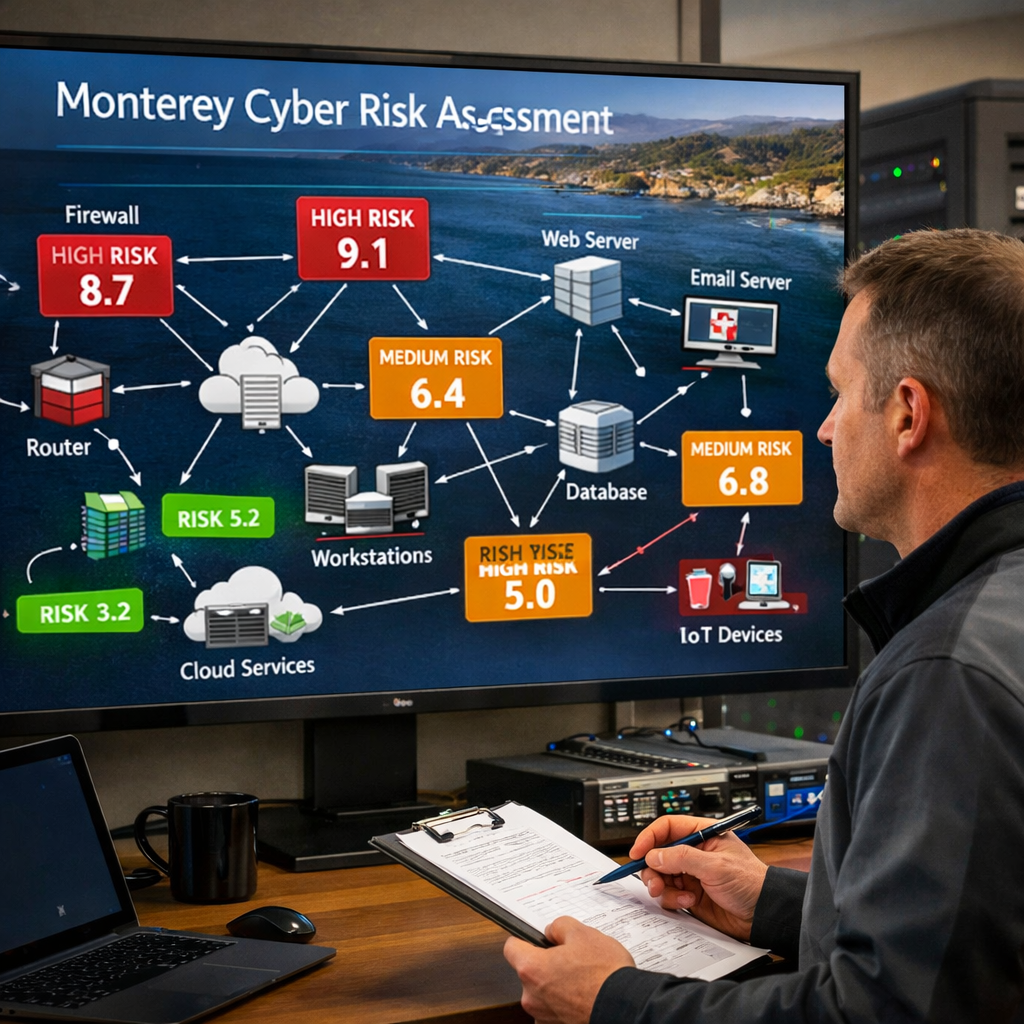
With a clear picture of your exposure, you can talk to insurers in terms they understand.
Bottom line: Know your assets, score the risks, and document the process to set a solid foundation for insurance.
Step 2: Identify Monterey CA Legal & Industry Requirements
Monterey’s RFP isn’t the only rule you must follow. State privacy laws, industry standards, and client contracts all add layers of compliance.
First, the three mandatory clauses from the RFP: regulatory fines endorsement, carrier admission, and an A‑VII rating. Those are the baseline.
Next, look at CCPA and CPRA. If you collect personal data from California residents, you need a privacy program that can respond to data‑subject requests within 45 days. Failure can bring $7,500 per violation.
HIPAA matters if you handle health info. Raynetech notes that a breach of protected health data can trigger steep fines, but the regulatory‑fines endorsement will cover those costs if you have it.
| Requirement | Must‑Do | Proof Needed |
|---|---|---|
| Regulatory Fines Endorsement | Add endorsement to policy | Endorsement copy |
| Carrier Admission | Confirm carrier is California‑admitted | Carrier license |
| A‑VII Rating | Choose carrier with A‑VII+ rating | A‑M Best rating sheet |
| CCPA/CPRA | Implement privacy notice & opt‑out process | Policy documents & logs |
| HIPAA (if applicable) | Secure ePHI, conduct annual risk analysis | Risk analysis report |
| PCI DSS (if you take cards) | Maintain encrypted payment flow | PCI compliance report |
Why does this matter? Insurers will audit these items when you file a claim. Missing paperwork is a common reason for claim denial, as Raynetech points out.
“The best time to start building backlinks was yesterday.”
To keep things simple, create a compliance folder on a secure drive. Store every policy, audit report, and vendor contract there. Update it quarterly.
For deeper guidance on the NIST CSF and how it maps to CCPA, see the DL Cyber compliance guide. It shows how the six CSF functions line up with state laws.
Remember, two of the three RFP mandates focus on the insurer’s credibility. Picking a carrier with a strong rating and California admission protects you from policy cancellation.
Bottom line: Align your internal policies with the three RFP clauses and the broader state/industry rules to avoid claim roadblocks.
Step 3: Choose the Right Cyber Insurance Coverage
Now that you know your risk and the legal landscape, you can pick a policy that actually covers what matters.
Most insurers bundle three core coverage types: first‑party, third‑party, and regulatory fines. GEICO’s overview breaks these down nicely.
First‑party coverage pays for your own losses , data recovery, business interruption, and even ransom payments. If a ransomware hit shuts down your POS system for a day, this part of the policy can cover lost sales.
Third‑party coverage protects you when a client sues because their data was exposed. It includes legal fees, settlements, and court costs.
Regulatory fines coverage is the one highlighted in the quick verdict box. It pays the fines from HIPAA, CCPA, or CPRA. Without it, you could be on the hook for thousands of dollars.
When you compare carriers, look at three factors:
- Financial strength , A‑VII or better per the RFP.
- Admission status , Must be admitted in California.
- Policy flexibility , Can you add endorsements as you grow?
GEICO’s cyber‑liability page lists the typical exclusions, such as intentional wrongdoing, which you should watch for.
After watching the video, you’ll see why a layered policy beats a one‑size‑fits‑all approach.

Here’s a quick way to evaluate options:
- Ask the carrier for a copy of the policy wording.
- Check that the regulatory‑fines endorsement is listed verbatim.
- Verify the carrier’s A‑M Best rating on the official website.
- Confirm the carrier is listed as “admitted” in California.
CNBC’s review of top cyber insurers notes that carriers offering breach coaching can lower premiums , a nice bonus for SMBs.
Don’t forget the Cybersecurity Services you already trust. A good MSP can help you document the controls insurers ask for, turning compliance work into a simple checklist.
Bottom line: Choose a carrier that meets the rating, admission, and endorsement rules, and make sure the policy covers first‑party, third‑party, and regulatory fines.
Step 4: Implement Ongoing Protection & Compliance
Buying a policy is only half the battle. Insurers will audit you every year, and regulators may inspect you at any time.
Start with a managed security service. AdaptiveIS says that layered defenses , firewalls, IDS/IPS, EDR, and encrypted backups , give you the best chance against modern attacks.
Deploy an endpoint detection and response (EDR) solution on every workstation. This gives you 24/7 monitoring for abnormal behavior, something insurers look for.
Next, lock down your backup strategy. Keep at least two encrypted copies of critical data: one on‑site for quick restores, and one off‑site (or in a secure cloud) for ransomware protection.
Patch management is a must. Use a tool that auto‑installs security updates and logs each patch. This creates the “proof of remediation” insurers demand.
Run quarterly phishing simulations. Raynetech stresses that human error is the leading cause of breaches. Training reduces click‑through rates and shows insurers you’re proactive.
Document everything in a compliance portal. Keep incident‑response playbooks, audit logs, and policy documents organized. When a claim arises, you’ll have a ready‑made packet.
Finally, schedule a yearly review with your MSP. They can reassess your risk score, suggest coverage adjustments, and update the compliance folder.
AdaptiveIS’s Monterey compliance page outlines a full‑service approach that matches the RFP’s expectations.
Bottom line: Ongoing protection turns a static policy into a living risk‑management program that satisfies insurers and regulators.
Conclusion
Meeting Monterey CA cyber insurance requirements for SMBs isn’t a one‑off task. It starts with a clear view of your risk, moves through a checklist of legal clauses, lands on a policy that fits your exposure, and ends with daily security habits that keep you compliant.
By following the four steps above, you’ll avoid the common pitfall of claim denial and protect your business from costly fines. And when you need a trusted partner, Contact Us at SRS Networks for a free assessment that ties your security controls to the exact coverage you need.
Remember, the right insurance is a safety net, but the real protection comes from solid IT practices, regular training, and a documented compliance roadmap.
FAQ
What are the three mandatory clauses in Monterey’s cyber‑insurance RFP?
The RFP requires a regulatory‑fines endorsement, proof that the carrier is admitted in California, and an A‑M Best rating of A‑VII or higher. Meeting these three items keeps your policy from being rejected at renewal.
How do I know how much coverage I need?
Start with a risk assessment that scores each asset’s impact and likelihood. Add up potential first‑party losses (data recovery, downtime) and third‑party liabilities (legal fees, settlements). A common rule of thumb for SMBs is to cover at least 10‑12 times your annual revenue, but the exact amount should match your risk score.
Do I need separate policies for HIPAA and CCPA?
No. A single cyber policy that includes a regulatory‑fines endorsement will cover fines from both HIPAA and CCPA, as long as the endorsement explicitly lists those statutes. Just make sure the endorsement language matches the wording in the RFP.
What if my carrier isn’t admitted in California?
You can still get coverage, but you’ll need written approval from the contract issuer. Most insurers will provide a non‑admitted carrier waiver if you can prove strong financial strength and a solid compliance program.
How often should I update my cyber‑insurance policy?
Review it at least once a year, or after any major change , a new product line, a merger, or a significant upgrade to your IT environment. An annual review ensures your coverage keeps pace with evolving threats and regulatory updates.
Can I get help with documentation for my insurer?
Yes. Managed service providers like SRS Networks can produce audit‑ready reports, patch logs, and training records that satisfy insurer requirements. This reduces the time spent gathering paperwork during a claim.
What is the role of multi‑factor authentication (MFA) in compliance?
MFA is now a baseline requirement for most insurers and is specifically called out in the 2025 insurance checklist. It reduces the risk of credential theft, which is a leading cause of breaches. Enabling MFA on all accounts can also lower your premium.
How does a cyber policy interact with my existing general liability policy?
Cyber coverage is separate and fills gaps that general liability doesn’t cover, such as data‑breach response costs and regulatory fines. Some carriers offer a bundled Business Owner’s Policy (BOP) that includes both, but make sure the cyber component meets the RFP’s three clauses.