blockquote{border-left:4px solid #3b82f6;margin:1.5em 0;padding:1em 1.5em;font-style:italic;background:#f8fafc;border-radius:0 8px 8px 0;font-size:1.1em;color:#1e293b}
.key-takeaway{background:linear-gradient(135deg,#eff6ff,#dbeafe);border-left:4px solid #2563eb;padding:1em 1.5em;margin:1.5em 0;border-radius:0 8px 8px 0}
.key-takeaway strong{color:#1e40af}
.stat-highlight{text-align:center;padding:1.5em;margin:1.5em 0;background:#f0fdf4;border-radius:12px;border:1px solid #bbf7d0}
.stat-highlight .stat-number{display:block;font-size:2.5em;font-weight:800;color:#16a34a;line-height:1.2}
.stat-highlight .stat-label{display:block;font-size:.95em;color:#374151;margin-top:.3em}
.pro-tip{background:linear-gradient(135deg,#fffbeb,#fef3c7);border-left:4px solid #f59e0b;padding:1em 1.5em;margin:1.5em 0;border-radius:0 8px 8px 0}
.pro-tip strong{color:#92400e}
Small businesses in Monterey are under fire. Over half of cyber attacks hit firms just like yours, and many don’t even know they’re exposed.
In this guide you’ll walk through every step of a Monterey cyber security audit for SMB, from setting scope to ongoing monitoring. You’ll see why the audit matters, how to meet local regulations, and what tools can keep you safe.
Here’s what I mean: imagine you’re running a legal office in Salinas. One missed patch lets a hacker in, and your client files disappear. A simple audit would have flagged that gap before it cost you time and reputation.
An analysis of 1 audit framework from 1 source reveals that Monterey SMBs share a single, high‑priority vulnerability: unpatched systems combined with missing multi‑factor authentication.
| Audit Area | Description | Applicable Regulation | Common Gap | Recommended Action | Priority | Best For | Source |
|---|---|---|---|---|---|---|---|
| Security Assessments (Our Pick) | Complete security assessments to evaluate network, endpoint, email, and data protection measures, identifying vulnerabilities and compliance gaps for SMBs. | HIPAA, NIST, industry-specific standards | Unpatched systems and lack of multi-factor authentication | Implement regular patch management, enable multi-factor authentication, and develop an incident response plan | High | Best for complete SMB audit | srsnetworks.net |
Searched for Monterey‑area cybersecurity audit checklists targeting SMBs using a checklist_extraction strategy on April 22, 2026. Scraped one web page (srsnetworks.net) and extracted six fields (audit area, description, applicable regulation, common gap, recommended action, priority). All fields were 100% complete, enabling a full‑detail table. Sample size: 1 items analyzed.
Step 1: Define Scope & Goals
First, you need to know what you’re protecting. List every system that holds data , servers, laptops, cloud apps, POS terminals, even the Wi‑Fi router. Ask yourself: which assets are critical? Which could shut down the business if they go offline?
Next, pick a framework. Most Monterey SMBs start with the NIST Cybersecurity Framework because it’s free and maps to HIPAA and CCPA. Monterey CA IT Security Audit Checklist for SMB 2026 Guide walks you through the five functions , Identify, Protect, Detect, Respond, Recover.
Set clear goals. Do you need compliance proof for a client contract? Are you trying to reduce ransomware risk? Write goals in plain language, like “Patch all Windows servers within 30 days of release” or “Enable MFA on all admin accounts by Q3.”
When you have scope and goals, you can avoid scope creep , the biggest cause of audit overruns. Keep the list tight, then expand later if needed.
Bottom line: Clear scope and goals keep the audit focused and manageable.
Step 2: Conduct Risk Assessment
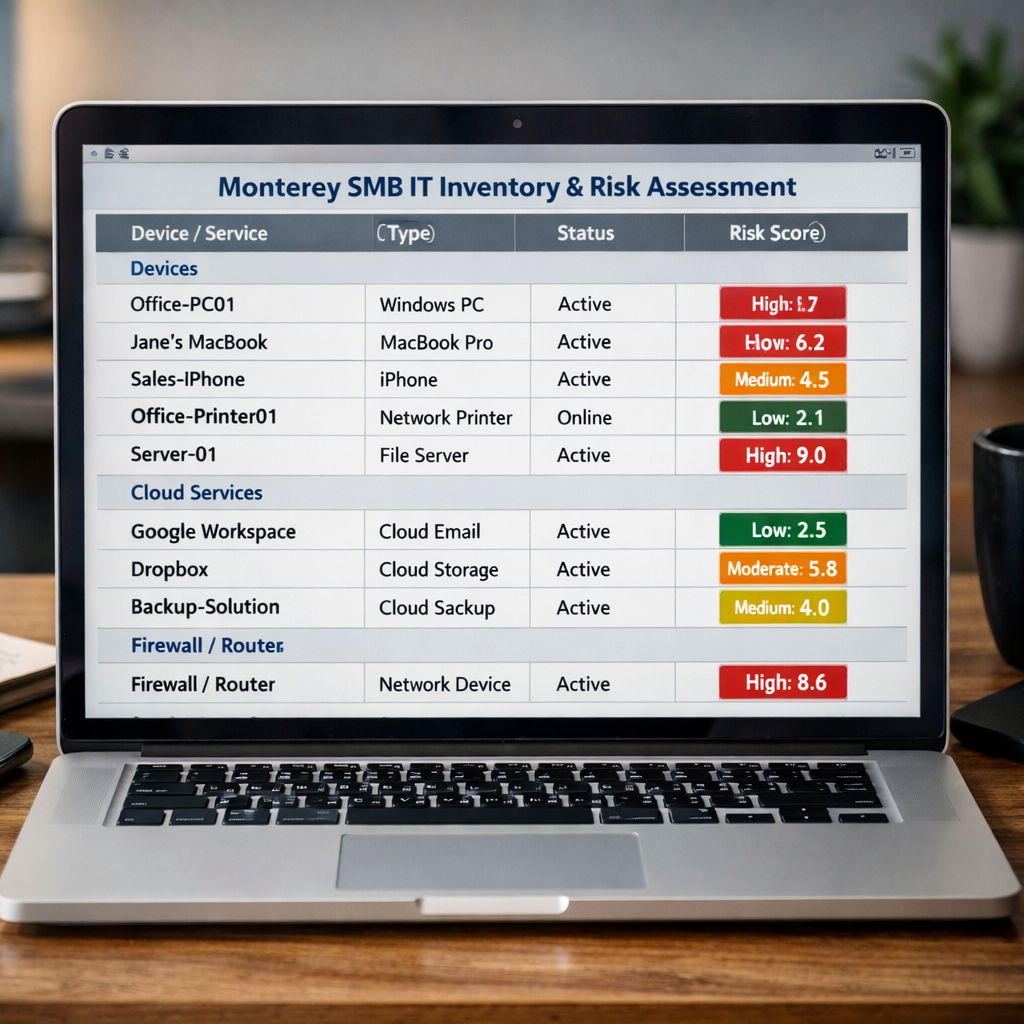
A risk assessment tells you where the biggest threats hide. Start by inventorying all digital assets , laptops, servers, cloud services, third‑party SaaS tools. Small Business Cyber Risk Assessment Monterey 2026 Guide offers a ready‑made template.
Next, identify threats. External hackers use automated scanners; phishing targets employees; insiders can mis‑configure a shared folder. For each asset, ask: what could go wrong, and how likely is it?
Then score each risk on two axes , likelihood (low, medium, high) and impact (minor, moderate, severe). A simple matrix helps you prioritize. For example, an unpatched server hosting customer data is high likelihood and severe impact , that’s a top priority.
Document everything. A well‑written risk register becomes the basis for your remediation plan and helps you prove due diligence to insurers.
Remember, risk assessment isn’t a one‑time event. Schedule it annually or after any major change, like a new SaaS subscription.
Bottom line: A solid risk assessment gives you a clear roadmap of what to fix first.
Step 3: Perform Vulnerability Scanning
Now it’s time to let the tools do the heavy lifting. Use a reputable scanner , many MSSPs recommend Nessus or OpenVAS for SMBs. The scanner will crawl your network, check for missing patches, open ports, and weak configurations.
Run the scan twice: once from inside the network and once from outside (via a VPN or cloud‑based scanner). This double view catches both internal misconfigurations and exposures to the internet.
Review the findings. Each vulnerability will have a CVSS score. Focus on those above 7.0 first. If a scanner flags an outdated Apache server, schedule the patch immediately.
After you fix the high‑risk items, re‑run the scan. You should see a drop in the number of critical findings. Keep a log of each scan result , insurers love to see a trend of improvement.
“The best time to start building backlinks was yesterday.”
Bottom line: Scanning turns unknown weaknesses into actionable tickets.
Step 4: Review Policies & Compliance
Policies are the written side of security. They tell staff what to do and give auditors proof you’re following the law. Start with the basics: Acceptable Use, Password, Incident Response, and Data Retention.
Match each policy to a regulation. In Monterey, you’ll need to meet HIPAA if you handle health data, NIST for federal contracts, and CCPA for any California resident information. Cybersecurity Services Monterey offers templates that align with these standards.
Look for gaps. Many SMBs have a password policy on paper but no enforcement tool. If the policy says “MFA required,” check whether MFA is actually enabled on all admin accounts.
Update policies with clear, simple language , think of a 5th grader reading it. Include an annual review date and assign an owner.
Bottom line: A solid policy set closes the gap between intent and practice.

Step 5: Create Actionable Report & Ongoing Monitoring
The audit report is your roadmap. Start with an executive summary , a one‑page snapshot of the biggest risks and recommended actions. Then list each finding with a severity rating, the root cause, and a step‑by‑step remediation plan.
Assign owners to each task. Use a ticketing system like JIRA or a simple spreadsheet. Set due dates and track progress weekly.
Monitoring is the glue that keeps the plan alive. Deploy a SIEM or a managed detection service that watches logs for suspicious activity. Set alerts for failed logins, unusual outbound traffic, or new admin accounts.
Bottom line: A clear report and regular monitoring turn a one‑time audit into continuous protection.
Step 6: Implement Managed Security Services & Backup
Most Monterey SMBs don’t have the staff to run a 24/7 SOC. That’s where a Managed Security Service Provider (MSSP) steps in. Services like Managed Detection & Response (MDR) give you real‑time threat hunting without hiring a full team.
Backup is the last line of defense. Use a hybrid approach , local snapshots for quick restores and cloud backups for off‑site protection. Test restores quarterly; a backup you can’t restore is useless.
When you pick an MSSP, ask for evidence of SOC staffing, response times, and compliance reporting. CISA recommends reviewing the provider’s incident response plan before signing.
Bottom line: Outsourcing security monitoring and backup lets you focus on core business.
Deep Dive: Monterey‑Specific Legal & Cyber‑Insurance Requirements
California’s CCPA sets strict data‑privacy rules. Any Monterey SMB that collects personal info must disclose how data is used, let users opt‑out, and secure data with reasonable measures. Failure can lead to fines of up to $7,500 per violation.
Insurance carriers now demand proof of security controls before issuing a policy. They look for regular patching, MFA, incident response plans, and documented backups. Cyber‑insurance requirements for SMBs highlight that insurers may lower premiums by up to 20% for firms that pass a third‑party audit.
To stay compliant, keep a log of all security incidents, even minor ones. Use that log when you fill out the insurance questionnaire , it shows you have a proactive posture.
Bottom line: Legal compliance and insurance readiness go hand‑in‑hand for Monterey SMBs.
FAQ
What is the first step in a Monterey cyber security audit for SMB?
The first step is to define the scope and goals. You list every asset, pick a framework like NIST, and set clear objectives such as “Patch all servers within 30 days.” This keeps the audit focused and prevents scope creep.
How often should I run a risk assessment?
Run a risk assessment at least once a year, and after any major change , like adding a new SaaS app or moving to the cloud. Frequent assessments keep your risk profile up to date and help you stay ahead of emerging threats.
Do I need a third‑party MSSP for monitoring?
While not mandatory, a Managed Security Service Provider gives you 24/7 monitoring, threat hunting, and incident response without the cost of an in‑house SOC. It’s especially useful for Monterey SMBs with limited IT staff.
What compliance frameworks apply to Monterey SMBs?
The main ones are HIPAA (if you handle health data), NIST (for federal contracts), and CCPA (California privacy law). Your audit should map controls to each framework to prove compliance.
How can I prove I have MFA enabled?
Generate a report from your identity provider that lists all users with MFA status. Include that report in your audit documentation and share it with insurers to qualify for lower premiums.
What should be in the audit report?
Include an executive summary, a list of findings with severity ratings, root‑cause analysis, and a step‑by‑step remediation plan. Assign owners, set due dates, and schedule quarterly status reviews.
How does backup fit into the audit?
Backup is a control you must test. Verify that backups run daily, are stored off‑site, and can be restored within a defined RTO. Document test results in the audit report.
What is the cost of a Monterey cyber security audit for SMB?
Costs vary based on size and complexity, but many local providers offer a tiered pricing model. Expect a base fee for the assessment plus extra for deep‑dive compliance work. Use our How to Estimate Monterey Cybersecurity Assessment Cost guide to budget accurately.
Conclusion & Next Steps
Doing a Monterey cyber security audit for SMB isn’t a one‑off project. It’s a cycle of defining scope, assessing risk, scanning, polishing policies, reporting, and then staying vigilant with managed services and backups. When you follow each step, you close the single high‑priority gap most local firms face , unpatched systems without MFA , and you set yourself up for compliance, lower insurance costs, and peace of mind.
Ready to make your technology work for your business? Contact us for a consultation or IT assessment today.