Disaster recovery planning is what separates companies that survive a crisis from those that unravel under pressure. One missed step can put 93 percent of businesses out of operation within a year after a major data loss event. It sounds harsh. Surprisingly, most disaster recovery plans fail not because of technology, but because critical processes and roles are unclear. The real safeguard is getting the basics right before you even think about backups and tech.
5 Essential Steps for an Effective Disaster Recovery Plan
- Step 1: Identify Critical Business Functions
- Step 2: Conduct A Risk Assessment
- Step 3: Develop A Communication Plan
- Step 4: Create Backup And Recovery Strategies
- Step 5: Test And Update Your Disaster Recovery Plan
Quick Summary
| Key Point | Explanation |
|---|---|
| 1. Identify critical functions first | Understand essential operations to prioritize recovery and mitigate disruption effectively. |
| 2. Conduct a thorough risk assessment | Evaluate potential threats to create effective mitigation strategies and prioritize resources accordingly. |
| 3. Develop a clear communication plan | Ensure coordinated information flow among stakeholders to facilitate a swift response during a disaster. |
| 4. Implement robust backup strategies | Protect vital data by categorizing and utilizing multiple storage solutions to ensure quick recovery. |
| 5. Regularly test and update the plan | Conduct simulations and revise the disaster recovery plan to adapt to changing risks and organizational needs. |
Step 1: Identify Critical Business Functions
Disaster recovery begins with understanding what truly keeps your business running. Identifying critical business functions is the foundation of an effective disaster recovery checklist, transforming potential chaos into a structured, strategic response.
Start by gathering key stakeholders from every department to conduct a comprehensive Business Impact Analysis (BIA). This collaborative process requires mapping out the core operational processes that generate revenue, serve customers, and maintain legal compliance. During these sessions, ask probing questions about which systems and workflows, if disrupted, would cause immediate financial or operational damage.
Your analysis should focus on time-sensitive functions like financial transactions, customer service platforms, production systems, and communication networks. According to University of Texas at Austin, the goal is determining which services must continue without interruption during specific timeframes after a potential disruption.
Break down each critical function by examining three essential dimensions: recovery time objective (RTO), recovery point objective (RPO), and potential financial impact. RTO defines how quickly a system must be restored, while RPO determines the maximum acceptable data loss. By quantifying these metrics, you create a clear roadmap for prioritizing recovery efforts.
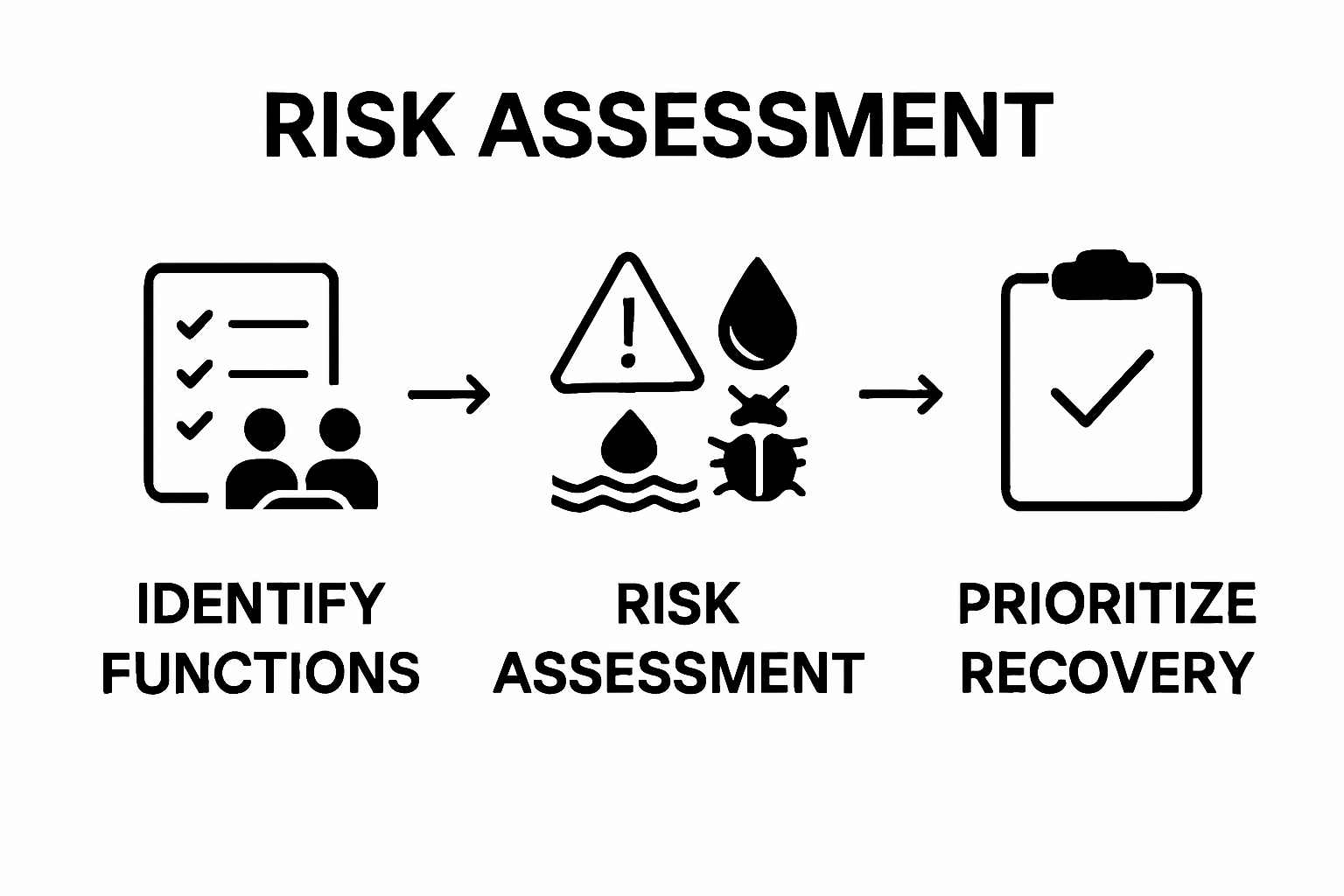
Documentation is crucial during this phase. Create a detailed matrix that ranks each business function by its criticality, potential downtime cost, and recovery requirements. This living document will serve as your disaster recovery blueprint, guiding technological and human resources during an emergency.
Verify your critical function identification by asking:
- Can this function be temporarily suspended without severe consequences?
- What is the financial impact if this function stops for one hour? One day?
- Are there regulatory or contractual obligations tied to maintaining this function?
Successful completion of this step means having a clear, agreed-upon inventory of your organization’s most vital operational components, ready to inform the subsequent stages of your disaster recovery strategy.
Step 2: Conduct a Risk Assessment
After identifying critical business functions, the next crucial step in your disaster recovery checklist is conducting a comprehensive risk assessment. This systematic process helps you understand potential threats that could disrupt your organization’s operations and develop strategies to mitigate them.
Begin by assembling a cross-functional team that includes representatives from IT, operations, finance, and leadership. Their diverse perspectives will help create a holistic view of potential risks. The goal is to systematically evaluate internal and external threats that could impact your business continuity.
Start your assessment by mapping out potential scenarios that could interrupt your business. These might include natural disasters like earthquakes or floods, technological failures such as network outages or cybersecurity breaches, human-induced risks like equipment failures or workforce disruptions, and pandemic-related challenges. According to Ready.gov, the key is identifying hazards and analyzing their potential impact on your operations.
For each identified risk, develop a detailed analysis that includes probability of occurrence, potential financial impact, and estimated recovery time. Create a risk matrix that ranks threats based on their severity and likelihood. This matrix will help prioritize your disaster recovery strategies and resource allocation.
Technology plays a critical role in risk assessment. Utilize risk assessment tools and software that can help quantify and track potential vulnerabilities. These tools often provide advanced analytics that can simulate different risk scenarios and their potential consequences.
During your assessment, pay special attention to technological vulnerabilities. Evaluate your current IT infrastructure, network security, data backup systems, and communication platforms. Consider potential points of failure and develop specific mitigation strategies for each identified risk.
Verify the completeness of your risk assessment by ensuring you have addressed:
- Physical infrastructure risks
- Technological system vulnerabilities
- Cybersecurity threats
- Personnel and workforce disruption scenarios
- External environmental and market risks
Successful completion of this step means having a comprehensive, documented risk assessment that provides a clear roadmap for your disaster recovery strategy. Your assessment should be a living document, regularly updated to reflect changing business environments and emerging threats.
Step 3: Develop a Communication Plan
A robust communication plan is the lifeline of any effective disaster recovery strategy. Without clear, coordinated communication, even the most comprehensive disaster recovery plan can quickly unravel during a crisis. This step transforms your recovery blueprint from a theoretical document into a practical, actionable framework that keeps everyone informed and aligned.
Begin by creating a comprehensive communication matrix that outlines how information will flow during a disaster. This matrix should clearly define communication channels, responsible personnel, and specific protocols for different types of emergencies. Identify primary and backup communication methods, recognizing that traditional communication channels might be compromised during a significant disruption.
Establish a communication hierarchy that specifies who communicates what, when, and to whom. This includes internal communication protocols for employees, external communication strategies for customers and stakeholders, and coordination mechanisms with external agencies or partners. According to SAMHSA, the goal is to develop processes that ensure all necessary personnel are informed while avoiding communication duplications.
Technology plays a critical role in modern communication plans. Implement multiple communication tools that can function independently, such as mobile messaging platforms, emergency notification systems, satellite phones, and designated communication backup servers. Create redundant communication paths to ensure information can still flow even if primary systems fail.
Your communication plan should include detailed contact information for key personnel, including alternate contact methods. Develop a system for regular updates that provides clear, concise information about the disaster’s status, recovery efforts, and individual responsibilities. Ensure that the communication plan is easily accessible to all team members and regularly updated to reflect organizational changes.
Verify the effectiveness of your communication plan by checking:
- Are all critical personnel contact details current?
- Have you established multiple communication channels?
- Is there a clear protocol for different types of emergencies?
- Have you conducted communication readiness drills?
Successful completion of this step means having a comprehensive, flexible communication strategy that can adapt to various disaster scenarios. Your plan should provide clear guidance, reduce uncertainty, and enable swift, coordinated responses during challenging times.
Step 4: Create Backup and Recovery Strategies
Backup and recovery strategies form the backbone of your disaster resilience, transforming potential data loss into a manageable operational challenge. Effective backup strategies protect your organization’s most critical asset: its information.
Begin by categorizing your data based on its criticality and recovery requirements. Not all data demands the same level of protection. Financial records, customer information, and operational databases need more robust backup protocols compared to less essential files. Create a comprehensive inventory of all digital and physical data sources, mapping their importance to your business functions.
Implement a multi-layered backup approach that combines onsite and offsite storage solutions. Local backups provide quick recovery options, while cloud or geographically distant backups protect against complete site destruction. Consider using automated backup systems that create incremental backups, capturing only changes since the last backup to reduce storage requirements and backup time.
According to Ready.gov, developing an IT disaster recovery plan requires setting clear recovery time objectives. This means determining exactly how quickly different systems and data must be restored to minimize business interruption. Establish specific recovery point objectives that define the maximum acceptable data loss for each critical system.
Choose backup technologies that align with your organization’s size and complexity. Small businesses might leverage cloud-based backup solutions, while larger enterprises may require more sophisticated hybrid backup systems that combine local network storage with cloud repositories. Encryption becomes crucial, ensuring that backed-up data remains secure and protected from unauthorized access.
Regular testing of your backup and recovery procedures is non-negotiable. Schedule periodic recovery drills that simulate different disaster scenarios, allowing your team to validate the reliability and speed of your backup systems. These tests help identify potential weaknesses in your strategy and provide practical training for your recovery team.
Verify the effectiveness of your backup strategy by confirming:
- Are all critical systems and data included in the backup plan?
- Can you successfully restore data within your defined recovery time objectives?
- Are backup systems tested regularly?
- Do you have offsite and encrypted backup solutions?
Successful completion of this step means creating a robust, tested backup strategy that provides multiple layers of data protection and rapid recovery capabilities.

Step 5: Test and Update Your Disaster Recovery Plan
Testing transforms your disaster recovery plan from a theoretical document into a reliable operational tool. A plan that remains untested is essentially a collection of hopeful assumptions that could crumble during an actual emergency.
Begin by developing a comprehensive testing strategy that includes multiple scenarios and simulation methods. Tabletop exercises provide an initial low-stakes approach where team members walk through hypothetical disaster scenarios, discussing responses and identifying potential gaps in the current plan. These conversations reveal communication bottlenecks, unclear responsibilities, and potential technological vulnerabilities before an actual crisis occurs.
Progress to more advanced testing methods that create increasingly realistic disaster simulations. Functional tests involve actually implementing parts of your recovery strategy, such as activating backup systems or practicing communication protocols. Full-scale tests simulate complete disaster scenarios, engaging all team members and testing every aspect of your recovery plan simultaneously.
According to University of Michigan, annual reviews and updates are critical. Technology evolves, organizational structures change, and new potential risks emerge. Your disaster recovery plan must remain a living document that adapts to these shifting landscapes.
Document every test meticulously. Create detailed after-action reports that capture what worked smoothly, what encountered challenges, and specific recommendations for improvement. These reports become invaluable resources for refining your strategy and training future team members.
Involve representatives from every department during testing to ensure comprehensive coverage. IT professionals, operations managers, communication specialists, and leadership should all participate. This cross-functional approach ensures that the disaster recovery plan addresses diverse operational needs and perspectives.
Verify the effectiveness of your testing process by confirming:
- Have you conducted multiple types of tests?
- Are all critical departments represented?
- Have you documented and addressed test findings?
- Is the plan updated after each testing cycle?
Successful completion of this step means developing a robust, dynamic disaster recovery plan that has been thoroughly tested, critically analyzed, and continuously improved. Remember, the goal isn’t perfection, but persistent, incremental enhancement of your organization’s resilience.
The table below summarizes key verification checks for each main step of your disaster recovery planning, helping ensure you have addressed all essential requirements before proceeding.
| Step | Verification Check | What to Confirm |
|---|---|---|
| Identify Critical Business Functions | Function can’t be suspended without severe consequences | Clear understanding of critical processes that affect business continuity |
| Conduct Risk Assessment | All key risk categories addressed | Assessment includes physical, technological, personnel, and external risks |
| Develop Communication Plan | All personnel contact info is current; multiple channels in place | Up-to-date contacts, backup systems, and confirmed protocols |
| Create Backup & Recovery Strategies | All systems/data included; backups regularly tested | Effectiveness of restoring data as per objectives |
| Test & Update Plan | Types of tests conducted and documented | Active participation from all departments and actionable updates made |
Ready to Protect Your Business with a Complete Disaster Recovery Plan?
You have worked hard to identify your most critical business functions, analyze risk, develop communication strategies, and put backup and recovery systems in place. Yet during an unexpected IT crisis, the real test comes down to how quickly you can bounce back and keep your operations running. Many local businesses struggle with disaster recovery planning because the details are overwhelming and hard to update as technology changes. Lost data, downtime, and communication breakdowns can become costly fast.
Let SRS Networks turn your checklist into true business resilience. Our data backup and business continuity solutions are designed for growing companies that need reliability, security, and quick recovery the moment an outage strikes. With expert risk assessment, robust backup plans, and proactive support by your side, you do not have to tackle disaster recovery alone. Visit SRS Networks right now to see how you can strengthen your recovery plan before the next crisis hits. Reach out today and take the first step toward unstoppable uptime and peace of mind.
Frequently Asked Questions
What are the critical dimensions of a business function in disaster recovery?
The critical dimensions include Recovery Time Objective (RTO), which specifies how quickly a system must be restored, and Recovery Point Objective (RPO), which determines the maximum acceptable data loss. Understanding these metrics helps prioritize recovery efforts.
How can I effectively conduct a risk assessment for my business?
To conduct a comprehensive risk assessment, assemble a cross-functional team to identify potential internal and external threats, evaluate their impact on operations, and create a risk matrix that ranks threats by severity and likelihood.
Why is a communication plan essential in disaster recovery?
A communication plan is crucial as it ensures that all stakeholders are informed and coordinated during a crisis. It outlines communication channels, responsible personnel, and protocols to maintain clarity and reduce confusion during recovery efforts.
What strategies should I implement for data backup and recovery?
Implement a multi-layered backup approach that includes both onsite and offsite storage solutions. Categorize data based on criticality, set clear recovery objectives, and regularly test backup systems to ensure efficient data restoration during an emergency.