Business continuity planning sounds like something only giant corporations need. Yet the reality is startling. About 40 percent of small businesses never reopen after a major disaster. You might think this only matters for rare, catastrophic events, but it actually shapes the everyday survival of local organizations and even the entire community economy.
Table of Contents
- Why Business Continuity Planning Matters Locally
- Key Steps to Build Your Plan in 2025
- Best Practices for Bay Area Industries
- Maintaining and Testing Your Continuity Plan
Quick Summary
| Takeaway | Explanation |
|---|---|
| Prioritize risk assessment in planning | Conduct a comprehensive evaluation of potential risks and vulnerabilities to build an effective continuity plan. |
| Leverage technology for continuity measures | Integrate advanced tools like AI and cloud systems to enhance responsiveness and adaptability in times of disruption. |
| Engage in continuous testing and adaptation | Regularly update and simulate your continuity plan to ensure it evolves with changing business environments and challenges. |
| Tailor strategies to specific industries | Customize business continuity efforts to fit the unique needs and risks of different sectors like healthcare or technology. |
| Maintain a living, adaptive plan | Treat your business continuity plan as a dynamic document, revising and improving it regularly based on real-world experiences. |
Why Business Continuity Planning Matters Locally
Business continuity planning isn’t just a corporate buzzword for large enterprises. For local organizations in the Monterey Bay Area, it represents a critical lifeline that can mean the difference between survival and total operational collapse during unexpected disruptions.
The Local Economic Vulnerability
Small and medium-sized businesses face unique challenges that make business continuity planning not just important, but essential. According to FEMA’s Business Emergency Preparedness Study, approximately 40% of small businesses never reopen after a major disaster. This stark statistic underscores the fragility of local enterprises when unprepared for potential disruptions.
Local businesses in sectors like agriculture, manufacturing, healthcare, and technology are particularly susceptible to regional risks. Earthquakes, wildfires, power outages, and technological failures can rapidly derail operations. A comprehensive business continuity plan provides a structured approach to identify potential threats, develop resilient strategies, and ensure rapid recovery.
Protecting Community Economic Ecosystem
Business continuity planning extends beyond individual organizational survival. It directly impacts the broader local economic ecosystem. When a single business experiences a prolonged disruption, it creates a ripple effect that can impact suppliers, employees, and interconnected service networks.
The Small Business Administration emphasizes that local businesses are the economic backbone of communities. A well-designed continuity plan doesn’t just protect an individual organization. It safeguards jobs, maintains supply chain stability, and ensures community economic resilience.
For local organizations in the Monterey Bay Area, business continuity planning is not about preparing for a hypothetical scenario. It’s about creating a pragmatic, actionable strategy that ensures operational stability, protects critical assets, and provides a clear roadmap for navigating unexpected challenges. By investing in robust continuity planning, local businesses can transform potential vulnerabilities into strategic advantages, demonstrating remarkable adaptability and commitment to long-term sustainability.
Key Steps to Build Your Plan in 2025
Building a robust business continuity plan in 2025 requires a strategic approach that goes beyond traditional risk management. Organizations must leverage technology, anticipate emerging threats, and create flexible frameworks that can adapt to rapidly changing business environments.
Comprehensive Risk Assessment
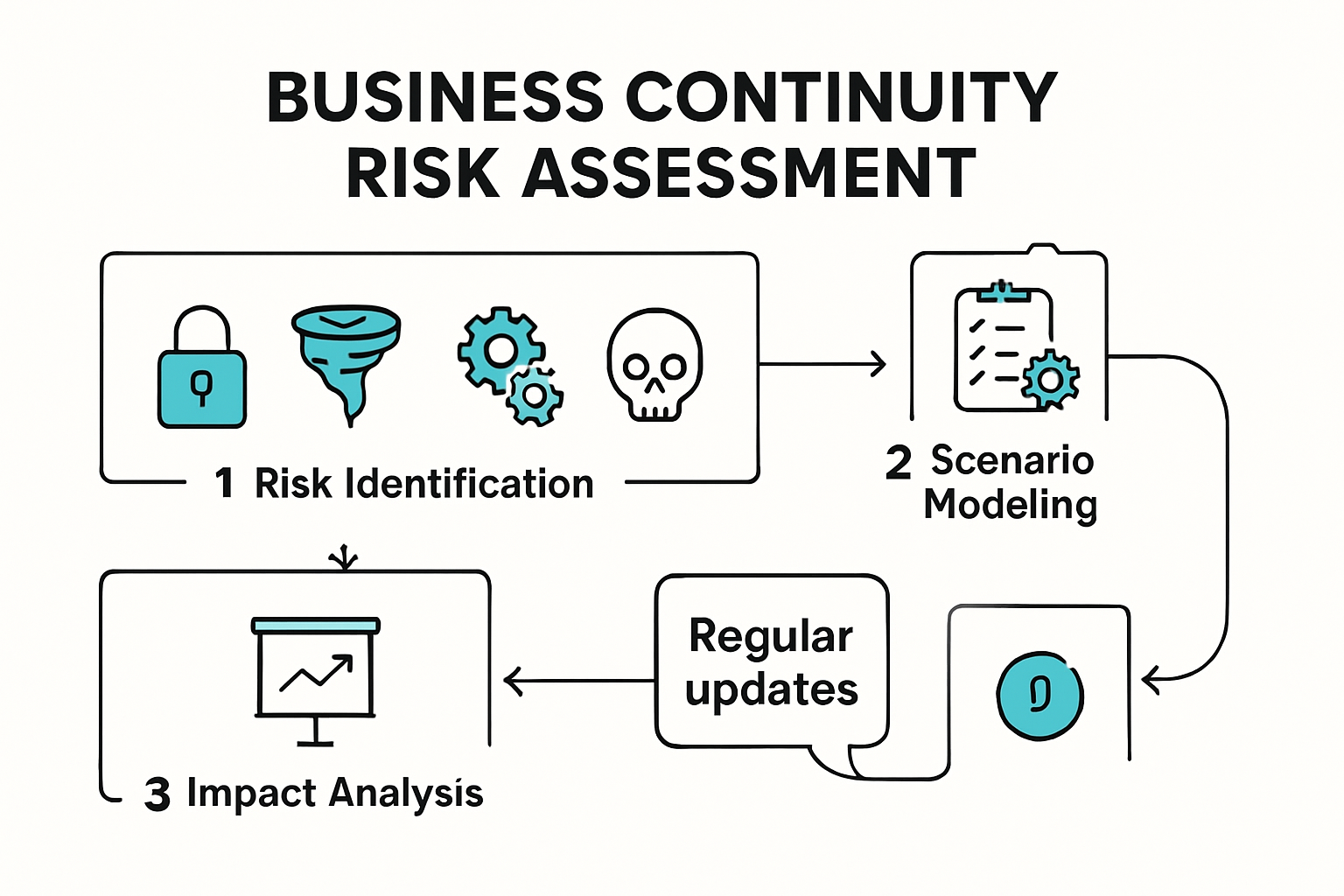
The foundation of any effective business continuity plan starts with a thorough risk assessment. Gartner’s 2024 Business Resilience Report highlights that organizations need to conduct a multi-dimensional analysis of potential disruptions. This involves identifying both internal and external risks, from technological failures to climate-related events, cybersecurity threats, and supply chain vulnerabilities.
Key elements of a comprehensive risk assessment include:
- Data Collection: Gather detailed information about critical business processes, dependencies, and potential impact points
- Scenario Modeling: Develop multiple scenarios that test different types of potential disruptions
- Impact Analysis: Quantify the potential financial and operational consequences of identified risks
Below is a summary table outlining the key elements of a comprehensive risk assessment, providing a clear overview of each component and its primary focus.
| Element | Focus | Description |
|---|---|---|
| Data Collection | Understanding critical processes & assets | Gather info on business operations, dependencies, and impact points |
| Scenario Modeling | Testing preparedness for disruptions | Develop multiple hypothetical disruption situations |
| Impact Analysis | Assessing risk consequences | Quantify financial and operational effects of risks |
Technology-Driven Continuity Planning
In 2025, technology will be a critical enabler of business continuity planning. The National Institute of Standards and Technology (NIST) recommends integrating advanced technologies to enhance resilience. Artificial intelligence, cloud computing, and automated recovery systems will play pivotal roles in creating more responsive and adaptable continuity strategies.
Organizations should focus on:
- Implementing real-time monitoring systems
- Developing cloud-based backup and recovery solutions
- Creating digital twins of critical business processes
- Establishing automated failover and recovery mechanisms
Continuous Adaptation and Testing
Business continuity planning is no longer a static annual exercise. It requires continuous refinement and regular testing. Successful organizations will treat their continuity plan as a living document that evolves with changing business landscapes. This means conducting frequent simulations, updating risk assessments, and maintaining flexible response protocols.
Effective continuous adaptation involves:
- Quarterly plan reviews
- Regular tabletop exercises and full-scale simulations
- Ongoing staff training and awareness programs
- Rapid iteration based on lessons learned from each testing cycle
By approaching business continuity planning as a dynamic, technology-enabled process, local organizations can build resilience that goes beyond mere survival. The goal is to create a strategic framework that allows businesses to not just withstand disruptions, but to potentially turn challenges into opportunities for innovation and growth.
Best Practices for Bay Area Industries
The Monterey Bay Area hosts a diverse range of industries, each with unique business continuity challenges that demand specialized approach and strategic planning. Understanding industry-specific best practices is crucial for developing resilient operational strategies.
Technology and Startup Sector Strategies
Tech companies and startups in the region face distinctive continuity planning requirements. Silicon Valley Business Continuity Association research indicates that technology firms must prioritize data protection, rapid recovery systems, and flexible remote work infrastructures. Successful continuity plans for tech organizations typically include:
- Cloud-Based Redundancy: Implementing multi-region cloud backup systems
- Cybersecurity Integration: Embedding continuity protocols within security frameworks
- Rapid Deployment Protocols: Creating instant remote work transition capabilities
Particularly for startups with limited resources, these strategies can mean the difference between operational survival and complete shutdown during unexpected disruptions.
Healthcare and Biotech Resilience Approach

California Healthcare Preparedness Program guidelines emphasize that medical and biotech organizations require multilayered continuity plans. Critical considerations include patient data protection, emergency medical service maintenance, and laboratory research preservation.
Key practice areas include:
- Redundant medical record systems
- Emergency power and equipment backup
- Alternative treatment facility protocols
- Secure data migration strategies
Manufacturing and Agriculture Continuity Framework
Manufacturing and agricultural businesses in the Monterey Bay region face unique challenges related to supply chain disruptions, equipment failures, and environmental risks. Effective continuity planning must address these complex interdependencies.
Strategic approaches include:
- Diversifying supplier networks
- Developing flexible production alternatives
- Creating comprehensive equipment replacement strategies
- Implementing predictive maintenance technologies
The table below summarizes industry-specific best practices for business continuity planning, offering a side-by-side comparison of the major focus areas for technology, healthcare, and manufacturing/agriculture sectors.
| Industry Sector | Key Continuity Focus Areas |
|---|---|
| Technology & Startups | Cloud redundancy, cybersecurity, remote work protocols |
| Healthcare & Biotech | Medical record backup, emergency power, alternative facilities |
| Manufacturing & Agriculture | Supplier diversification, flexible production, equipment strategies |
By tailoring business continuity planning to specific industry characteristics, local organizations can build robust, adaptive frameworks that protect operational integrity. The goal is not just survival, but creating strategic resilience that transforms potential vulnerabilities into competitive advantages.
Maintaining and Testing Your Continuity Plan
A business continuity plan is not a static document to be filed away and forgotten. It requires consistent maintenance, regular updates, and rigorous testing to remain effective in an ever-changing business environment. The goal is to transform your plan from a theoretical document into a living, adaptable strategy that can respond to real-world challenges.
Systematic Plan Review and Update Processes
The International Organization for Standardization (ISO) recommends a structured approach to continuity plan maintenance. Organizations should establish a formal review cycle that addresses emerging risks, technological changes, and organizational shifts. A comprehensive review typically involves:
- Quarterly comprehensive plan assessments
- Annual full-scale document updates
- Immediate revisions following significant organizational changes
- Continuous monitoring of internal and external risk landscapes
Key areas of focus during reviews include infrastructure changes, new technology implementations, shifts in business processes, and evolving regulatory requirements. Gartner’s Business Continuity Research emphasizes that organizations should treat their continuity plan as a dynamic blueprint that evolves with the business.
Simulation and Scenario Testing Strategies
Effective testing goes beyond theoretical document reviews. Organizations must conduct practical simulations that challenge the plan’s effectiveness and expose potential weaknesses. This involves creating realistic scenarios that test the organization’s response capabilities across different types of disruptions.
Comprehensive testing strategies include:
- Tabletop exercises simulating various disaster scenarios
- Full-scale operational interruption simulations
- Partial system failure tests
- Remote work and communication breakdown scenarios
These exercises should involve key stakeholders from different departments, ensuring a holistic approach to emergency response. The objective is not to create perfect performance, but to identify gaps, improve response times, and build organizational resilience.
Technology-Enabled Continuous Improvement
Modern business continuity planning leverages advanced technologies to enhance testing and maintenance processes. Artificial intelligence and data analytics can provide deeper insights into potential vulnerabilities and simulate complex disruption scenarios with unprecedented accuracy.
Technological approaches to plan maintenance include:
- Automated risk assessment tools
- Real-time monitoring of potential disruption indicators
- Machine learning-powered scenario modeling
- Advanced data analytics for predictive risk assessment
By adopting a proactive, technology-driven approach to maintaining and testing business continuity plans, organizations can transform these documents from passive safety nets into dynamic strategic tools. The ultimate goal is to create an adaptive framework that not only protects the organization during crises but also provides a competitive advantage through rapid, intelligent response to unexpected challenges.
Frequently Asked Questions
What is business continuity planning and why is it important for local organizations?
Business continuity planning involves creating strategies to ensure that an organization can continue to operate during and after a disruptive event. It is crucial for local organizations to mitigate risks, protect jobs, and maintain community economic stability.
How can local businesses conduct a comprehensive risk assessment for their continuity plan?
Local businesses can perform a comprehensive risk assessment by identifying potential internal and external risks, collecting data on critical processes, and using scenario modeling to anticipate various types of disruptions.
What role does technology play in business continuity planning for 2025?
In 2025, technology plays a crucial role in business continuity planning by enabling organizations to implement real-time monitoring systems, develop cloud-based recovery solutions, and utilize AI for enhanced decision-making and scenario simulations.
How often should a business update its continuity plan?
A business should regularly review and update its continuity plan, ideally conducting comprehensive assessments quarterly and performing full-scale document updates annually, as well as revising the plan immediately after significant organizational changes or disruptions.
Ready to Secure Your Local Business Against Any Disruption?
Unexpected challenges can quickly threaten the stability of local businesses. The article on business continuity planning highlighted how small and medium-sized organizations are especially vulnerable to disasters, data loss, and operational interruptions. Key pain points like downtime, loss of critical data, and the need for rapid recovery are real issues every organization in the Monterey Bay Area faces. This is not just about big catastrophes. Even a short outage can impact your bottom line, your staff, and your community.
If you want a smarter, proactive way to protect your business, SRS Networks is your local partner for building resilience. Our Data Backup & Business Continuity solutions are designed for local companies that demand reliability and fast recovery. We take your risk assessment, cloud backup, and cybersecurity needs seriously, building a roadmap that fits your exact challenges.
Don’t wait until a disruption happens. Start your journey to a safer, more resilient business today. Visit our main site to see how our managed IT and business continuity planning can keep your operations running—no matter what tomorrow brings. Speak to a local expert now and take the first step toward true peace of mind.
Recommended
-
[
The Importance of Online Presence for Colorado Business Owners 2025
](https://peakdigital.pro/2025/07/23/importance-of-online-presence-for-colorado-business-owners-2025)